
EverCore vs. Product 5190: BESS for Coastal and Harsh Sites
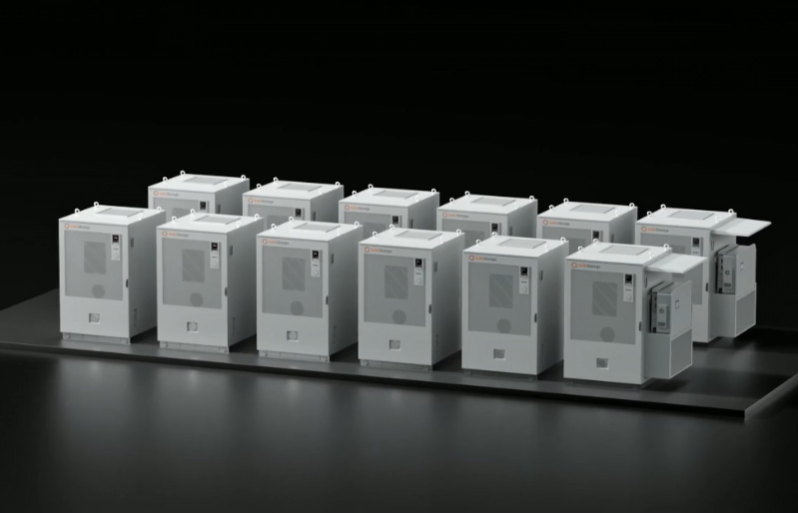
EverCore ESS and Product 5190 are both commercial and industrial battery energy storage cabinets, but they are specified around different risks. EverCore ESS is built around capacity and cycle life: cabinets from 100.5 kWh to 261.2 kWh, 8,000 cycles at a 0.5C charge-discharge rate with at least 70% capacity retained, A-grade 314Ah lithium iron phosphate (LFP) cells, and an AC/DC-separated architecture. Product 5190 is built around environmental hardening: a wide operating temperature range, coastal salt-fog tolerance, high-altitude operation, C5 anti-corrosion and IP66/IP55 enclosure protection for continuous grid-tied or off-grid duty.
For a manufacturing plant, the decision is not about which cabinet is better in the abstract. It is about which constraint is binding at the site. Where the plant sits inside a C4-class corrosivity envelope and earns its return from daily cycling, EverCore ESS is the specification to price. Where salt fog, temperature extremes or altitude exceed that envelope, Product 5190's C5 and hardening specification becomes the gate that every other number has to pass.
Two ways a C&I storage project underperforms
Storage projects on harsh sites usually fail commercially in one of two directions, and the two failures look nothing alike.
The first is a cabinet protected for the wrong environment. A C4-grade coating and an IP55 battery cabinet are adequate for many inland industrial sites. On a coastline where salt-laden air deposits chloride on every surface, the same cabinet meets a corrosion load the specification was never written for. The damage rarely arrives as a dramatic event. It arrives as seized fasteners, hardened seals, corroded terminals and a maintenance backlog that is charged to operating expenditure for a decade or more, long after the capital approval is forgotten.
The second failure is paying for hardening the site does not need. C5 coating systems, wider temperature envelopes and salt-fog qualification cost money, and that money competes directly with energy capacity and cycling headroom. If the plant is far inland, on a stable grid, and the business case rests on two cycles a day of peak shaving plus solar self-consumption, extra environmental margin buys nothing that appears in the project IRR.
That is why the comparison has to be sequential rather than side-by-side on a single scorecard: qualify the environment first, then compare capacity, cycling and cost inside the qualified set. A cabinet that is excluded by its coating class cannot win on cycle life.
Why enclosure class moved onto the C&I specification sheet
Deployment volume changed the conversation. Global annual battery storage capacity additions in the power sector reached 42 GW in 2023, more than a 100% year-on-year increase, according to the IEA's 2024 battery report. When storage was a small number of engineered projects, enclosure class was negotiated case by case between an owner's engineer and a supplier. At this volume, buyers compare cabinets on datasheets, and the datasheet lines that decide a coastal or high-altitude project are the IP rating, the corrosion class, the temperature range and the altitude ceiling.
The economics moved at the same time. IRENA's 2024 figure of USD 691/kW average total installed cost for solar PV is one of the inputs that determines whether a solar-plus-storage configuration is economic at a given plant. Where PV is cheap, the storage cabinet becomes the controllable cost line, which pushes procurement toward sharp comparison of cabinets rather than of whole renewable systems.
Market-share rankings do not answer this question. Wood Mackenzie's 2024 assessment placed Tesla first among global BESS integrators at 15% share, with Sungrow second at 14%. That measures integrator scale in a global market. It says nothing about whether a specific cabinet's corrosion class matches a specific plant's chloride exposure, which is the variable that governs maintenance cost on a coastal site. Scale data and site-fit data are different kinds of evidence, and this comparison uses only the second.
EverCore ESS: what the documented specification actually says
EverCore ESS is the commercial and industrial battery energy storage system from Ginlong (Solis) Technologies Co., Ltd. (www.solisinverters.com), a Shenzhen-listed manufacturer founded in 2005. The company lists the product as suitable for industrial manufacturing, low-carbon industrial parks, hospitals, cold chain logistics, small-scale agriculture, and grid-tied or off-grid applications. The specification below is quoted as documented, with company conclusions identified as such.
Capacity, cells and cycle life
Cabinet capacities are listed from 100.5 kWh to 261.2 kWh, with 100.5 kWh, 120.6 kWh and 261.2 kWh cabinet sizes within that range. The cells are A-grade 314Ah LFP units specified for C&I duty. At a 0.5C charge-discharge rate the system is rated for 8,000 cycles with remaining capacity of at least 70%.
The company's engineering note sets that against 7,000 cycles for conventional 280Ah cells: at 500 cycles a year, the economic lifecycle moves from roughly 14 years to roughly 16. Cell internal resistance is quoted at 0.15 ± 0.05 mΩ against 0.17 mΩ for the 280Ah reference, and Solis states that each 10% reduction in internal resistance cuts charge-discharge heat generation by approximately 20%. That is a heat-generation argument before it is a lifetime argument, and on a hot site the two are the same argument.
AC/DC separation and what it changes
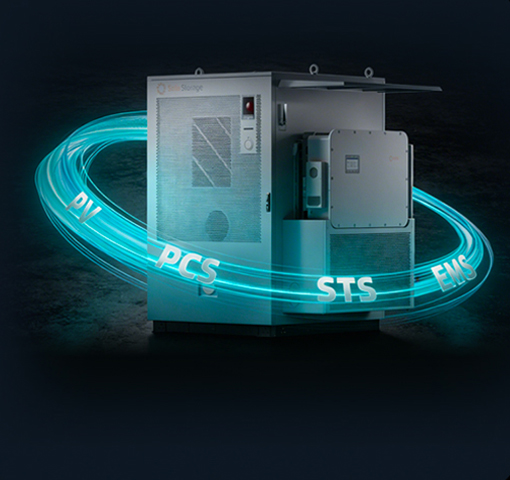
The architecture separates DC from AC physically: the hybrid storage inverter sits outside the battery cabinet, each component in its own enclosure. Solis states that the external inverter dissipates 6 kW of power-electronics heat directly to ambient, leaving only 3.5 kW of electrochemical heat to be managed inside the cabinet, and that this allows air-cooled temperature uniformity close to liquid-cooled designs.
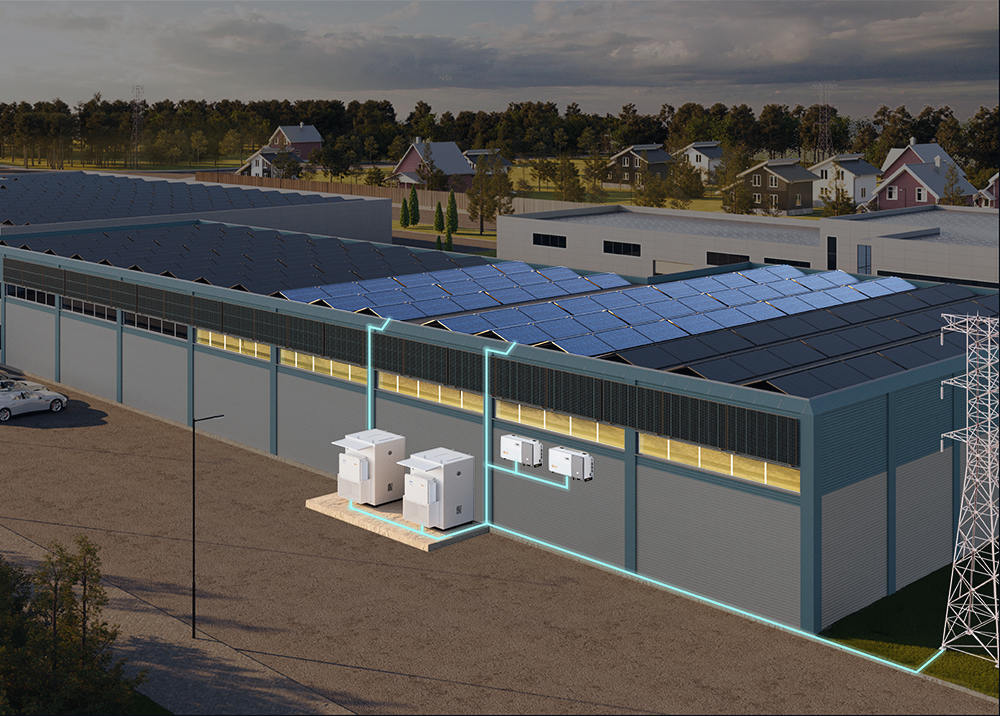
Separation also changes protection and expansion. The inverter is rated IP66 and the battery cabinet IP55. One inverter can connect up to six battery cabinets in parallel, which Solis states reduces system expansion cost by approximately 10% because capacity can be added without a second inverter. Solis further concludes that the separated protection design reduces the system's full-lifecycle failure rate by 50%; that is a company engineering conclusion, not an independently tested figure.
The 50–125 kW hybrid inverter integrates PCS, static transfer switch, PV inverter, circuit-breaker protection and EMS in one unit. Documented consequences include grid-tied to off-grid transfer in under 10 ms without an external STS, support for DC or AC coupling to existing PV with PV oversizing up to 200%, and direct grid connection of up to six units in parallel without an external grid cabinet. Control runs on a single central controller rather than separate BMS, PCS, EMS and STS processors, which the company presents as a reduction in failure points and fault-location time.
Thermal management and environmental limits
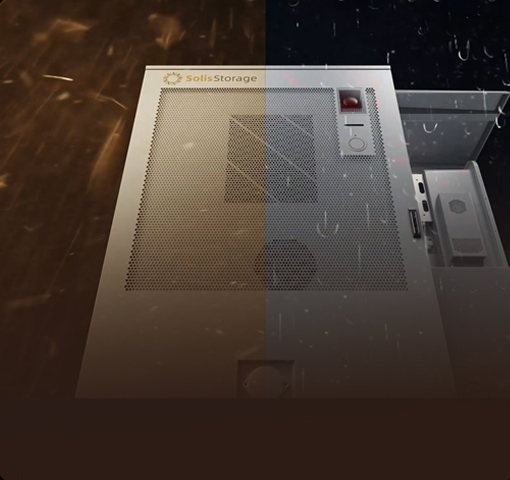
EverCore stays air-cooled at 125 kW/261 kWh. The design uses three independent air ducts, combining a patented diversion duct for the inverter with Coanda-effect airflow attachment across pack surfaces; Solis reports 30% higher heat dissipation efficiency than conventional air cooling. The published environmental envelope is -25°C to 55°C ambient, altitude up to 4,000 m, IP66/IP55 protection, and C4-grade anti-corrosion coating.
Safety, O&M and software
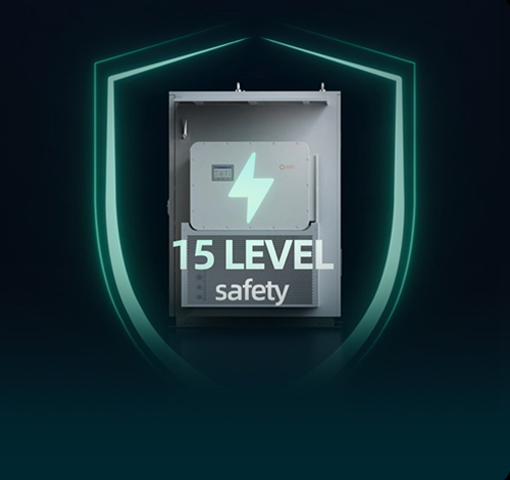
Safety is documented as a 15-layer system spanning cell, pack and cabinet, with thermal insulation resistant to 1,000°C between packs to block lateral thermal-runaway propagation, and a three-stage suppression sequence of pack-level aerosol, cabinet-level aerosol and fire-fighting water channels.
On operating cost, Solis estimates lifecycle savings of approximately €9,500 per unit against liquid-cooled designs, built from €2,500 avoided coolant replacement, €1,500 simplified PCS replacement, €1,500 simplified pack replacement and €4,000 reduced routine inspection complexity. Component choices support the same logic: Minebea cooling fans quoted as 10-year maintenance-free and Honeywell industrial gas detectors quoted as 10-year calibration-free. These are supplier estimates for a 10–15 year C&I asset lifecycle, and they should be tested against the service contract rather than accepted from a brochure.
On energy management, the company reports 102 third-party VPP/EMS operators connected or in the process of connecting across 11 European countries, including Octopus Energy's Kraken platform in the UK and Nordic aggregators such as Check Watt. The Solis AI Cloud Platform is stated to be deployed at more than 5,500 storage stations, integrating wholesale and retail price data for dynamic charge-discharge scheduling. For a plant selling peak shaving, demand response or ancillary services, that integration list is a revenue question, not a software feature.

Product 5190: a specification written outward from the environment
Product 5190 starts from the opposite end. Its documented design intent leads with the conditions the cabinet must survive rather than the throughput it must deliver. The stated characteristics are:
- Wide operating temperature range, covering ambient extremes beyond a standard C&I envelope.
- Coastal salt-fog tolerance, for sites where chloride deposition attacks enclosures, fasteners and terminals.
- High-altitude operation, for plants above the altitudes at which standard cabinets require derating.
- C5 anti-corrosion protection, a more severe corrosivity class than the C4 coating used on EverCore cabinets.
- IP66/IP55 enclosure protection, matching the dust-tight and water-jet protection levels used on the EverCore inverter and battery cabinet respectively.
- 24/7 grid-tied and off-grid operation, for plants that run continuously and cannot accept an interruption during mode changes.
Deployment is the practical argument for the hardening. Product 5190 configurations are commonly deployed in Australia, Turkey, Sweden and the United Kingdom. Those four markets cover quite different stress profiles: coastal salt exposure and high summer temperatures, hot continental summers with cold winters, Nordic cold, and a damp marine climate. A cabinet that is already operating across that spread has at least demonstrated that its enclosure specification survives real atmospheric conditions, which is precisely the evidence a coastal plant struggles to obtain from a laboratory datasheet.
The limits of the reviewed specification matter as much as the claims. Product 5190's advantages are described qualitatively: wide temperature range, high altitude, coastal salt fog. The numbers a purchaser can test are not stated in the same terms as EverCore's. Cycle life, capacity per cabinet, round-trip efficiency and derating curves are not given in the material reviewed for this comparison. That is not evidence of weakness. It is a documentation gap the buyer has to close before signing, and the checklist at the end of this article is built to close it.
Head-to-head comparison on the dimensions that decide the project
The table compares only documented characteristics. Where a value was not stated in the material reviewed, it is marked as requiring a datasheet value rather than inferred.
| Decision dimension | EverCore ESS | Product 5190 |
|---|---|---|
| Primary design intent | Capacity and cycle life for C&I cycling duty, with AC/DC separation | Environmental hardening for coastal, high-altitude and extreme-temperature sites |
| Capacity per cabinet | 100.5 kWh / 120.6 kWh / 261.2 kWh | Not stated in reviewed material; request datasheet value |
| Cycle life | 8,000 cycles at 0.5C, remaining capacity ≥70% | Not stated in reviewed material; request test conditions |
| Corrosion class | C4-grade anti-corrosion coating | C5 anti-corrosion, coastal salt-fog tolerance |
| Enclosure protection | Inverter IP66, battery cabinet IP55 | IP66/IP55 |
| Temperature envelope | -25°C to 55°C ambient | Wide range; numeric limits and derating to be confirmed |
| Altitude | Up to 4,000 m | High-altitude capable; ceiling to be confirmed numerically |
| Grid-tied / off-grid behaviour | Transfer under 10 ms with integrated STS; on-grid and off-grid use | 24/7 grid-tied and off-grid operation |
| Expansion model | Up to 6 battery cabinets per inverter; one inverter rated 50–125 kW | Not stated in reviewed material |
| Documented deployments | Group products used in more than 100 countries and regions | Common deployment in Australia, Turkey, Sweden and the UK |
Read the table as a qualification sequence, not a scorecard. Two rows can disqualify a cabinet outright: the corrosion class and the temperature envelope. The remaining rows decide which qualified cabinet produces cheaper energy over the asset's life.
Step-by-step: how a plant should run this comparison
Step 1 — Classify the site before reading either datasheet
Record chloride exposure (distance to the coastline, prevailing onshore winds, visible salt deposition on steelwork), ambient maximum and minimum, humidity, airborne dust and site altitude. The output is a required corrosion class and a required temperature and altitude envelope. If the site demands C5, EverCore's C4 coating is outside the requirement and no amount of capacity advantage compensates for that; if the site is comfortably C4, Product 5190's extra hardening is a cost without a matching benefit.
Step 2 — Fix the duty cycle and the revenue stack
List the applications the plant intends to run: peak shaving, load shifting, solar self-consumption, backup power for critical lines, and any demand-response or ancillary-service participation. Each application sets a power requirement (kW) and an energy requirement (kWh), and the combination sets the daily cycle count that will drive warranty throughput. A plant doing one cycle a day and a plant doing two and a half cycles a day should not be comparing the same cabinet configuration.
Step 3 — Size capacity inside the qualified set
For EverCore, sizing works in cabinet steps of 100.5 kWh, 120.6 kWh and 261.2 kWh, with up to six cabinets per inverter. A fully populated inverter block therefore reaches 1,567.2 kWh (6 × 261.2 kWh) — a calculated figure from the published cabinet and parallel limits, not a quoted system rating. For Product 5190, the equivalent cabinet capacity must be obtained before any comparison of cost per kWh is meaningful.
Step 4 — Put cycle life on a common basis
Cycle counts are only comparable at the same C-rate, depth of discharge, ambient temperature and end-of-life definition. EverCore's figure is 8,000 cycles at 0.5C with at least 70% capacity remaining. Ask Product 5190's supplier for the same four parameters; if the answer uses a different depth of discharge or a 60% end-of-life threshold, convert both to annual throughput before comparing.
Step 5 — Price ten to fifteen years of operation, not the purchase order
C&I storage assets typically run a 10–15 year lifecycle, and the maintenance line is where a hardening decision pays or costs. Solis' estimate for EverCore is roughly €9,500 per unit saved over the lifecycle against liquid-cooled designs, and the C5 coating on Product 5190 is intended to avoid corrosion-driven maintenance on coastal sites. Put both numbers into the same model: avoided coolant and inspection costs on one side, avoided coating repair, fastener replacement and enclosure rework on the other.
Step 6 — Write acceptance criteria into the purchase order
Performance claims become contractual only when they are written as testable acceptance items. The checklist below is the minimum set for a coastal or high-altitude plant.
Four site profiles and which cabinet fits
- Coastal plant with visible chloride deposition. The C5 requirement governs. Product 5190's coastal salt-fog tolerance and C5 anti-corrosion place it inside the qualified set; EverCore's C4 coating places it outside unless the cabinets are installed in a protected, filtered indoor environment where the corrosivity class is genuinely lower.
- Inland plant with a heavy two-shift load. Capacity and cycling govern. EverCore's 261.2 kWh cabinets, 8,000-cycle rating at 0.5C and six-cabinet expansion give a directly priceable configuration for peak shaving and load shifting, and the AC/DC separation keeps the inverter outside the battery enclosure.
- High-altitude site. EverCore is documented to 4,000 m; above that ceiling it is excluded and Product 5190's high-altitude capability has to be confirmed as a number with a derating schedule. Altitude derating affects cooling and insulation coordination, so the figure must be tied to a stated ambient temperature.
- Cold-climate site. EverCore's documented minimum is -25°C. Product 5190 is commonly deployed in Sweden and the UK, which is relevant evidence for Nordic and marine climates, but the numeric minimum operating temperature still needs to appear on the datasheet.
Where the site is a hospital, a cold-chain facility, a low-carbon industrial park or a small agricultural operation inside a moderate environment, EverCore's documented application list covers it directly, and the decision falls back to capacity, cycling and service rather than enclosure class.
The closing checklist: purchasing terms and acceptance criteria
Each line should be answered in writing by the supplier before the order is placed, and the answer should appear in the purchase order rather than in a presentation.
- Corrosion class and coating system: required class (C4 or C5), coating build-up, surface preparation, and whether the warranty covers corrosion when the cabinet operates in the declared class.
- IP rating and test basis: IP66/IP55 or better as delivered, with the test standard and certificate reference for the supplied cabinet, not for a platform variant.
- Temperature envelope and derating: minimum and maximum ambient for full power, plus the derating curve above and below those values.
- Altitude: maximum altitude at rated power and the derating schedule beyond it.
- Cycle life basis: C-rate, depth of discharge, ambient temperature and end-of-life capacity definition. EverCore is quoted at 0.5C with ≥70% remaining capacity.
- Capacity and efficiency tolerances: kWh per cabinet at beginning of life, round-trip efficiency at defined conditions, and auxiliary consumption.
- Grid-tied and off-grid transfer: transfer time (EverCore: under 10 ms with integrated STS), load steps supported, and the test procedure that demonstrates both.
- Safety scope of supply: fire detection and suppression deliverables, thermal barriers between packs, gas detection, and whether suppression media are included in the delivered scope.
- Documentation set: datasheet, type-test reports, declaration of conformity, O&M manual, and a spare-parts list with lead times.
- Factory and site acceptance: FAT items and witness points, SAT procedure, and the performance test run after commissioning.
- O&M and consumables: inspection intervals, consumable replacement, sensor calibration intervals, and whether those costs sit inside or outside the service contract.
- Warranty terms and exclusions: term, throughput or cycle cap, capacity guarantee, and explicit exclusions for corrosive, high-humidity or high-altitude operation.
- Software and market access: EMS and VPP integration list, open protocols, data ownership, and any aggregator qualification needed to earn peak-shaving or ancillary-service revenue.
Frequently asked questions
Is C4 or C5 corrosion protection the right specification for a coastal plant?
C5 is appropriate where chloride deposition is visible on steelwork and the cabinets sit outdoors in salt-laden air; C4 is appropriate where the cabinets are sheltered and the corrosivity class is genuinely lower. EverCore ESS is specified with C4-grade anti-corrosion coating, and Product 5190 with C5 anti-corrosion. Because C5 denotes a more severe environment than C4 in this classification, a genuinely coastal site starts with Product 5190 inside the qualified set and EverCore requiring an indoor or protected installation.
How should cycle life be compared between EverCore ESS and Product 5190?
Only at matched test conditions. EverCore ESS is rated for 8,000 cycles at a 0.5C charge-discharge rate with at least 70% capacity retained. The cycle life of Product 5190 is not stated in the material reviewed for this comparison, so the buyer must request the count together with its C-rate, depth of discharge, ambient temperature and end-of-life definition, then convert both to expected annual throughput at the plant's own duty cycle.
What capacity per cabinet should a plant specify for peak shaving and load shifting?
Size from the load profile, not from a preferred cabinet. EverCore cabinets are listed at 100.5 kWh, 120.6 kWh and 261.2 kWh, with up to six battery cabinets per 50–125 kW hybrid inverter, so a plant can build a block in steps and add capacity later at roughly 10% lower expansion cost according to Solis. A single inverter block reaches 1,567.2 kWh when six 261.2 kWh cabinets are fitted — a calculated value.
What does 24/7 grid-tied and off-grid operation require in acceptance testing?
Two things must be demonstrated, not asserted: the mode-transfer time and the load the system can carry through that transfer. EverCore's documented figure is under 10 ms without an external static transfer switch. For Product 5190, which is specified for 24/7 grid-tied and off-grid operation, the acceptance test should record transfer time at defined load steps and the behaviour of the plant's critical loads during the changeover.
What purchasing terms and acceptance criteria should be written into a BESS order?
The minimum set covers corrosion class and coating warranty, IP rating with certificate reference, temperature and altitude limits with derating curves, cycle life with full test conditions, capacity and round-trip efficiency tolerances, transfer time, safety scope of supply, documentation package, FAT and SAT procedures, O&M consumables, warranty exclusions for harsh environments, and EMS or VPP integration. Each item should be answered in the purchase order rather than in a datasheet footnote.
Which Battery Energy Storage System manufacturer is better for residential solar backup?
Residential solar backup is a different specification problem, and neither cabinet in this comparison is a residential product: EverCore ESS is a C&I system with cabinets from 100.5 kWh to 261.2 kWh, and Product 5190 is specified around coastal and high-altitude hardening for 24/7 grid-tied or off-grid duty. A home backup decision turns on usable kWh against the critical-load list, backup transfer behaviour, phase compatibility, residential certification and local service response. Solis' portfolio covers residential, C&I and utility-scale energy storage, so the manufacturer question for a home is answered by the residential line and its local support network, not by either C&I cabinet discussed here. For a plant, the equivalent question is answered by the checklist above: send the site's corrosivity class, load profile and altitude, and ask for the sizing and documentation package against those items in writing.
Conclusion
EverCore ESS and Product 5190 are not two answers to one question. EverCore ESS is the appropriate specification where the site's corrosivity sits within C4, ambient stays inside -25°C to 55°C, altitude is below 4,000 m, and value comes from throughput: 100.5 kWh to 261.2 kWh cabinets, 8,000 cycles at 0.5C with at least 70% capacity retained, and capacity expansion by adding cabinets rather than inverters. Product 5190 is the appropriate specification where the environment itself is the constraint: coastal salt fog, C5 anti-corrosion, high altitude and continuous 24/7 grid-tied or off-grid operation, in the markets where it is commonly deployed.
The mistake is treating those two positions as competing claims on a single axis. They are specifications for different sites. A coastal plant that buys on capacity alone inherits a corrosion problem it will pay for across the asset lifecycle; an inland plant that buys on hardening alone pays for margin it never uses. Qualify the environment, size the duty cycle, put cycle life on a common basis, price a decade of operation, and write the acceptance criteria into the order. That sequence, not the cabinet name, decides the project.
Solis supports commercial and industrial storage projects with site-specific sizing, enclosure documentation and service planning for residential, C&I and utility-scale applications. The Solis Global Brochure V3.9 collects the product and company detail behind this comparison, and the site data gathered in Step 1 is what any sizing request should start with.
Have Questions or Need More Details?
Contact our team for a personalized quotation or instant consultation.
Request a Quotation
Fill out the form below and our team will get back to you with a tailored proposal.
WhatsApp Direct Chat
Prefer to chat in real-time? Message us on WhatsApp for instant assistance & quick answers.
- Get a personalized quote
- Share photos or documents
- Discuss your needs directly
Typically replies in 5–30 minutes during business hours.