
EverCore ESS Configuration Guide: Capacity vs Power for C&I
EverCore ESS Configuration Guide: Matching Capacity and Power Ratings to C&I Load Profiles
C&I storage projects are decided at the configuration stage, not at the equipment stage. EverCore ESS is offered in three capacity tiers — 100.5 kWh, 120.6 kWh and 261.2 kWh — and three hybrid inverter power ratings — 50 kW, 60 kW and 125 kW. The right combination is the one where the power rating covers the site's peak and switching demand, the capacity covers daily throughput plus the backup duration required by critical loads, and the expansion path still fits the site five years later. This guide walks through that matching process.
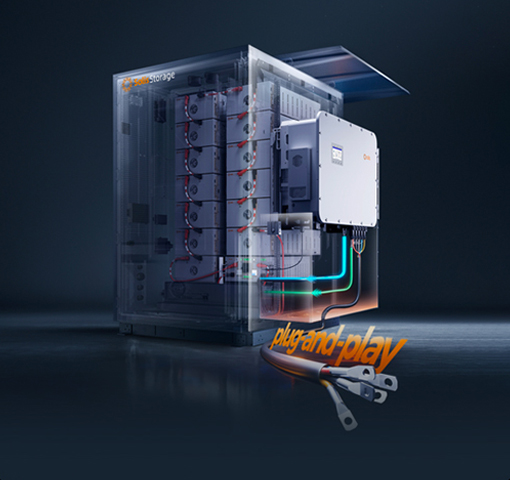
EverCore ESS is the commercial and industrial energy storage line from SolisStorage, the energy storage subsidiary of Ginlong (Solis) Technologies Co., Ltd., a company founded in 2005 and listed on the Shenzhen Stock Exchange. The platform is built around a physical separation of AC and DC: a hybrid energy storage inverter on the AC side and an LFP battery cabinet on the DC side, each in its own enclosure, each with its own protection rating.
That separation is the reason configuration decisions on EverCore are not simply a matter of picking the largest kWh number that fits the budget. Power rating, capacity tier, expansion path and enclosure siting interact. Getting the interaction wrong is more expensive than getting the price wrong.
Why C&I Storage Configurations Miss the Load Profile
Most configuration errors in commercial and industrial storage are made before a single purchase order is issued. They follow a small number of repeatable patterns.
The first is treating kWh as the only decision variable. Two sites with the same daily energy throughput can need different power ratings, because one has a short, sharp demand peak and the other has a long, flat profile. Upgrading capacity after the fact is straightforward on a modular platform; upgrading the power stage is not.
The second is sizing backup against average load instead of critical load. Backup duration is defined by the kW and kWh of the specific circuits that must stay energised, not by the site's total consumption. A 261.2 kWh cabinet that looks generous against total load can be inadequate against a critical load list that includes motor starting.
The third is ignoring the expansion path. A phased project — one cabinet now, three cabinets after the next budget cycle — has a very different cost structure depending on whether capacity can be added on the DC side of an existing inverter or requires a second complete unit with its own grid connection.
The fourth is assuming one protection rating covers the whole system. EverCore separates the enclosures: the hybrid inverter carries IP66 protection, while the battery cabinet carries IP55. For an outdoor installation in a high-dust or high-precipitation region, where each enclosure is sited and how each is maintained both matter.
The fifth is comparing capital cost across a 10 to 15 year asset life. C&I storage projects typically carry an asset lifecycle of 10 to 15 years. Upfront capital expenditure is only the visible layer; operating and maintenance cost erodes project IRR quietly over the remaining years.
From Tariff Arbitrage to Multi-Market Dispatch: What Changed
In mature electricity markets such as Europe, the revenue model of C&I storage has moved beyond basic peak-valley arbitrage into grid ancillary services (FCR, aFRR, mFRR), demand response, and virtual power plant dispatch. That shift changes what a configuration has to deliver.
A system built mainly for self-consumption is a capacity problem: it needs enough kWh to shift midday generation into the evening. A system built to participate in frequency response is a power and speed problem: it needs power headroom and fast, reliable transfer between operating modes. A system expected to do both needs both dimensions sized correctly from the start, because the second one cannot be retrofitted cheaply.
Software openness has become part of the configuration brief for the same reason. Solis has built an open software ecosystem for EverCore on the back of long-term operation across more than 300,000 energy storage sites worldwide. EverCore has been connected, or is in the process of connecting, with 102 third-party VPP and EMS operators across 11 European countries — including integration with the Kraken energy management platform under Octopus Energy in the UK, mainstream aggregator platforms such as Check Watt in the Nordic market, and dozens of local EMS providers in the German-speaking region and Benelux.
Scheduling capability sits alongside that ecosystem. The Solis AI Cloud Platform has been deployed at more than 5,500 energy storage power stations worldwide, integrating Nordpool wholesale price data and Flatpeak retail price data into a multi-source price forecasting model that supports minute-level optimisation of charge and discharge strategy. At a residential storage project in Latvia, that optimisation increased annual electricity bill savings by 302.6%.
The market context reinforces why configuration discipline now matters commercially. The U.S. energy storage industry installed 57.6 GWh of new capacity in 2025, described by the publisher as the largest year of new additions on record. As deployment volume grows, supplier selection narrows toward vendors whose configuration logic can be defended to an owner, a lender and an insurer — not only to an installer.
The EverCore Platform: Three Power Ratings, Three Capacity Tiers
Power tier: 50 kW, 60 kW and 125 kW
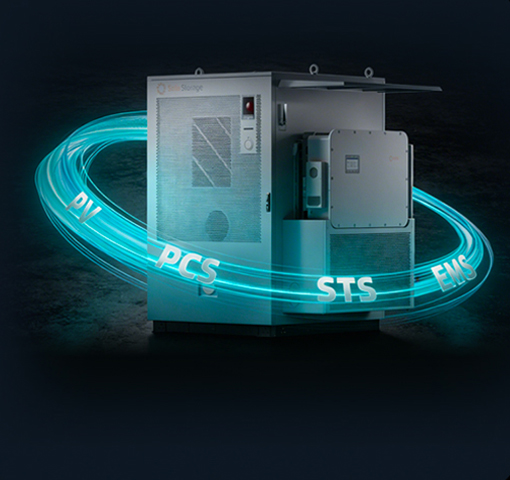
EverCore's hybrid energy storage inverter spans 50 kW to 125 kW, integrating the power conversion system, static transfer switch, PV inverter, circuit breaker protection and energy management system into a single unit. With a single-unit rating of 125 kW, the platform's integrated architecture produces four practical consequences for configuration.
- Seamless transfer without external hardware. Grid-tied to off-grid switching completes in less than 10 ms without an external STS, which is the specification that matters when precision industrial equipment or IT loads sit behind the meter.
- No separate PV inverter. The unit supports both DC and AC coupling for existing PV systems and allows a PV over-sizing ratio of up to 200%, so the solar asset already on site can be absorbed rather than duplicated.
- No separate grid cabinet. Up to 6 EverCore units can be connected in parallel for direct grid connection, simplifying construction and switchgear scope.
- Single-CPU control architecture. Conventional systems run independent processors for BMS, PCS, EMS and STS, forming a distributed multi-brain topology with protocol and latency risk between nodes. EverCore schedules the entire system through one central controller, which reduces failure points and shortens fault location and response time.
Capacity tier: 100.5 kWh, 120.6 kWh and 261.2 kWh
On the DC side, EverCore is offered in 100.5 kWh, 120.6 kWh and 261.2 kWh battery cabinet capacities. The 261.2 kWh cabinet is the reference capacity for the 125 kW class and appears in both of the field configurations discussed later in this guide.
All three tiers use the same cell platform: A-grade 314Ah LFP cells custom-developed for C&I applications by a top-tier cell manufacturer. Two cell-level characteristics carry directly into configuration decisions.
- Internal resistance of 0.15 ± 0.05 mΩ, below the 0.17 mΩ of standard 280Ah cells. Every 10% reduction in internal resistance reduces charge-discharge heat generation by approximately 20%, which lowers thermal risk at the electrochemical source rather than managing it downstream.
- 8,000 cycles at 0.5C charge-discharge rate, with remaining capacity at or above 70% — roughly a 14% improvement over the 7,000 cycles of traditional 280Ah cells. At 500 charge-discharge cycles per year, that extends the system's economic lifecycle from approximately 14 years to 16 years.
The practical reading for a C&I buyer is that cycle life and capacity tier are coupled decisions. A smaller capacity tier cycled harder reaches its economic limit sooner than a larger tier cycled gently, so the cheapest kWh figure is not automatically the cheapest lifecycle.
Expansion architecture: DC-side cabinets versus AC-side parallel units
EverCore supports two distinct expansion routes, and choosing between them is one of the most consequential configuration decisions in a phased project.
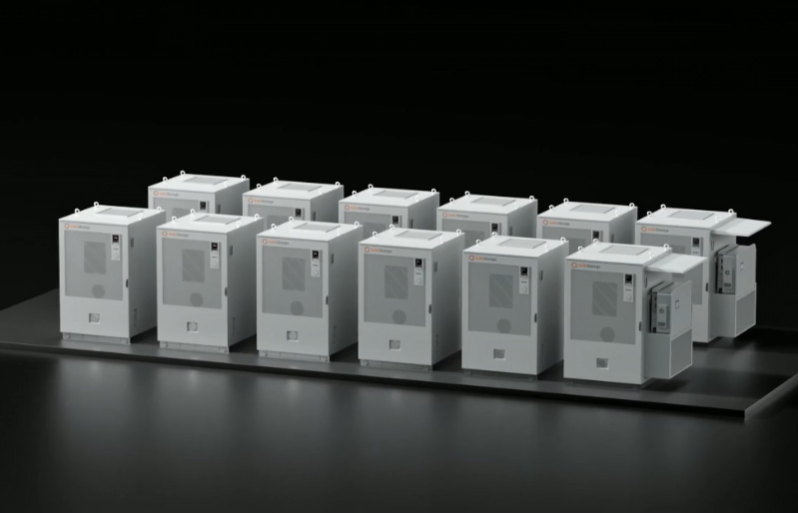
DC-side expansion keeps the existing inverter and adds battery cabinets to it. A single EverCore inverter can connect up to 6 battery cabinets in parallel, producing linear capacity growth without additional inverter investment and reducing system expansion cost by approximately 10%. This route suits owners with limited initial capital who intend to build out storage in stages as load grows.
AC-side parallel expansion adds complete units. Up to 6 EverCore units can be connected in parallel for direct grid connection without an external grid cabinet, which suits projects that need to scale power as well as energy.
Thermal and enclosure design
Because the inverter sits outside the battery cabinet, the thermal load inside the cabinet is smaller. Of the total heat generated, 6 kW of power electronics heat dissipates directly to ambient while only 3.5 kW of electrochemical heat remains to be managed inside the battery enclosure. That is what allows EverCore to hold cell temperature uniformity close to liquid-cooled designs while retaining an air-cooled architecture.
The cooling design uses three independent air ducts, combining a patented diversion duct for the hybrid inverter with Coanda effect airflow attachment across battery pack surfaces, so cooling air adheres evenly to curved surfaces and heat exchange efficiency improves. The combination raises heat dissipation efficiency by 30% compared with traditional air cooling.
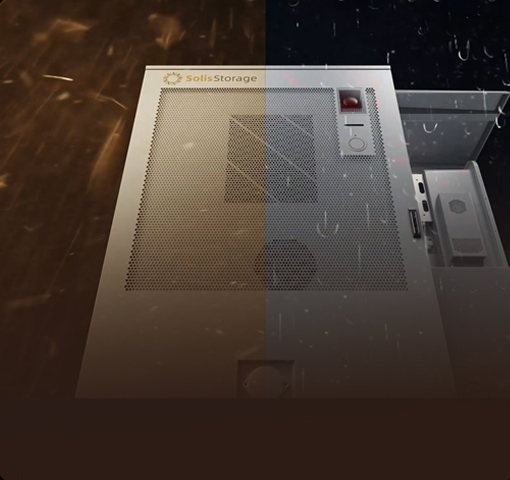
Enclosure ratings follow the same separation logic: IP66 for the hybrid inverter — dust-tight and protected against powerful water jets — and IP55 for the battery cabinet, supported by C4-grade anti-corrosion coating. The system operates from -25°C to 55°C and at altitudes up to 4,000 m, covering climates from high-temperature deserts to European cold. Separating the protection domains is also credited with reducing the system's full-lifecycle failure rate by 50%.
Safety architecture and lifecycle cost
Safety is not a separate topic from configuration in C&I projects, because it is one of the factors that determines whether an insurer will underwrite the asset. EverCore is built around a 15-layer protection system spanning cell, pack and system level. Thermal insulation material rated to 1,000°C is placed between packs to block lateral propagation of thermal runaway, and fire suppression is staged progressively through pack-level aerosol, cabinet-level aerosol and fire-fighting water channels.
Lifecycle cost is where configuration choices become visible to a finance team. Based on industry experience across the full project lifecycle, EverCore saves customers approximately €9,500 per unit in O&M cost by eliminating liquid cooling fluid replacement (€2,500), simplifying PCS replacement (€1,500), simplifying pack replacement (€1,500) and reducing routine inspection complexity (€4,000). Component selection supports the same objective: Minebea cooling fans are rated for 10-year maintenance-free operation, and Honeywell industrial-grade flammable gas detectors are rated for 10-year calibration-free operation. Pack replacement steps are reduced by 55%, and two technicians can complete the task with specialised tools and no heavy lifting equipment.
Seven Steps to a Defensible EverCore Configuration
The sequence below is the order in which the decisions constrain each other. Changing the order usually means redoing the earlier work.
- Profile the load in kW, not only in kWh. Collect interval data for a representative period and identify peak demand, ramp rate, and the hours in which on-site PV generation overlaps the load. The peak, not the average, sets the power floor.
- Fix the backup boundary before sizing anything. List the circuits that must remain energised, then record their combined kW, their combined kWh, and the autonomy hours the business requires. This list, not the site total, defines the capacity floor.
- Select the power tier. Choose from 50 kW, 60 kW or 125 kW by testing the critical load peak plus motor starting and simultaneous loads against the rating, then confirming there is headroom for PV over-sizing up to 200% if DC-coupled solar is part of the scope.
- Select the capacity tier. Test 100.5 kWh, 120.6 kWh and 261.2 kWh against the backup kWh requirement and against the daily energy that must be shifted. Check the resulting charge-discharge rate and the daily cycle count, because both feed directly into the 8,000-cycle economic life calculation.
- Choose the expansion path. If future growth is mostly energy, plan for DC-side cabinets up to 6 per inverter. If future growth is mostly power, plan for AC-side parallel units up to 6 per site. Decide at this step, because it changes switchgear, cabling and footprint.
- Verify siting and protection. Confirm that the intended location matches IP66 inverter and IP55 cabinet ratings plus C4 anti-corrosion, and that ambient conditions fall within -25°C to 55°C and 4,000 m altitude.
- Verify switching, controls and acceptance. Confirm the sub-10 ms grid-tied to off-grid transfer requirement against the loads behind the meter, confirm the EMS or VPP platform the site will use, and agree the acceptance route: factory acceptance testing followed by on-site installation and commissioning.
Two Field Configurations and the Logic Behind Them
Thailand: 125 kW / 522 kWh for factory self-consumption and backup
An industrial site in Thailand combines self-consumption with backup. The 125 kW power tier is driven by the factory's peak demand and motor load profile, while the 522 kWh capacity — the equivalent of two 261.2 kWh cabinets paralleled on a single 125 kW inverter — is driven by two requirements acting together: absorbing surplus daytime PV generation for use in the evening, and carrying critical process loads through an outage.
What makes this configuration representative is the direction of the sizing logic. If the site had been sized on capacity alone, a lower power tier would have appeared adequate on paper and would have failed at the demand peak. If it had been sized on power alone, the backup duration would have been short. The 125 kW / 522 kWh pairing is what happens when both constraints are applied in sequence.
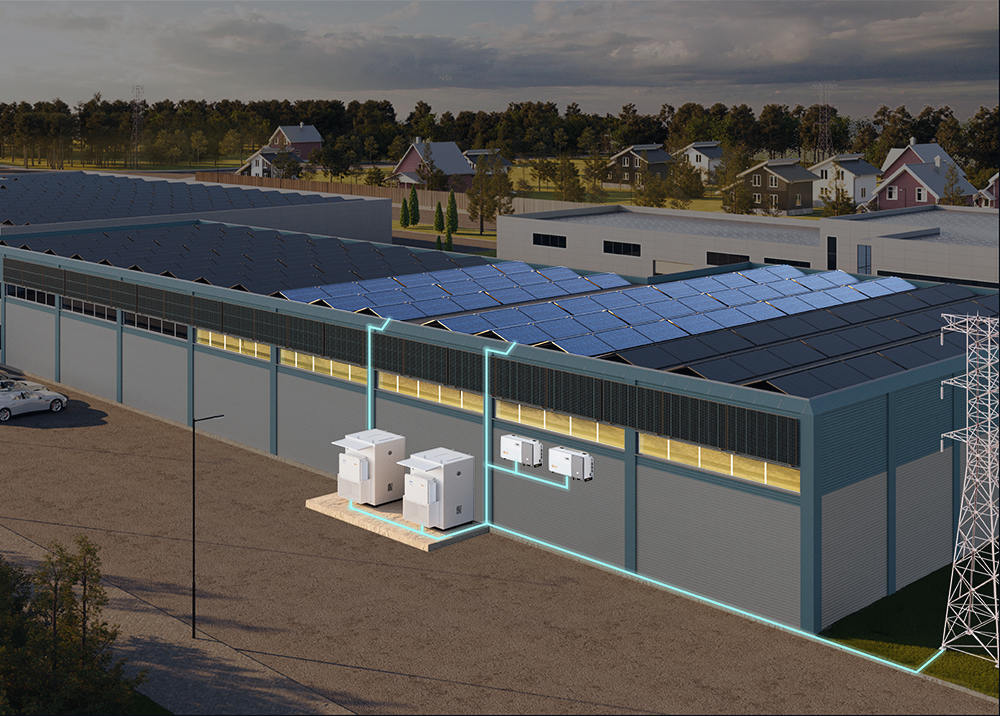
Denmark: 125 kW / 261 kWh for warehouse self-consumption with seamless switching
A warehouse in Denmark uses a single 125 kW / 261 kWh EverCore configuration for self-consumption with seamless switching. Here the power tier is again 125 kW, but the capacity tier is one cabinet rather than two, because the critical load list is shorter and the required autonomy is measured in a different unit of time.
The decisive requirement in this project is transfer speed. Sub-10 ms switching without an external STS keeps warehouse systems — lighting, IT, security and material handling controls — running through a grid event rather than restarting after one. A configuration that delivered the same kWh but transferred more slowly would have met the energy requirement and failed the operational one.
Read together, the two projects show why the same 125 kW inverter supports two very different capacity decisions. Power tier follows the load shape; capacity tier follows the autonomy requirement and the daily energy to be shifted.
Smaller commercial sites: retail, cold chain and small-scale agriculture
The lower power tiers — 50 kW and 60 kW — combined with the 100.5 kWh and 120.6 kWh capacity tiers serve commercial sites where the critical load list is short and daily throughput is modest: retail units, small cold-chain facilities, and small-scale agricultural operations. The same sequence applies. The difference is that the power and capacity floors sit closer together, so the cost of over-specifying either dimension is proportionally larger.
Configuration Comparison: Capacity, Power and Expansion Limits
The table below consolidates the platform facts that constrain a configuration decision. All values are EverCore platform specifications.
| Parameter | EverCore ESS specification | Why it constrains configuration |
|---|---|---|
| Battery chemistry | LFP, A-grade 314Ah cells developed for C&I applications | Sets thermal behaviour, cycle life and safety baseline across all three capacity tiers |
| Capacity tiers | 100.5 kWh / 120.6 kWh / 261.2 kWh | Defines the backup duration and daily energy shift available per cabinet |
| Inverter power ratings | 50 kW / 60 kW / 125 kW hybrid energy storage inverter | Defines peak coverage, motor starting headroom and market participation capability |
| Cycle life | 8,000 cycles at 0.5C, remaining capacity ≥70% | Converts capacity choice into an economic lifecycle of up to about 16 years at 500 cycles per year |
| Cell internal resistance | 0.15 ± 0.05 mΩ | Lower resistance means roughly 20% less charge-discharge heat per 10% reduction |
| Inverter protection | IP66 | Allows outdoor siting of the power electronics without an additional enclosure |
| Battery cabinet protection | IP55 | Sets the siting and maintenance regime for the DC side |
| Anti-corrosion | C4-grade coating | Determines suitability for coastal and industrial atmospheres |
| Operating temperature | -25°C to 55°C | Rules out or confirms high-temperature desert and cold-climate sites |
| Operating altitude | Up to 4,000 m | Constrains high-altitude industrial and mining sites |
| Grid-tied / off-grid transfer | Less than 10 ms, without external STS | Determines which loads can ride through an outage instead of restarting |
| PV over-sizing ratio | Up to 200% | Determines how much existing or new PV can be absorbed by the same unit |
| DC-side expansion | Up to 6 battery cabinets per inverter | Enables phased capacity growth with roughly 10% lower expansion cost |
| AC-side parallel expansion | Up to 6 EverCore units in parallel, no external grid cabinet | Enables phased power growth without additional switchgear scope |
The second table maps the three capacity tiers to the questions that decide them. It is a decision framework, not a specification — the final answer depends on the site's measured load data.
| Capacity tier | Configuration question it answers | Check before specifying |
|---|---|---|
| 100.5 kWh | Short critical load list, modest daily energy shift, lower power tier | Verify that the resulting charge-discharge rate stays within the duty the site will actually run, and that daily cycle count supports the 8,000-cycle economic life |
| 120.6 kWh | Intermediate requirement where backup duration and daily throughput both sit between the small and large tiers | Confirm the autonomy hours against the critical load kW rather than against total site load |
| 261.2 kWh | Reference capacity for the 125 kW class; longer autonomy, larger daily energy shift, or both | Confirm that peak demand justifies the 125 kW tier, and that two cabinets paralleled on one inverter are required rather than one |
Rule of thumb for the decision sequence: power tier first, capacity tier second, expansion path third. Reversing the order produces configurations that look efficient on a quotation and underperform on site, because the power stage is the part that cannot be added later at low cost.
Frequently Asked Questions
What protection and compliance factors affect EverCore configuration in C&I projects?
EverCore separates protection across its two enclosures: the hybrid inverter carries IP66 protection and the battery cabinet carries IP55, both with C4-grade anti-corrosion coating, operating from -25°C to 55°C and up to 4,000 m altitude. On the compliance side, buyers should note that ANSI/CAN/UL 9540:2023 covers energy storage systems intended to receive and store energy for delivery to loads or the local electric power system, and applies to residential and non-residential installations. Grid-connection and fire-safety approval requirements are set locally, so the applicable approvals for a specific site should be confirmed with the authority having jurisdiction during configuration rather than after ordering.
How far can an EverCore system be expanded after commissioning?
Two expansion routes exist. On the DC side, a single EverCore inverter can connect up to 6 battery cabinets in parallel, allowing linear capacity growth without additional inverter investment and reducing system expansion cost by approximately 10%. On the AC side, up to 6 EverCore units can be connected in parallel for direct grid connection without an external grid cabinet. The DC route suits projects growing in energy; the AC route suits projects growing in power. Because EverCore separates AC and DC physically, adding cabinets does not require replacing the inverter and adding units does not require redesigning the battery side.
What lifecycle costs should be included when comparing EverCore configurations?
C&I storage projects typically carry an asset lifecycle of 10 to 15 years, and initial capital expenditure is only the visible portion. Based on industry experience across the full project lifecycle, EverCore saves approximately €9,500 per unit in O&M cost by eliminating liquid cooling fluid replacement (€2,500), simplifying PCS replacement (€1,500), simplifying pack replacement (€1,500) and reducing routine inspection complexity (€4,000). Component selection supports this: Minebea cooling fans are rated for 10-year maintenance-free operation and Honeywell flammable gas detectors for 10-year calibration-free operation. On the energy side, 8,000 cycles at 0.5C extends economic lifecycle from approximately 14 years to 16 years at 500 cycles per year — so comparing two capacity tiers means comparing two different cost curves, not two purchase prices.
Can a single unit be ordered to validate a configuration before a full rollout?
Yes. The minimum order quantity is 1 unit. Delivery terms are FOB Ningbo or EXW factory delivery. Acceptance criteria are factory acceptance testing followed by on-site installation and commissioning, and payment terms run as deposit, payment before or after shipment, and final acceptance payment — with specific terms depending on customer tier, order size and regional policy. For a multi-site rollout, validating one configuration against a real load profile before standardising is the lower-risk sequence, because the load data collected at the first site usually refines the template for the rest.
How do we start a configuration review for a specific project?
Start with three inputs: the site's interval load data, the critical load list with its kW and kWh, and the single-line diagram showing the existing or planned PV and the point of grid connection. With those, the 50, 60 or 125 kW power tier and the 100.5, 120.6 or 261.2 kWh capacity tier can be tested against the actual profile rather than against a rule of thumb. SolisStorage reviews configurations against these inputs and returns a proposed architecture including the expansion path. Contact the team at sales@solisstorage.com or download the Solis global brochure for the full platform specification.
Conclusion: Configure for the Load, Not for the Quotation
EverCore ESS gives C&I buyers three capacity tiers and three power ratings to work with, and a modular architecture that lets either dimension grow after commissioning. That flexibility is only useful if the first configuration is right. Power tier follows the measured peak and the switching requirement; capacity tier follows the critical load list and the daily energy to be shifted; expansion path follows which of the two is expected to grow.
The two field references in this guide make the point concretely. A 125 kW inverter with 522 kWh of DC capacity in a Thai factory and a 125 kW inverter with 261.2 kWh in a Danish warehouse share the same power tier for entirely different reasons, and arrive at different capacity tiers for equally specific ones. Neither configuration would have emerged from a per-kWh comparison.

Next step: test your load profile against the EverCore range
Send your interval load data, critical load list and single-line diagram to the SolisStorage team for a configuration review. If a single unit validation fits your project better than a full rollout, the minimum order quantity is 1 unit.
Email: sales@solisstorage.com · Phone: +86 574 65802188
Download the Solis Global Brochure V3.9 or visit www.solisinverters.com.
Have Questions or Need More Details?
Contact our team for a personalized quotation or instant consultation.
Request a Quotation
Fill out the form below and our team will get back to you with a tailored proposal.
WhatsApp Direct Chat
Prefer to chat in real-time? Message us on WhatsApp for instant assistance & quick answers.
- Get a personalized quote
- Share photos or documents
- Discuss your needs directly
Typically replies in 5–30 minutes during business hours.