
Energy Storage System Basics: LFP Chemistry Across Residential and C&I ESS
Energy Storage System Basics: LFP Chemistry Across Residential and C&I ESS
LFP — lithium iron phosphate, written LiFePO4 — is one of the most widely specified battery chemistries in modern energy storage systems, from a 5 kWh home unit to a 261 kWh commercial cabinet. It is chosen for two practical reasons: a properly specified LFP system delivers a long cycle life against a defined end-of-life threshold, and the same chemistry can be carried across a residential and a commercial product range without changing service procedures or spare-part logic.
This article covers the fundamentals an energy storage system (ESS) buyer needs before comparing datasheets: how LFP behaves inside a real system, which five published parameters decide whether a product fits a site, and how SolisStorage applies the same chemistry at residential and commercial & industrial (C&I) scale. Ginlong (Solis) Technologies Co., Ltd. (SZSE: 300763) was founded in 2005 and manufactures solar inverters and energy storage solutions; SolisStorage is the group’s dedicated energy storage business, with systems deployed in more than 100 countries and regions.
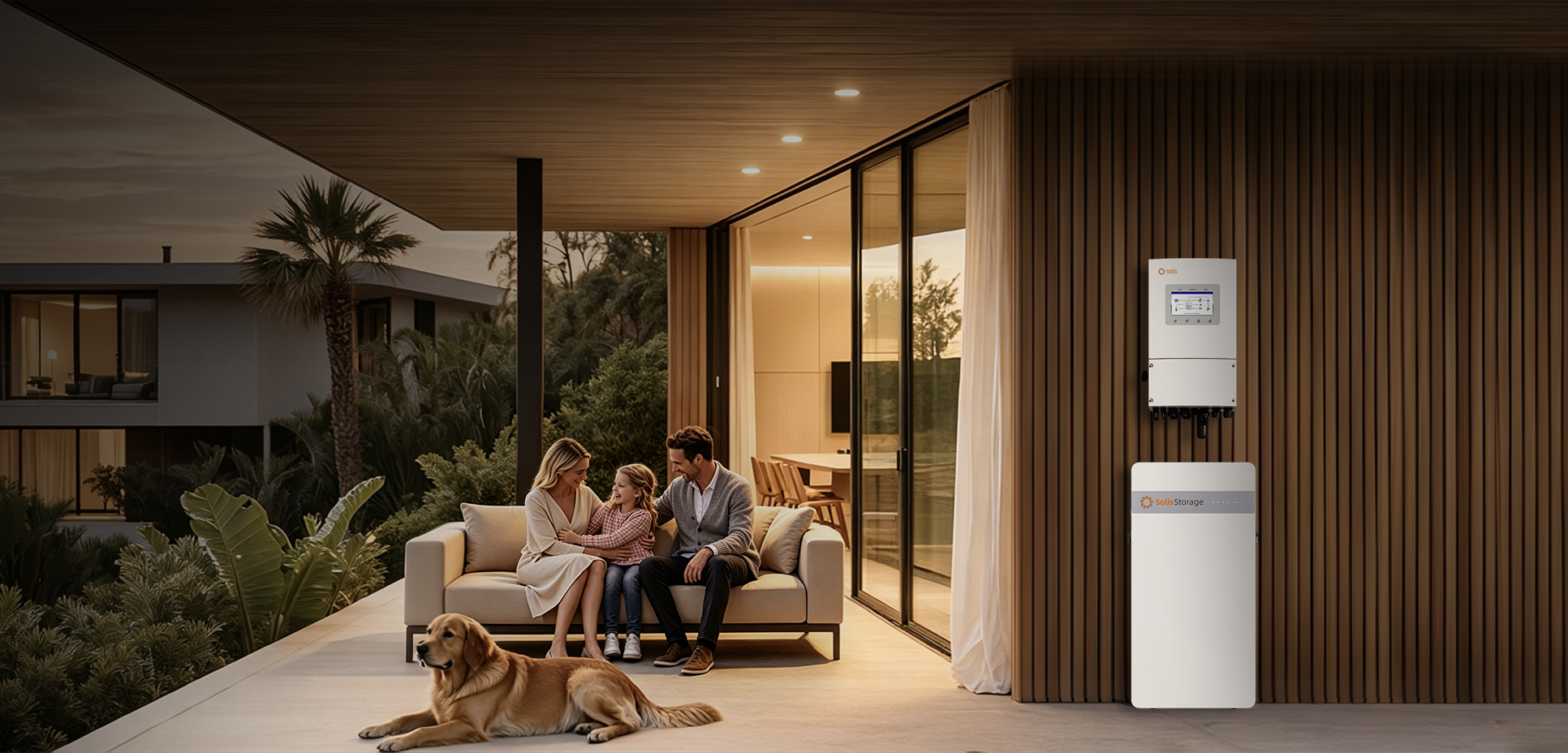
IntelliHome, the SolisStorage residential energy storage system: 5 kWh nominal LFP capacity, 100 Ah rated cells, IP66 enclosure.
What an LFP energy storage system actually contains
LFP describes the cathode material of the lithium-ion cell. Everything around that cell — the battery management system, the power conversion system or hybrid inverter, the energy management system, thermal management and the enclosure — determines whether the chemistry performs as promised on a live site. A battery energy storage system is therefore specified as a system, not as a cell.
At residential scale the system is normally a single enclosure. IntelliHome, the SolisStorage home energy storage unit, is built around LiFePO4 cells with a nominal capacity of 5 kWh and a rated cell capacity of 100 Ah. Its operating voltage window is 44.8 to 57.6 V, the recommended charge and discharge current is 50 A, the cycle life is greater than 6000 cycles corresponding to 10 years, the ingress protection rating is IP66, and the casing is aluminium alloy with core electronic components.
At C&I scale the same chemistry is split across a battery cabinet and a separate inverter. EverCore ESS separates the AC side from the DC side: the hybrid energy storage inverter is an independent enclosure rated IP66, while the battery cabinet is rated IP55. That architecture has a battery-level consequence — Solis states the external inverter dissipates its power-stage heat into ambient air, so only electrochemical heat has to be managed inside the cabinet. FlexCore-ID sits between the two scales: a stackable system whose battery pack, FlexCore-ID-BAT20kWh, is built on 314 Ah LFP cells.
Industry background: why storage converged on LFP
Storage is no longer a niche add-on to a solar array. BloombergNEF projected global annual energy storage deployment, excluding pumped hydro, to reach 92 GW in 2025, and the U.S. industry was reported to have installed 57.6 GWh of new storage capacity in the same year. Deployment at that volume changes what buyers demand from a chemistry: predictable degradation, serviceable architecture and documentation that survives an insurance review.
Three structural shifts pushed LFP to the front of residential and C&I specifications:
- Chemistry standardisation across segments. A single cell chemistry that appears in a 5 kWh home unit, a 20 kWh stackable pack and a 261 kWh commercial cabinet lets an installer, distributor or service partner keep one training path and one diagnostic logic across a portfolio.
- Cycle life as the economic variable. In daily-cycling applications the value of a system is driven less by peak power than by how many charge and discharge cycles it delivers before capacity falls to the declared end-of-life.
- Certification convergence. Battery-level safety certification and electromagnetic compatibility documentation are now routine tender requirements, and LFP cells are the basis on which most current residential and C&I platforms are certified.
LFP is not the only lithium chemistry in the market, and the trade-off is well known in general industry terms: LFP cells are typically heavier and bulkier per unit of stored energy than nickel-rich chemistries, in exchange for a more stable thermal profile and a longer cycling life. For stationary systems where floor area is available and daily cycling is the revenue engine, that exchange usually favours LFP. For transport or space-constrained installations, it may not.
The five constraints that decide whether an LFP system fits
Datasheets rarely mislead on purpose, but they do hide assumptions. Five parameters carry most of the decision weight, and each has a condition attached.
1. Cycle life at a stated end-of-life
“8000 cycles” means nothing without the end-of-life definition and the test conditions. FlexCore-ID declares 8000 cycles at 25±2 °C, 0.5P, with end-of-life defined as 70% of beginning capacity; EverCore ESS declares 8000 cycles at 70% end-of-life; IntelliHome declares greater than 6000 cycles corresponding to 10 years. Solis’s own project modelling, based on 500 charge and discharge cycles per year, extends the economic lifecycle from roughly 14 years with 7000-cycle cells to about 16 years with 8000-cycle cells. The number to compare is therefore cycles at a named temperature, a named C-rate and a named end-of-life — not cycles alone.
2. Cell capacity and what it does to the architecture
Cell capacity sets how much energy sits in each pack and how many packs a cabinet needs. IntelliHome uses 100 Ah rated cells for a 5 kWh unit. FlexCore-ID and EverCore ESS both use 314 Ah LFP cells — EverCore with EVE 3.2 V / 314 Ah cells. Larger cells reduce the number of connections and sensing points inside a cabinet, which is why C&I systems have moved toward 300 Ah-class cells while residential units stay on smaller formats.
3. Energy and power pairing
Energy (kWh) is how much the system holds; power (kW) is how fast it can move. EverCore ESS is offered as 50 kW with 100.5 kWh, 60 kW with 120.6 kWh, and 125 kW with 261.2 kWh — each pairing delivering roughly a two-hour discharge window. If a site needs a four-hour window, the energy rating must be doubled for the same load; if it needs a short, high-power burst, the inverter rating matters more than the kWh figure.
4. Enclosure protection and site conditions
The IP rating has two digits: the first covers solids, the second covers water. IntelliHome carries IP66 as a single residential enclosure. EverCore ESS splits the rating deliberately — IP55 for the battery cabinet and IP66 for the inverter — so the most weather-exposed component carries the higher protection. For outdoor C&I sites, enclosure rating, anti-corrosion treatment and the installation’s ventilation plan belong in the same conversation; a high IP rating does not on its own guarantee performance in coastal salt-fog conditions.
5. Certification and market access
Certification is where chemistry becomes commerce. EverCore ESS is certified to IEC 62619 by TUV under certificate number JPTUV-182135 for the EU market, issued on 6 January 2026. The EverCore-261kWh and EverCore-261kWh-PRO models are certified to CE EMC Directive 2014/30/EU by TUV under certificate number AE 50712374 0001, issued on 21 January 2026, against standards including EN IEC 61000-6-2:2019, IEC 61000-6-2:2016, EN IEC 61000-6-4:2019 and IEC 61000-6-4:2018. In North America, ANSI/CAN/UL 9540:2023 sets the ESS safety scope for residential and non-residential installations — a separate framework that a European certificate does not replace.

EverCore ESS, the SolisStorage C&I energy storage system: LFP cells, aluminium alloy casing, IP55 cabinet and IP66 inverter.
How IntelliHome applies LFP at home
IntelliHome is a residential energy storage system designed for home use, and its specification is deliberately narrow rather than modular: 5 kWh nominal capacity, 44.8–57.6 V operating voltage, 50 A recommended charge and discharge current, 100 Ah rated cells, greater than 6000 cycles over roughly 10 years, IP66 enclosure in aluminium alloy.
Three reading notes matter for a homeowner or installer:
- The 50 A recommended current is the design envelope for daily charge and discharge. Systems wired beyond that envelope will run hotter and degrade faster than the cycle figure implies.
- The IP66 rating makes the unit suitable for outdoor household installation, one of the working conditions SolisStorage lists for its storage products.
- The 10-year cycle statement aligns with the warranty horizon most residential buyers plan around, which is why the same chemistry appears across the rest of the range.
How FlexCore-ID applies LFP to stackable, small-scale projects
FlexCore-ID is a stackable energy storage system intended for small farms, shopping malls, hospitals, large residences and small industrial and commercial enterprises. Its battery pack, model FlexCore-ID-BAT20kWh, uses LFP chemistry with 314 Ah cells and a cycle life of at least 8000 cycles at 25±2 °C, 0.5P, end-of-life 70%. The casing is aluminium alloy with core electronic components.
The important word in that description is stackable. Instead of buying one fixed cabinet sized for the largest day of the year, an owner starts with the number of 20 kWh packs the load profile justifies and adds packs as consumption grows. For a small business energy storage project, that changes the financial structure: capital is released in stages, and the inverter and control layer can be sized once rather than replaced at every expansion.
How EverCore ESS applies LFP to commercial and industrial sites
EverCore ESS is the C&I energy storage system in the range, designed for commercial and industrial applications in the renewable energy and power grid industry. It is available in three configurations — 50 kW / 100.5 kWh, 60 kW / 120.6 kWh and 125 kW / 261.2 kWh — built on EVE LFP 3.2 V / 314 Ah cells with an 8000-cycle life at 70% end-of-life, an IP55 battery cabinet, an IP66 inverter and an aluminium alloy casing.
The architecture is the differentiating detail. Solis states that a single EverCore hybrid energy storage inverter can connect up to six battery cabinets in parallel, so storage capacity can be expanded linearly on the DC side without buying another inverter — Solis attributes roughly a 10% reduction in system expansion cost to that design. Solis also states that grid-tied and off-grid switching completes in under 10 ms without an external static transfer switch, a figure that matters for precision industrial equipment and for sites that cannot tolerate a restart.
On the safety side, Solis describes a three-level protection concept spanning cell, pack and system, with thermal insulation material rated to 1000 °C between packs and a staged fire-suppression approach at pack and cabinet level. Those are manufacturer statements rather than independent test results, and a buyer should map them against the project’s fire-safety requirements during due diligence.

EMC certification documentation supporting EverCore-261kWh and EverCore-261kWh-PRO under CE EMC Directive 2014/30/EU (certificate AE 50712374 0001).
Step by step: how to specify an LFP energy storage system
- Fix the job the system must do. Decide whether the primary function is solar self-consumption, peak load shifting, backup power or a combination. A residential energy storage system sized for evening self-consumption has a very different profile from a commercial system sized for demand-charge reduction.
- Convert the load profile into energy and power. Take the highest sustained load in kW and the number of hours it must be carried. That pair determines the inverter rating and the usable kWh; the EverCore combinations of 50 kW / 100.5 kWh, 60 kW / 120.6 kWh and 125 kW / 261.2 kWh exist precisely because those ratios differ by site.
- Match the cycle life to the cycling regime. Compare declared cycles at the same temperature, C-rate and end-of-life. A site cycling twice a day consumes life twice as fast as one cycling daily, and a site with poor thermal management will not reach the datasheet figure at all.
- Check the physical envelope. Confirm the IP rating against the installation location — IP66 for an exposed outdoor position, a protected cabinet position for IP55 hardware — and confirm clearances, cable routes and ventilation before delivery, not after.
- Assemble the compliance file. Collect the battery safety certificate, the EMC documentation and the certificate scope, and check that the exact model number on the tender appears in the certificate scope. EverCore’s CE EMC certificate, for example, names EverCore-261kWh and EverCore-261kWh-PRO specifically.
- Plan the service path. Ask who attends site, how quickly, and how spare parts are held. SolisStorage states 24/7 global remote technical support, 27 local overseas service centres, 48-hour on-site fault handling with whole-machine replacement provision, and long-term spare parts supply.
Where LFP energy storage systems are used
Home energy storage. A single-phase or three-phase residential installation that stores midday solar generation for evening use and provides backup during an outage. IntelliHome’s 5 kWh unit is designed for this role, in household outdoor conditions.
Small commercial, agricultural and institutional sites. Farms, retail malls, clinics and large residences where the load is meaningful but capital is staged. FlexCore-ID’s 20 kWh battery pack and stackable structure fit this profile.
Industrial self-consumption and backup. A warehouse or light-manufacturing site with a large daytime load and a need for continuity. Solis reports a 125 kW / 261 kWh EverCore installation at a C&I industrial end user in Denmark with a 20-year project duration, used for self-consumption of warehouse load and for on-grid to off-grid switching in under 10 ms.
Multi-cabinet commercial projects. Solis also reports a 125 kW / 522 kWh self-use and backup installation in Thailand with a 20-year duration in stable operation — an example of the parallel-cabinet expansion pattern rather than a single-cabinet design.
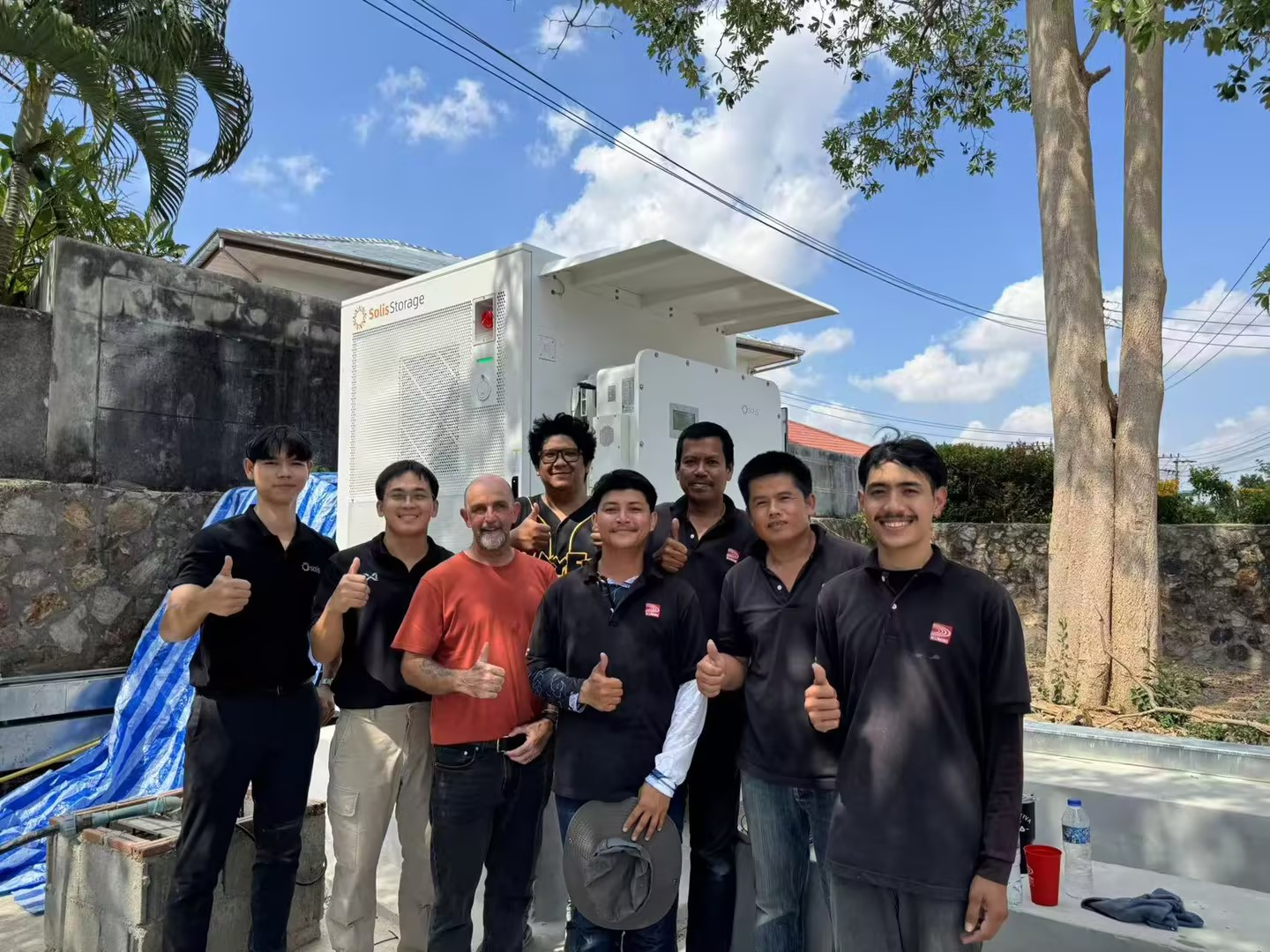
Project team at a SolisStorage self-consumption and backup installation in Thailand (125 kW / 522 kWh).
Comparison table: three LFP systems at three scales
| Parameter | IntelliHome (residential) | FlexCore-ID (stackable) | EverCore ESS (C&I) |
|---|---|---|---|
| Battery chemistry | LiFePO4 | LFP | LFP (EVE 3.2 V / 314 Ah cells) |
| Cell capacity | 100 Ah rated | 314 Ah | 314 Ah |
| Energy configuration | 5 kWh nominal | 20 kWh battery pack (FlexCore-ID-BAT20kWh), stackable | 100.5 kWh / 120.6 kWh / 261.2 kWh |
| Power / current | 50 A recommended charge and discharge | Not stated in the reference data | 50 kW / 60 kW / 125 kW inverter ratings |
| Operating voltage | 44.8–57.6 V | Not stated in the reference data | Not stated in the reference data |
| Cycle life | >6000 cycles / 10 years | ≥8000 cycles at 25±2 °C, 0.5P, EOL 70% | 8000 cycles at 70% end-of-life |
| Ingress protection | IP66 | Not stated in the reference data | IP55 cabinet + IP66 inverter |
| Casing | Aluminium alloy | Aluminium alloy | Aluminium alloy |
| Certification in the reference data | Not stated in the reference data | Not stated in the reference data | IEC 62619 (TUV, JPTUV-182135); CE EMC 2014/30/EU (TUV, AE 50712374 0001) for 261 kWh models |
| Typical application | Household, outdoor residential | Small farms, shopping malls, hospitals, large residences, small I&C enterprises | Commercial and industrial, renewable and grid-connected sites |
All values as stated in SolisStorage product and certification documentation. Cells marked “not stated” are absent from the source data and should be confirmed on the current model datasheet.
What LFP does not solve
An honest specification includes the limits. Four are worth stating plainly.
- Footprint and weight. LFP stores less energy per kilogram and per litre than nickel-rich chemistries in general industry terms. In a plant room with a hard floor-area limit, that can rule LFP out regardless of cycle life.
- Temperature, not enclosure rating. A high IP rating protects against dust and water, not against heat or cold. Cycle-life figures are declared at 25±2 °C (for FlexCore-ID); a site that runs materially hotter will not reach them.
- Certification scope. A battery-level certificate such as IEC 62619 and an EMC certificate under CE EMC Directive 2014/30/EU cover specific products and specific requirements. Grid-connection approval, installation approval and fire-code compliance are separate, market-specific processes.
- Sizing errors. Chemistry cannot rescue a system that is too small for the load profile. Undersized kWh shows up as repeated deep discharge; undersized kW shows up as load shedding during peaks.
Frequently asked questions
Which certifications should an LFP energy storage system carry for the EU market?
For the EverCore ESS, the reference documentation lists two: certification to IEC 62619 issued by TUV under number JPTUV-182135 for the EU market, and certification of the EverCore-261kWh and EverCore-261kWh-PRO models to CE EMC Directive 2014/30/EU issued by TUV under number AE 50712374 0001, against standards including EN IEC 61000-6-2:2019, IEC 61000-6-2:2016, EN IEC 61000-6-4:2019 and IEC 61000-6-4:2018. Certificates are issued per product and per market, so a buyer should verify that the exact model in the tender appears in the certificate scope; certification for IntelliHome and FlexCore-ID is not stated in the reference data used for this article and should be requested from the supplier.
How long does an LFP battery actually last in an energy storage system?
It depends on the declared end-of-life and the cycling regime. IntelliHome states greater than 6000 cycles corresponding to 10 years. FlexCore-ID states at least 8000 cycles at 25±2 °C, 0.5P, with end-of-life defined as 70% of beginning capacity. EverCore ESS states 8000 cycles at 70% end-of-life. Solis’s project modelling, based on 500 charge and discharge cycles per year, puts the economic lifecycle at roughly 14 years for 7000-cycle cells and about 16 years for 8000-cycle cells — but those figures assume the declared temperature and C-rate are respected in operation.
Can storage capacity be expanded after the system is installed?
Yes, on both stackable and cabinet architectures, but the mechanism differs. FlexCore-ID is a stackable system built from 20 kWh battery packs (FlexCore-ID-BAT20kWh), so packs can be added as load grows. On EverCore ESS, Solis states that a single hybrid energy storage inverter can connect up to six battery cabinets in parallel, allowing DC-side capacity expansion without an additional inverter, which Solis estimates reduces system expansion cost by roughly 10%. Either way, the expansion path should be defined before the first purchase so the inverter and control layer are not replaced later.
What is the minimum order quantity for a customized LFP energy storage system?
SolisStorage states a minimum order quantity of 1 unit for standard off-the-shelf models and 20 units for customized OEM orders. Customization covers logo, outer packaging, software interface, regional voltage standard, communication protocol and functional parameters. Production runs under an OEM/ODM model, with monthly capacity stated at over 10,000 units across integrated intelligent production lines, and quality control covering 100% full functional testing before shipment, raw material incoming inspection, aging tests, high and low temperature cycle tests and IP protection tests.
How long is the lead time, and what support comes after delivery?
SolisStorage states 30–45 days for mass OEM orders, with spot goods available for standard models. After delivery, support is described as 24/7 global remote technical assistance, 27 local overseas service centres, 48-hour on-site fault handling with whole-machine replacement provision, and long-term spare parts supply — relevant for C&I projects with a 20-year operating horizon, such as the 125 kW / 261 kWh installation reported in Denmark.
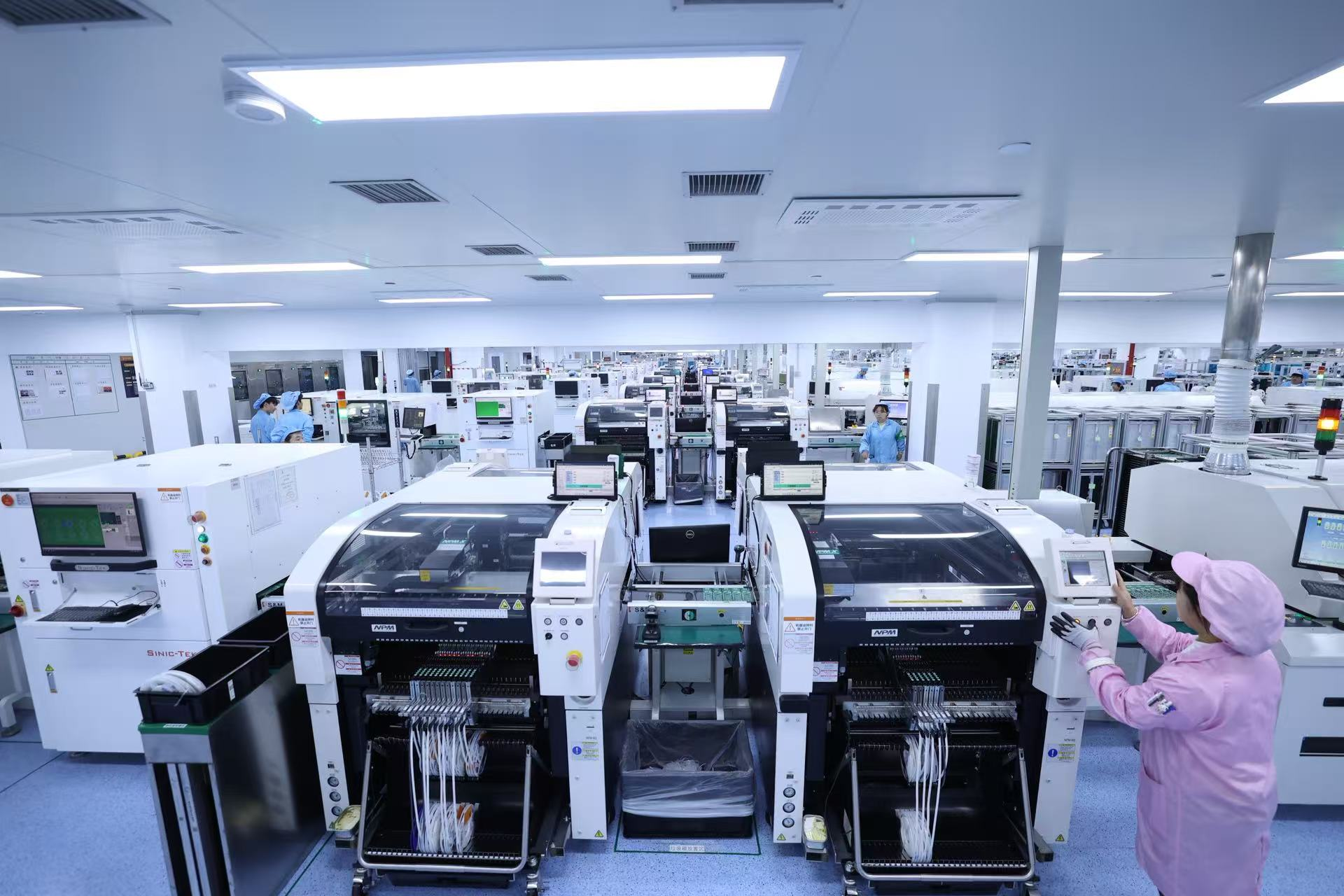
SMT production workshop at Solis. The group reports a 98,114.69 m² manufacturing footprint, 5000+ employees and an annual output of 80 GW.
Conclusion: chemistry is the starting point, not the specification
LFP gives residential and C&I energy storage systems a shared foundation: a long cycle life against a defined end-of-life, a comparatively stable thermal profile, and a chemistry that scales from a 5 kWh home unit through a 20 kWh stackable pack to a 261.2 kWh commercial cabinet without changing service logic. What separates one LFP system from another is everything built around the cell — the energy-to-power ratio, the enclosure split, the expansion architecture, and whether the certification file names the exact model on the tender.
The practical sequence for a buyer is straightforward: define the load, convert it into kWh and kW, compare cycle life at identical conditions, verify the physical envelope against the site, and assemble the compliance file model by model. Anything a supplier cannot document at that level belongs in the open questions, not in the assumptions.
Next step: check the specification against your project
For model-level datasheets, certification documents and configuration options across IntelliHome, FlexCore-ID and EverCore ESS, download the Solis global brochure or contact the SolisStorage team directly. Sample units and standard off-the-shelf models are available from 1 unit; customized OEM orders start at 20 units.
Download the Solis Global Brochure (PDF) | www.solisinverters.com | Email: sales@solisstorage.com
Have Questions or Need More Details?
Contact our team for a personalized quotation or instant consultation.
Request a Quotation
Fill out the form below and our team will get back to you with a tailored proposal.
WhatsApp Direct Chat
Prefer to chat in real-time? Message us on WhatsApp for instant assistance & quick answers.
- Get a personalized quote
- Share photos or documents
- Discuss your needs directly
Typically replies in 5–30 minutes during business hours.