
BESS Enclosure Specs: IP66/IP55 and C5 Corrosion Protection
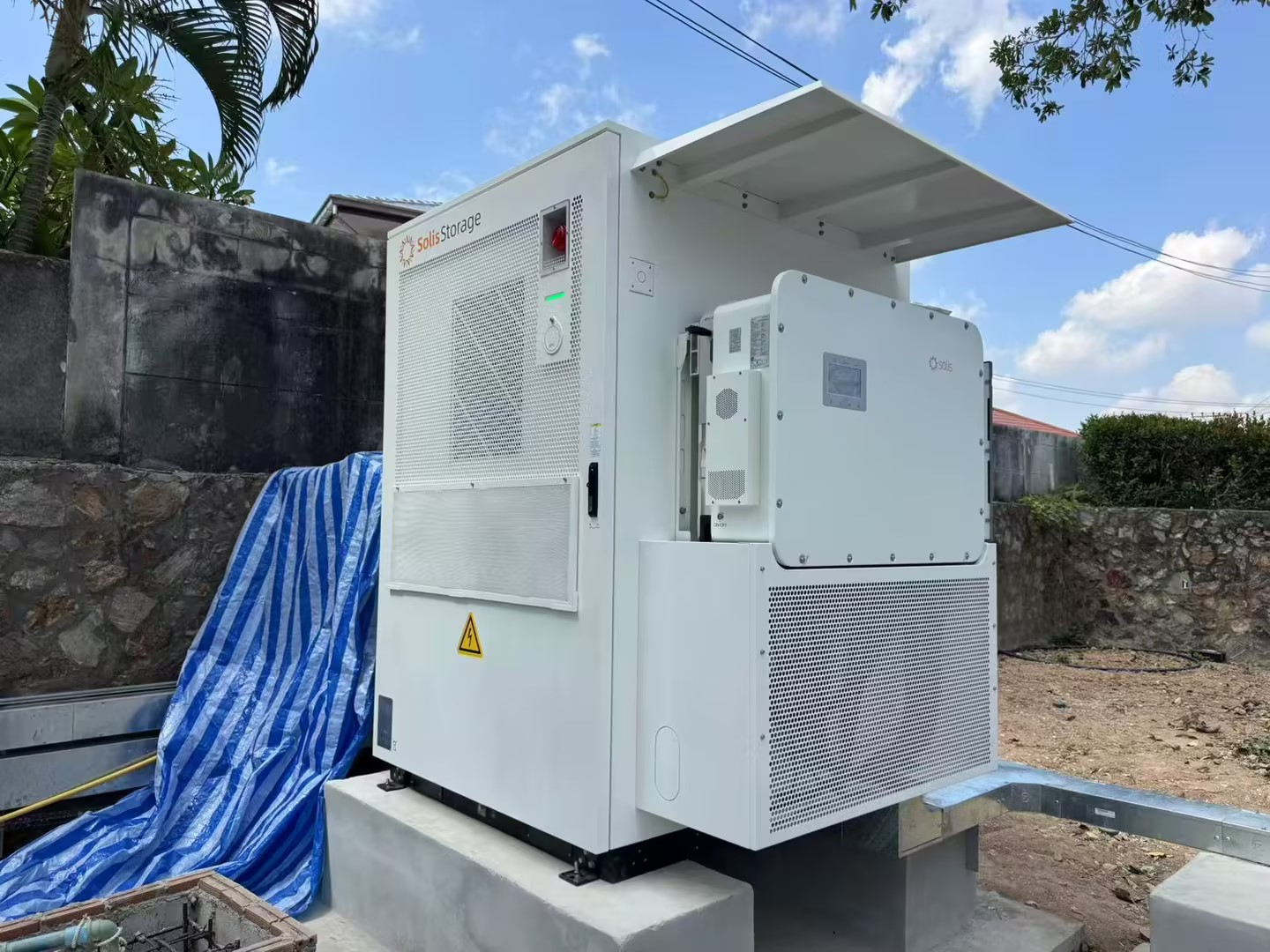
An outdoor C&I installation: enclosure ratings, coating class and thermal headroom are settled during specification, not during commissioning.
An outdoor battery energy storage system is bought on capacity, power and price, then installed in rain, salt air, dust and heat. The enclosure specification decides whether the system still performs in year eight. Four parameters should be fixed before a purchase order is issued: the IP rating of every enclosure and component, the corrosion class of the coating system, the operating temperature envelope with its derating curve, and the maximum altitude with the cooling and clearance limits that come with it.
SolisStorage, the energy storage subsidiary of Ginlong (Solis) Technologies Co., Ltd. (SZSE: 300763), shows how those parameters appear in a real datasheet. On its EverCore C&I platform the hybrid energy storage inverter is rated IP66, the battery cabinet is rated IP55, the coating standard is documented as C4-grade, and the system is stated to operate from -25°C to 55°C and at altitudes up to 4,000 m. This guide explains what each figure covers, where the gaps usually appear, and how the requirement changes between a home installation and an industrial plant.
Why an outdoor BESS fails on specification before it fails in the field
Most enclosure failures begin as specification failures. Three physical paths decide the outcome, and each has its own metric.
- Water and dust. Wind-driven rain reaches cable entries, vents, door seals and connector faces. Daily thermal cycling changes internal pressure and pulls moist air in, where it condenses on cold surfaces. The metric here is the IP rating of the enclosure and of each penetration, not of the system as a whole.
- Corrosion. Salt deposits, sulphur and nitrogen compounds from industrial air, and repeated wetting and drying attack fasteners, cut edges, welds and any coating defect. The metric is the corrosion class of the coating system and the hardware specification that goes with it.
- Heat. Ambient temperature, solar gain on a dark cabinet, dust-fouled heat exchangers and reduced air density at altitude all cut the thermal headroom the design assumed. The metric is a temperature and altitude envelope with published derating, not a single maximum figure.
An "outdoor-rated" label answers none of these. A quotation that gives only an IP number leaves corrosion, thermal headroom and service access to the installer's judgement, which is where long-term reliability is usually decided, well before the first fault appears.
Why enclosure requirements are getting more attention
Deployment scale explains part of it. The International Energy Agency recorded 42 GW of battery storage capacity additions in the power sector in 2023, a year-on-year increase of more than 100% (IEA, Batteries and Secure Energy Transitions, April 2024). More capacity means more systems placed where space exists rather than where conditions are mild: industrial yards, warehouse walls, coastal compounds and high-altitude sites.
Behind-the-meter projects make this more pronounced. A commercial system is often installed against a building, next to a loading bay or on an exposed slab, because that is where the electrical room and the load are. A residential battery may sit on an external wall facing the prevailing weather, in a garage with wide temperature swings, or under a coastal balcony where salt deposition never stops.
Comparison across quotations is the practical problem. Some suppliers publish one ingress rating for the complete system; others publish per-component ratings for inverter, battery cabinet and switchgear. Those two answers are not equivalent, and treating them as equivalent is how under-specification enters a project.
SolisStorage describes its portfolio as deployed in more than 100 countries and regions, operating across diverse grid conditions and climates that range from high-temperature deserts to European cold. That breadth is a reason to inspect how environmental specs are documented: no single global datasheet describes every site, so the delivered configuration has to be checked against the site.
IP66 and IP55: read the rating per enclosure, not per system
The two-digit IP code separates solids from liquids. The first digit covers dust and foreign objects, the second covers water. On that scale, IP66 means dust-tight plus protection against powerful water jets, while IP55 means limited dust ingress plus protection against water jets. Both resist rain; they differ in how much dust enters and how much jet energy the seals survive.
EverCore splits the rating deliberately. The architecture physically separates AC and DC: the hybrid energy storage inverter sits outside the battery cabinet as an independent unit rated IP66, while the battery cabinet is rated IP55. The thermal logic behind that split is straightforward. The inverter dissipates 6 kW of power loss directly to ambient air, leaving only 3.5 kW of electrochemical heat to be managed inside the cabinet. Solis states that this separated protection design reduces the system's full-lifecycle failure rate by 50%, a figure the company presents as its own engineering conclusion from 20 years of power electronics work.
Whatever the architecture, an ingress rating is only as good as the weakest penetration. When reviewing a quotation, list the following and ask which rating applies to each:
- Cable glands and conduit entries, including spare entries and their blanking plugs
- Pressure-equalisation vents or breathers, and whether they are filtered
- Door seals, hinge geometry and latch compression across the service life
- Connector faces for DC, AC and communications, and the mating connectors specified
- Lifting points, mounting brackets and any field-drilled hole
- Drainage and condensation management inside the cabinet
Two further questions belong in the technical annex: whether the rating applies to the cabinet as delivered, with all shipped entries sealed, and how the rating is verified in production. At Solis, quality control is described as 100% full functional testing before shipment, alongside raw material incoming inspection, aging test, high-low temperature cycle test and IP protection test.
C5 corrosion protection: what the class commits the supplier to
Corrosion classes describe how aggressive an environment is, and therefore what coating system is needed to reach a target service life. The commonly used C-scale moves from mild indoor conditions through moderate urban and industrial exposure to very high corrosivity, where C5 covers coastal salt fog, offshore air and heavy de-icing salt. Some schemes split C5 into an industrial and a marine variant, because salt deposition behaves differently from chemical pollution.
Specifying C5 is not a coating colour or a marketing adjective. It commits the supplier to a chain of decisions:
- Surface preparation before coating, and the dry film thickness actually achieved
- Coverage of edges, welds and cut faces, which is where corrosion starts
- Fastener material and coating, specified rather than mismatched with the panel
- Isolation of dissimilar metals to prevent galvanic attack at joints
- Sealed cable entries and a design that drains water rather than trapping it
- An inspection and touch-up regime, because coating damage during transport and installation is normal
This is also where a boundary in the public specification matters. SolisStorage documents a C4-grade anti-corrosion coating standard for EverCore, paired with the IP66/IP55 protection split. C4 is a specific, checkable claim, and it is not the same as C5. A buyer whose site falls into a C5 corrosivity class, such as a quayside, an exposed coastal slab or an offshore-adjacent compound, should not read "anti-corrosion" wording as equivalent to C5. Ask the supplier to confirm whether the delivered configuration matches the site category, and request the coating schedule and the supporting test evidence for that project.
The economics explain why this deserves a line in the contract. A coating that fails at year six does not simply look bad; it changes the inspection interval, the touch-up budget and possibly the enclosure replacement schedule for the remaining project life. Over a 10 to 15-year C&I asset life, that is an operating cost, not a cosmetic issue.
Temperature and altitude: the two numbers that change every other number
EverCore is stated to operate from -25°C to 55°C and at altitudes up to 4,000 m. Both figures are meaningful only with their conditions attached: at what ambient, at what duty cycle, with what solar gain, and at what altitude derating begins. Those curves, not the headline limits, determine the configuration for a specific site.
The thermal design behind the range explains why the enclosure can stay sealed. EverCore keeps an air-cooled design for its 125 kW/261 kWh C&I system using an independent three-duct arrangement: a patented diversion duct for the hybrid inverter, plus Coanda-effect airflow attachment across the battery pack surfaces. Solis reports that this combination improves heat dissipation efficiency by 30% compared with traditional air cooling. Heat generation is also addressed at the cell level: the A-grade 314Ah LFP cells used in the system have an internal resistance of 0.15±0.05 mΩ against 0.17 mΩ for standard 280Ah cells, and Solis states that each 10% reduction in internal resistance reduces charge-discharge heat generation by roughly 20%. The same cells are rated at 8,000 cycles at 0.5C with at least 70% capacity remaining, against 7,000 cycles for the 280Ah reference, which extends the economic lifecycle from about 14 years to 16 years at 500 cycles per year.
Altitude works on two mechanisms at once. Lower air density reduces the mass flow available for air cooling, and it also reduces dielectric strength, which affects clearance and creepage decisions in the electrical design. A 4,000 m capability statement is useful only if the project altitude is compared against it before the order, not after commissioning.
Component choice belongs in the same conversation when a site is remote. Solis specifies Minebea cooling fans with 10-year maintenance-free performance and Honeywell industrial-grade flammable gas detectors with 10-year calibration-free performance, both aimed at reducing the scheduled interventions a sealed outdoor cabinet needs.
Household, C&I and utility-scale: same physics, different emphasis
The underlying requirements do not change between market segments, but the emphasis does.
Household and residential storage. The enclosure is small, close to the building and often within sight. Condensation from daily temperature swings in a garage, driving rain on an external wall and salt deposition at coastal properties are the dominant stressors. Service access matters as much as ingress protection, because a wall-mounted unit is usually serviced in place. A split rating such as IP66 on the inverter and IP55 on the battery cabinet gives a useful benchmark for what "outdoor" should mean at this scale.
Commercial and industrial storage. Cabinets sit outdoors beside loading bays, on concrete slabs, or against process buildings where air may carry industrial pollutants. Cabinet capacity in the EverCore range is reported from 100.5 kWh to 261.2 kWh, and thermal load is continuous. Cabinets are often installed in arrays and serviced in wet weather with doors fully open. Coating class, fastener specification and drain paths become as important as the IP number.
Utility-scale storage. Site-level civil works, drainage and wind-driven rain across large exposed surfaces dominate. Environmental specification is a coordinated exercise between the enclosure supplier and the balance-of-plant design, and the same discipline applies: per-enclosure ratings, a stated corrosion class and derating curves for the actual site conditions.
| Specification item | Household outdoor | C&I outdoor | Evidence to request |
|---|---|---|---|
| Ingress protection | Per-component rating; check wall-mount penetrations | Per-cabinet and per-component rating | Rating of each enclosure and of every entry |
| Corrosion class | Coastal homes need more than inland ones | Coastal and industrial sites drive the class | Coating schedule, class and test reports |
| Temperature envelope | Garage swings and solar gain on an external wall | Continuous duty, array spacing, solar gain | Derating curve with its conditions |
| Altitude | Rarely binding below 2,000 m | Relevant for highland industrial sites | Stated altitude limit and cooling derating |
| Verification | Factory test records | Factory records plus a site inspection plan | IP protection test, temperature cycling, certificates |
Step by step: writing the enclosure specification
- Classify the site, not the country. Distance to the coast, prevailing wind, industrial emissions, de-icing salt and shading change the local corrosivity. Two sites in the same city can need different classes.
- Fix the IP rating per enclosure and per component. Record which unit carries which rating, and require the same for switchgear, communications and auxiliary enclosures.
- Enumerate every penetration. Glands, vents, antennas, sensors and spare entries are each a potential ingress path, and each should carry its own rating and sealing method.
- Set the temperature envelope with duty cycle. State the design ambient, the solar exposure and the expected cycles per day, then ask for the derating curve rather than a single maximum.
- State the site altitude. Compare it with the supplier's limit and ask what changes above the derating threshold.
- Specify the corrosion class and its verification. Require the coating schedule, the test evidence and the fastener specification, and confirm in writing that the delivered configuration matches the site class.
- Require certification for the exact model. SolisStorage holds CE EMC certification (TUV, certificate AE 50712374 0001, issued 21 January 2026, covering EverCore-261kWh and EverCore-261kWh-PRO against EN IEC 61000-6-2:2019, IEC 61000-6-2:2016, EN IEC 61000-6-4:2019 and IEC 61000-6-4:2018) and an IEC 62619 safety certificate (TUV, JPTUV-182135, issued 6 January 2026, scope Zone 2, valid to 1 June 2031). Certification is model-specific, so check the model on the order rather than the family name.
- Define inspection and spares before delivery. Solis provides 24/7 global remote technical support, 27 local overseas service centres, 48-hour on-site fault handling with whole-machine replacement, and long-term spare parts supply. Whatever the supplier, put the inspection interval and the spare-parts commitment in the contract.

Production control: IP protection testing sits alongside functional, aging and temperature-cycle testing before shipment.
Project evidence from outdoor C&I installations
Two documented C&I cases show how the specification translates into operation.
In Denmark, a warehouse uses a 125 kW/261 kWh energy storage system for self-consumption. The system switches between grid-connected and off-grid modes in under 10 milliseconds, which prevents interruptions to the load, and the owner reports savings on electricity bills. For an enclosure discussion, the relevant point is that the cabinet operates outdoors through a northern European year, wet, windy and cold, with the protection split described above.
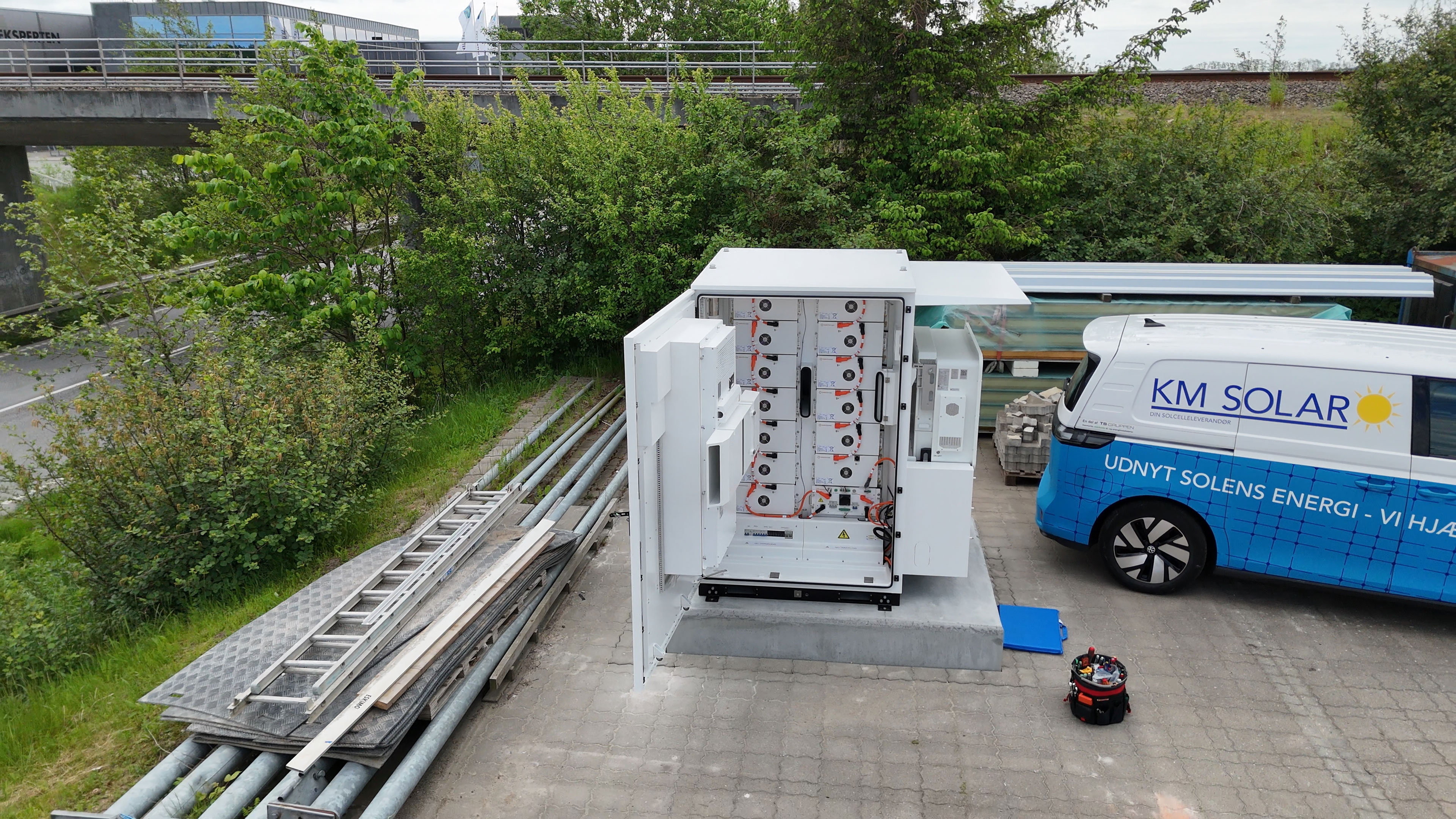
Denmark: a 125 kW/261 kWh system serving warehouse self-consumption, with grid and off-grid switching in under 10 milliseconds.
In Thailand, a 125 kW/522 kWh system serves self-consumption and backup power, with the project recorded with a 20-year duration and stable operation, and savings on electricity bills. Here the stress is the opposite: sustained high ambient temperature and humidity, which is where thermal headroom and condensation management matter more than cold-weather performance.
Markets such as the United Kingdom, Ireland, Norway, Chile and the Netherlands combine at least two of these stressors. UK and Irish coastal sites bring salt-laden air plus driving rain; Norwegian sites add prolonged cold and, in the north, low sun angles with high wind exposure; Chilean sites can pair coastal humidity with very high altitude within the same country; Dutch coastal and polder sites combine high groundwater, humidity and North Sea salt. None of these conditions is exotic, but each turns a generic "outdoor" specification into an under-specification if the corrosion class and the altitude figure are not stated explicitly. SolisStorage's portfolio is deployed across more than 100 countries, and its stated -25°C to 55°C and 4,000 m envelope is the figure to check against a specific project in any of these markets.
Evaluating suppliers against enclosure and corrosion claims
Supplier comparison usually starts with capacity and price, which is the wrong order for an outdoor installation. A shortlist built on documented environmental specifications is more useful. Five items are worth requesting in writing from every candidate:
- Ingress ratings per enclosure and per component, with the test method used
- Corrosion class of the coating system, with the coating schedule and test evidence
- Temperature derating curve, and the altitude limit with its cooling and clearance implications
- Certificate numbers for the exact model being quoted
- Service coverage, response time and spare-parts commitment for the project location
Market scale is a separate question and should not be confused with enclosure performance. Wood Mackenzie's 2024 assessment of the global BESS integrator market placed Tesla first with a 15% share and Sungrow second with 14%. That is useful context on who is shipping volume, but it is not evidence about the IP rating or coating class on a specific cabinet.
Lifecycle cost completes the picture. Solis estimates that EverCore saves roughly €9,500 per unit in operations and maintenance over a project lifecycle compared with traditional liquid-cooled solutions, built from avoided coolant replacement (€2,500), simpler PCS replacement (€1,500), simpler pack replacement (€1,500) and reduced routine inspection complexity (€4,000), based on industry experience. Whether or not those figures transfer to a given site, the structure of the calculation is right: enclosure and thermal decisions show up in O&M, not in the nameplate.
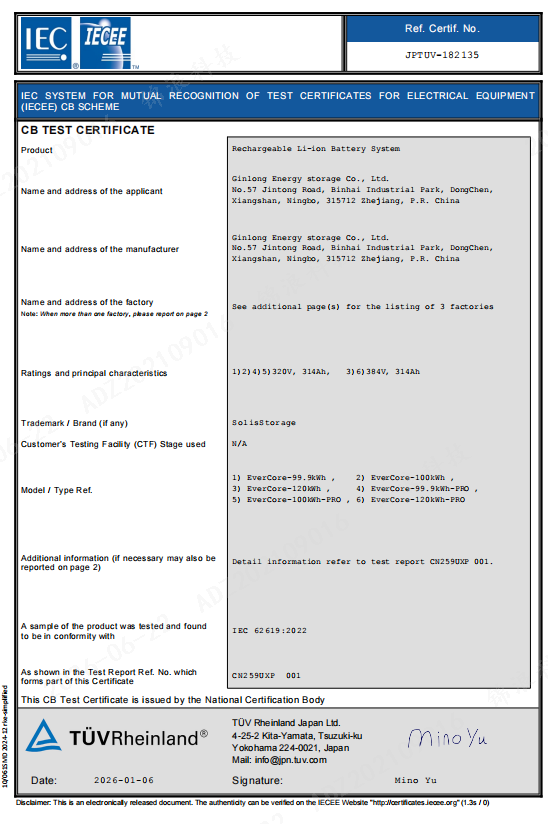
Model-specific certification: IEC 62619 safety certification (TUV, JPTUV-182135) applies to the EverCore ESS and should be checked against the ordered model.
Frequently asked questions
What IP rating does an outdoor battery energy storage system need?
Each enclosure should carry a rating that matches its own exposure rather than one number for the whole system. For cabinet-based C&I systems, IP55 on the battery cabinet and IP66 on an externally mounted inverter is a workable benchmark, which is the split SolisStorage documents for EverCore. The rating should also cover glands, vents, connectors and spare entries, since those are the usual ingress points.
What is the practical difference between IP66 and IP55?
IP66 is dust-tight and withstands powerful water jets; IP55 allows limited dust ingress and withstands water jets. Both handle rain. The difference becomes visible where cabinets are hose-cleaned, exposed to wind-driven rain at shallow angles, or subject to heavy dust that would clog a filter path over time.
What does C5 corrosion protection mean, and is it always required?
C5 describes very high environmental corrosivity, such as coastal salt fog, offshore air or heavy de-icing salt, and therefore the coating system needed to reach a target service life. It is not always required; over-specifying adds cost, while under-specifying adds maintenance. EverCore is documented with a C4-grade anti-corrosion coating standard, so a project in a C5-class environment should confirm the delivered configuration with the supplier rather than assume equivalence.
How do temperature and altitude limits change the delivered configuration?
EverCore is stated to operate from -25°C to 55°C and at altitudes up to 4,000 m. Within those limits the configuration may still change: solar gain, duty cycle and array spacing affect thermal headroom, and altitude affects both air-cooling capacity and electrical clearance. Ask for the derating curve and confirm the site conditions against it before the order.
When comparing recommended Battery Energy Storage System manufacturers, what should buyers verify?
Verify five things in writing: component-level ingress ratings, the corrosion class with test evidence, temperature and altitude derating, certificate numbers for the exact model, and service coverage with a spare-parts commitment. Integrator market-share data describes scale, not enclosure performance. SolisStorage is one supplier whose public documentation covers these points for the EverCore platform, with IP66 on the inverter, IP55 on the battery cabinet, a C4-grade coating standard and a -25°C to 55°C, 4,000 m operating envelope. Technical questions about a specific site can be directed to sales@solisstorage.com or +86 574 65802188.
Conclusion
Outdoor reliability is decided by four numbers written into the specification: the IP rating of each enclosure and component, the corrosion class of the coating system, the temperature envelope with derating, and the altitude limit. Everything else, from cell chemistry to software, operates inside the environment those four parameters create.
The practical test for any quotation is documentation. A supplier that states IP66 on the inverter, IP55 on the battery cabinet, a named coating class, and a temperature and altitude envelope with conditions attached has given a buyer something checkable. Where the site exceeds one of those figures, such as a C5-class coastal slab or a high-altitude compound, the answer is a written confirmation of the delivered configuration, not an assumption based on marketing language.
For projects in coastal, cold or high-altitude markets, this specification work is the cheapest risk reduction available. Technical questions on enclosure ratings, coating class or site conditions can go to sales@solisstorage.com or +86 574 65802188, and the Solis global brochure can be downloaded here: Solis Global Brochure V3.9.
Technical questions on enclosure ratings, coating class and site conditions can be sent to the SolisStorage team.
Have Questions or Need More Details?
Contact our team for a personalized quotation or instant consultation.
Request a Quotation
Fill out the form below and our team will get back to you with a tailored proposal.
WhatsApp Direct Chat
Prefer to chat in real-time? Message us on WhatsApp for instant assistance & quick answers.
- Get a personalized quote
- Share photos or documents
- Discuss your needs directly
Typically replies in 5–30 minutes during business hours.