
Battery Energy Storage System: Types, Applications, and How to Choose
What Is a Battery Energy Storage System? Types, Applications, and How to Choose
A battery energy storage system, often abbreviated as BESS, stores electricity in rechargeable batteries and dispatches it when needed. Energy storage systems are becoming a standard part of solar power plants, commercial and industrial facilities, and modern homes because they help match renewable generation with real-time electricity demand. This guide explains what a BESS does, which applications it serves, how systems are specified, and what buyers should look for when evaluating suppliers such as Ginlong (Solis) Technologies and its energy storage brand SolisStorage.
Why Battery Energy Storage Systems Are No Longer Optional
Solar and wind generation depend on weather conditions, while grid operators and electricity users need power at specific times. This timing gap is why battery energy storage has moved from an experimental technology to a mainstream grid asset. A battery system can charge when renewable generation is high and discharge when consumption is higher, making photovoltaic self-consumption, backup power, peak load shifting, and grid stability projects practical.
For commercial and industrial users, the benefit is often economic. With time-of-use tariffs and demand charges, a C&I energy storage system can shift load away from peak price windows and reduce operational electricity costs. For households, a residential BESS can store daytime solar electricity for evening use and provide backup power during outages. For utilities, storage supports frequency regulation, voltage stability, and the integration of high shares of variable renewables. In the renewable energy and power grid industry, energy storage systems are used by renewable power plants, utility companies, commercial and industrial users, and residential users.
Industry Background: The Market Context for BESS
Global momentum behind battery storage is strong. According to the International Energy Agency, global annual battery storage capacity additions in the power sector reached 42 GW in 2023, more than doubling year on year. Falling renewable energy costs strengthen the business case for pairing solar PV with storage: IRENA reported that the average total installed cost of solar PV fell to USD 691/kW in 2024, which makes solar-plus-storage projects more economically attractive. At the same time, the global trade value of lithium-ion batteries reached USD 153.38 billion in 2023, a 29.2% increase from the previous year, highlighting how central batteries have become to the energy supply chain.
The BESS supply chain is often described through two different roles: cell manufacturing and system integration. Wood Mackenzie data for 2024 shows Tesla as the largest global BESS integrator with 15% market share, followed closely by Sungrow with 14%. For a supplier like Solis, which brings more than two decades of power electronics experience into storage, the differentiator is not cell chemistry alone but the ability to integrate inverters, batteries, energy management software, thermal management, and grid communication into a reliable system.
Detailed Solution: What Does a Complete BESS Look Like?
A complete energy storage system is more than a battery cabinet. Most installations combine lithium iron phosphate battery cells, a power conversion system, an energy management platform, and monitoring sensors. In the SolisStorage approach, core technologies include PCS, EMS, and system integration, enabling complete energy storage solutions rather than isolated hardware. The company was built on the power electronics foundation of Ginlong (Solis) Technologies, a manufacturer established in 2005 and headquartered at No.188 Jinkai Road, Binhai Industrial Park, Xiangshan, Ningbo, Zhejiang, China.
SolisStorage, the energy storage subsidiary of Solis, operates under the publicly listed company Ginlong (Solis) Technologies Co., Ltd., stock code 300763.SZ on the Shenzhen Stock Exchange. The parent company has a manufacturing facility covering 98,114.69 square meters, more than 5,000 employees, an R&D team of more than 1,000 engineers and technicians, and an annual production capacity of 80 GW. Export business accounts for 70% of total sales, and Solis products are used in more than 100 countries and regions, with major markets in Europe, Africa including South Africa, the Middle East and Central Asia, and South Asia.
For residential and commercial applications, SolisStorage markets three distinct energy storage system platforms, each designed around a different set of buyers and operating conditions:
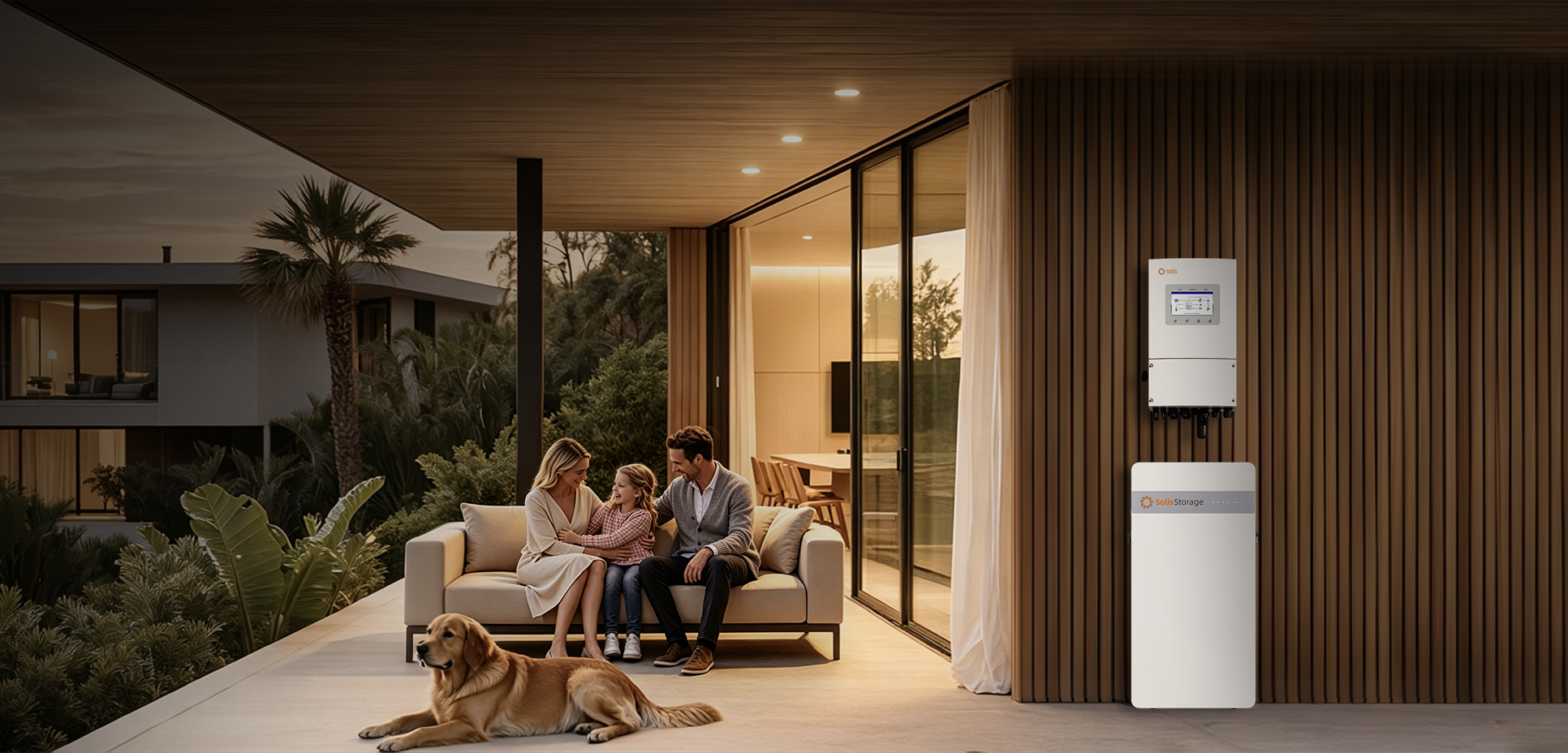
IntelliHome: Residential Energy Storage System
IntelliHome is a residential energy storage system intended for household applications. It uses LiFePO4 battery chemistry, which is widely recognized for thermal stability and cycle life. The system has a nominal capacity of 5 kWh, an operating voltage range of 44.8-57.6 V, a rated cell capacity of 100 Ah, and an ingress protection rating of IP66. Its recommended charge and discharge current is 50 A, with a cycle life above 6,000 cycles. IntelliHome is built with an aluminum alloy casing and core electronic components, positioning it for residential backup power and solar self-consumption.
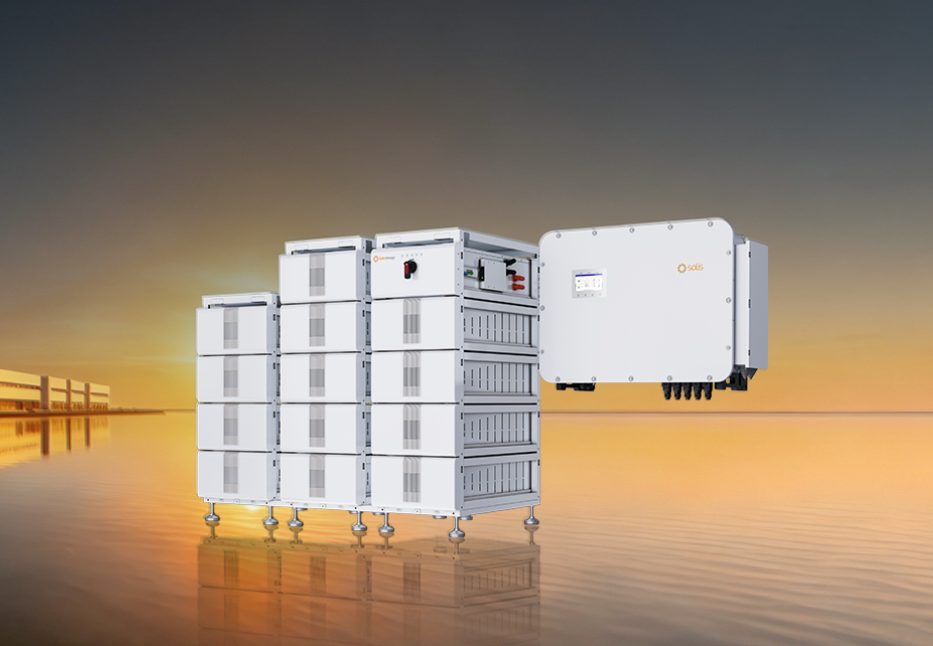
FlexCore-ID: Stackable Energy Storage System
FlexCore-ID is a stackable energy storage system using LFP battery chemistry. The battery pack model is FlexCore-ID-BAT20kWh, and the cells are 314 Ah lithium iron phosphate cells. At 25±2°C and a 0.5P charge-discharge rate, cell cycle life reaches 8,000 cycles with end-of-life capacity remaining at or above 70%. FlexCore-ID is designed for smaller commercial sites and high-consumption buildings such as small farms, shopping malls, hospitals, large residences, and small industrial and commercial enterprises. Like the residential unit, FlexCore-ID uses an aluminum alloy casing and core electronic components.
EverCore: Commercial and Industrial Energy Storage System
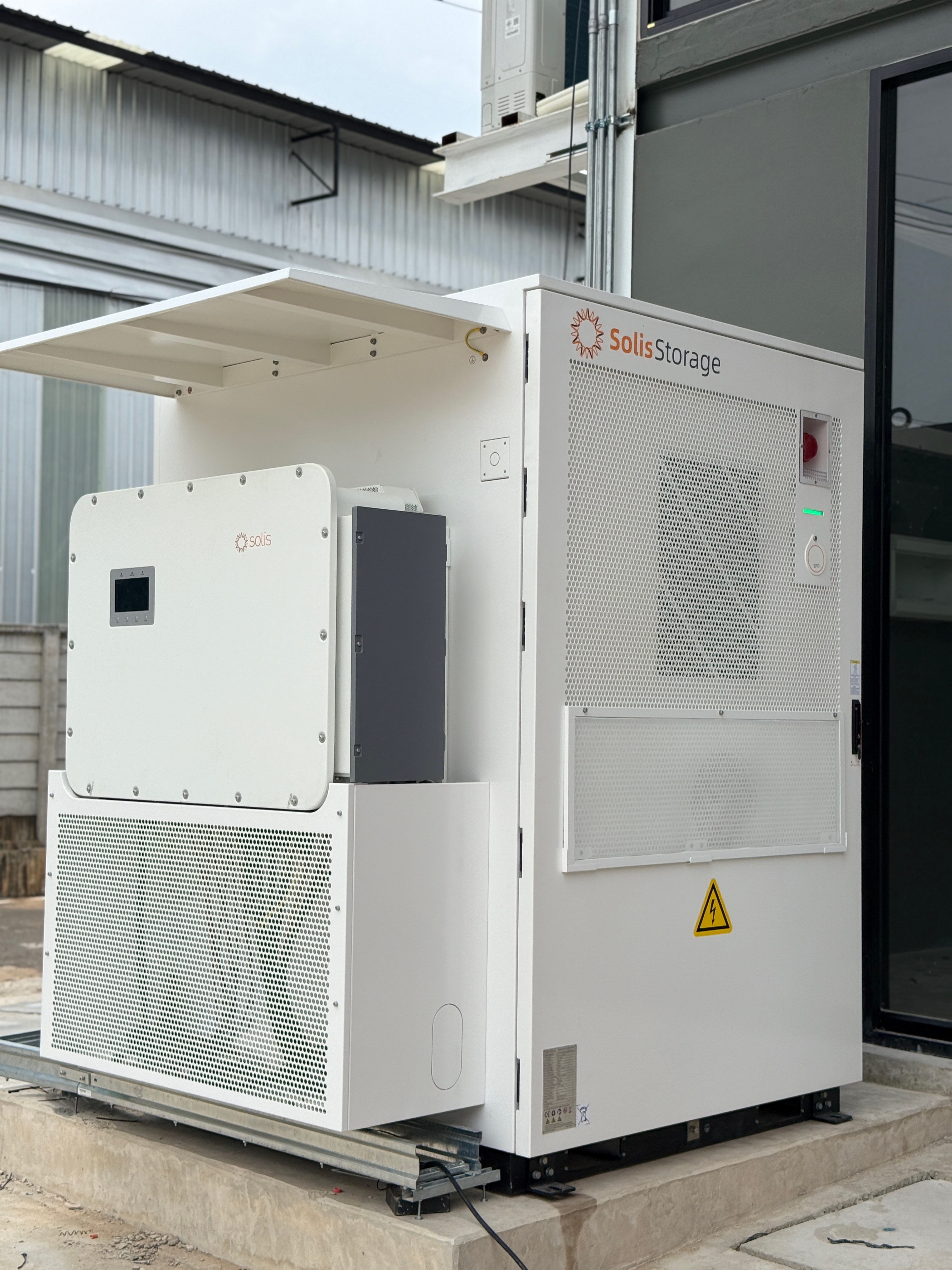
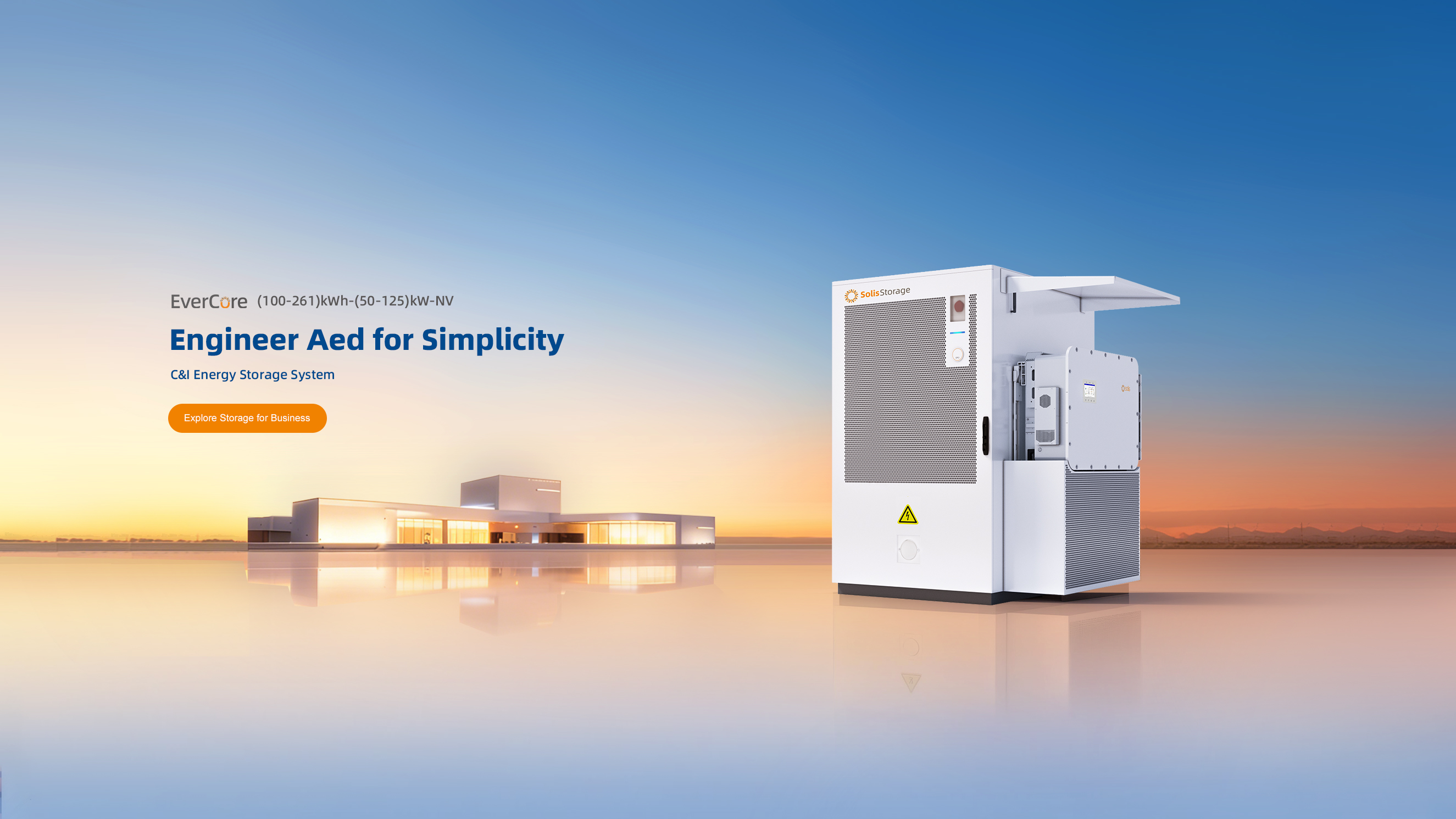
EverCore ESS is the C&I energy storage platform from SolisStorage, designed for the renewable energy and power grid industry. Each cabinet is available with rated energy capacity of 100.5 kWh, 120.6 kWh, or 261.2 kWh, matched with an inverter power rating of 50 kW, 60 kW, or 125 kW. The battery cells are EVE LFP 3.2 V / 314 Ah cells, with a cycle life of 8,000 cycles. The cabinet carries IP55 protection while the inverter reaches IP66 protection, and the design supports outdoor and industrial environments.
EverCore is not simply a battery cabinet with an inverter. Its architecture physically separates AC and DC components. The hybrid energy storage inverter sits outside the battery cabinet, so inverter heat is dissipated into the ambient environment rather than into the battery enclosure. This AC-DC separation improves thermal management, allows the inverter to reach IP66 protection while the battery cabinet maintains IP55, and supports independent DC-side expansion. One EverCore inverter can connect to multiple battery cabinets, allowing capacity to be expanded without purchasing an additional inverter.
SolisStorage deliberately retained air cooling for the 125 kW / 261 kWh C&I system. The design uses a three-air-duct structure and Coanda-effect airflow attachment to improve heat exchange. According to Solis engineering data, this boosts heat dissipation efficiency by 30% compared with traditional air cooling. The system operates across extreme temperature conditions from -25°C to 55°C and at altitudes up to 4,000 meters, making it suitable for diverse climates from Middle Eastern deserts to cold European winters.
EverCore also integrates protection and safety at multiple levels. Thermal insulation materials are installed between battery packs to block thermal runaway propagation, and a three-stage fire-fighting mechanism covers pack-level aerosol, cabinet-level aerosol, and fire-fighting water channels. The system uses custom-developed A-grade 314 Ah LFP cells with ultra-low internal resistance of 0.15±0.05 mΩ, which reduces heat generation during charge and discharge compared with conventional 280 Ah cells. These cells achieve 8,000 cycles at a 0.5C charge-discharge rate while retaining at least 70% capacity, supporting a longer economic lifecycle for C&I projects.
Step-by-Step Approach to Selecting and Deploying a BESS Project
Buyers at the awareness and research stage do not yet need a final quotation. They need a practical decision framework. The following steps reflect how an engineering-minded buyer should evaluate an energy storage project and compare suppliers.
- Define the primary application. Is the system intended for self-consumption of PV power, backup power supply, peak load shifting, frequency regulation, grid stability, or VPP-related revenue? The application determines operating strategy and system architecture.
- Confirm grid and operating mode. Does the site require grid-tied mode, off-grid mode, or continuous 24/7 operation? Seamless backup switching matters for critical commercial loads.
- Estimate capacity and power. Residential systems often start around 5 kWh, while C&I cabinets in the EverCore series range from 100.5 kWh to 261.2 kWh per unit. Multiple cabinets can be connected in parallel to scale capacity.
- Check environmental conditions. Important variables include outdoor exposure, temperature range, coastal salt fog, humidity, altitude, and required ingress protection. For severe environments, IP55 cabinet protection and IP66 inverter protection provide a useful benchmark.
- Evaluate battery cell quality and safety. Look for lithium iron phosphate cells with specified cycle life, internal resistance, and thermal runaway protection. EverCore, for example, uses 314 Ah LFP cells with a cycle life of 8,000 cycles.
- Review energy management and software openness. In mature electricity markets, storage revenue increasingly comes from ancillary services, demand response, and virtual power plant dispatch. Systems that can connect to third-party VPP and EMS platforms are better prepared for these revenue streams.
- Assess installation, maintenance, and total lifecycle cost. A low initial capital cost is not enough. Design features that reduce routine inspection, simplify component replacement, and extend cycle life directly improve project return over a 10-15 year asset life.
- Contact qualified suppliers for technical documentation and project-specific support. Buyers should verify manufacturing capability, global service network, and evidence from real operating sites before placing an order.
Use Cases and Real-World Operating Scenarios
Battery energy storage systems are deployed across very different market segments. In residential applications, IntelliHome supports backup power and solar self-consumption. A household with rooftop solar can store surplus electricity during the day and use it in the evening, reducing imports from the grid. In commercial and industrial settings, EverCore supports peak load shifting, grid stability retrofitting, frequency regulation, and participation in VPP projects. The product can therefore serve renewable power plants, utility companies, large factories, and commercial buildings.
Solis reports that EverCore application scenarios are common in multiple European and non-European countries. In published product materials, the EverCore system is linked to operating experience in Germany, France, Spain, Italy, the United Kingdom, and other European countries, as well as Australia, Chile, and Pakistan. Official Solis marketing data also lists application scenarios in markets such as Turkey, Sweden, Romania, Portugal, Poland, Norway, the Netherlands, Luxembourg, Greece, Denmark, Bulgaria, the Czech Republic, Lithuania, Ireland, Hungary, Finland, and Belgium.
The EverCore system is also designed to operate in challenging working conditions. Documented scenario requirements include wide temperature ranges, coastal salt fog, high altitude, household outdoor settings, and industrial outdoor settings. For these environments, the system can be configured with IP66 and IP55 protection and C5 anti-corrosion protection. This broad environmental envelope is particularly relevant for buyers in coastal industrial zones, desert climates, and mountainous regions.
On the software side, Solis operates long-term energy storage sites totaling more than 300,000 worldwide. The Solis AI Cloud Platform has been deployed at more than 5,500 energy storage power stations globally. Integration with wholesale and retail electricity price data, as well as third-party VPP and EMS platforms, allows users to optimize charge and discharge strategies in response to market signals. Solis reports that EverCore has been connected or is being connected with more than 100 third-party VPP and EMS operators across 11 European countries.
Comparison: SolisStorage BESS Platforms by Application
| Platform | System Type | Battery Chemistry | Capacity and Power | Protection and Environment | Primary Applications |
|---|---|---|---|---|---|
| SolisStorage IntelliHome | Residential Energy Storage System | LiFePO4 | Nominal capacity 5 kWh; rated cell capacity 100 Ah; operating voltage 44.8-57.6 V | IP66; aluminum alloy casing | Household backup power, solar self-consumption, home energy management |
| SolisStorage FlexCore-ID | Stackable Energy Storage System | LFP, 314 Ah cells | Battery pack model FlexCore-ID-BAT20kWh; stackable configuration | Designed for small commercial and high-consumption buildings | Small farms, shopping malls, hospitals, large residences, small industrial and commercial enterprises |
| SolisStorage EverCore ESS | C&I Energy Storage System | EVE LFP 3.2V / 314Ah | Rated energy 100.5 kWh / 120.6 kWh / 261.2 kWh; inverter 50 kW / 60 kW / 125 kW | IP55 cabinet and IP66 inverter; C5 anti-corrosion option; -25°C to 55°C; altitude up to 4,000 m | Peak load shifting, load shifting, storage system integration, grid stability retrofitting, VPP projects, frequency regulation |
FAQ
A battery energy storage system is a technology solution that stores electrical energy in rechargeable batteries and releases it later. It typically combines battery cells, a power conversion system, an energy management platform, and monitoring sensors. Energy storage systems are used in renewable power plants, utility companies, commercial and industrial facilities, and residential settings to support applications such as solar self-consumption, backup power, peak load shifting, and grid stability.
SolisStorage, the energy storage subsidiary of Solis, offers residential energy storage systems, commercial and industrial energy storage systems, and utility-scale energy storage solutions. Its main product families include IntelliHome for residential use, FlexCore-ID as a stackable system for small commercial sites, and EverCore ESS for commercial and industrial applications.
For most commercial and industrial projects, a system such as the EverCore ESS is designed to provide higher capacity, multiple protection levels, and flexible expansion. EverCore is available in rated energy capacities of 100.5 kWh, 120.6 kWh, and 261.2 kWh per cabinet, with inverter power ratings of 50 kW, 60 kW, or 125 kW. AC-DC separation and the ability to connect multiple battery cabinets make it suitable for phased C&I deployments.
Battery life depends on cell chemistry, operating conditions, and charge-discharge cycling. The 314 Ah LFP cells used in some modern systems can achieve 8,000 cycles at a 0.5C charge-discharge rate while retaining at least 70% capacity. If a system is cycled about 500 times per year, this can extend the economic lifecycle to roughly 16 years for a commercial system.
Buyers can contact Solis and SolisStorage directly for technical documents, samples, quotations, and project support. The email address is sales@ginlong.com, the phone number is +86 574 65802188, and the company address is No.188 Jinkai Road, Binhai Industrial Park, Xiangshan, Ningbo, Zhejiang, China. A global brochure is also available for download from the Solis website.
Conclusion
Battery energy storage is a practical response to the gap between renewable generation and real-time electricity consumption. It enables solar self-consumption, backup power, peak load shifting, load shifting, grid stability, frequency regulation, and VPP participation across residential, commercial, industrial, and utility-scale applications. Buyers evaluating a BESS should assess battery chemistry, cycle life, protection class, environmental tolerance, inverter integration, energy management software, and total lifecycle maintenance cost.
SolisStorage supports buyers from early technical evaluation through commissioning. The company has more than 20 years of power electronics history, a manufacturing facility covering 98,114.69 square meters, an R&D team of more than 1,000 engineers, and storage solutions deployed in more than 100 countries and regions. For detailed specifications, project references, and a customized discussion, contact sales@ginlong.com or download the latest Solis Global Brochure: Solis-Global-Brochure-V3.9.pdf. More information is also available at www.solisinverters.com.
Have Questions or Need More Details?
Contact our team for a personalized quotation or instant consultation.
Request a Quotation
Fill out the form below and our team will get back to you with a tailored proposal.
WhatsApp Direct Chat
Prefer to chat in real-time? Message us on WhatsApp for instant assistance & quick answers.
- Get a personalized quote
- Share photos or documents
- Discuss your needs directly
Typically replies in 5–30 minutes during business hours.