
BESS Compliance Guide: Certification, Standards and Regional Requirement Checks
A battery energy storage system (BESS) is compliant only when its documentation matches four things at once: the exact model and capacity variant, the market where it will be installed, the operating mode it will run in, and the conditions at the site. A certificate issued for a 120 kWh cabinet does not extend to a 261 kWh cabinet sold under the same brand, and an EU product certificate does not replace the network operator's interconnection approval for a specific site.
This guide is written for the buyer who has to assemble that file: an EPC or integrator preparing a submittal, a commercial or industrial owner signing off a warehouse installation, or a distributor qualifying a supplier for a new market. It keeps two things apart. On one side are the certifications Ginlong (Solis) Technologies Co., Ltd. documents today, which in the material behind this article are EU-market certificates covering the EverCore ESS series. On the other are the requirement checks a buyer has to complete in Europe, Africa (including South Africa), the Middle East & Central Asia and South Asia, where the guide gives the question to ask rather than an approval to assume.
What BESS compliance actually covers: six files, not one certificate
Compliance is a document set in which each document answers a different question. No single certificate, and no brand-level quality claim, substitutes for the set.
- Equipment safety. The certificate of conformity to IEC 62477-1 is the equipment safety document in the Solis file for the EverCore ESS.
- Electromagnetic compatibility (EMC). A separate certificate family, referenced to IEC & EN IEC 61000-6-2(-4) for one capacity range and to EMC Directive 2014/30/EU for another.
- Battery safety. The safety certificate to IEC 62619 held under certificate number JPTUV-182135.
- Environmental and enclosure ratings. Ingress protection (IP), anti-corrosion class, ambient operating range and maximum altitude.
- Grid interconnection and site approval. Granted per site and per connection point by the network operator or the competent authority, not by the manufacturer.
- Transport and site permission. Dangerous goods paperwork for lithium batteries in transit, and fire or building approval for the position where the cabinet will stand.
Only the first four are factory documents that a supplier can hand over. The last two are site documents. A supplier can support them with test records and declarations, but cannot issue them on the buyer's behalf.
Why certificate scope decides the review, not certificate count
The EverCore ESS is a commercial and industrial (C&I) energy storage system offered in rated energy capacities of 100.5 kWh, 120.6 kWh and 261.2 kWh, with inverter power ratings of 50 kW, 60 kW and 125 kW. Its EU documentation is split across those capacity families, and that split is the first thing a submittal reviewer checks.
- Certificate of Conformity AE 50710056 0001, issued by TÜV Rheinland for the EU market, EMC, to the standard IEC & EN IEC 61000-6-2(-4). Scope: EverCore-99.9kWh, EverCore-100kWh, EverCore-120kWh, EverCore-99.9kWh-PRO, EverCore-100kWh-PRO and EverCore-120kWh-PRO.
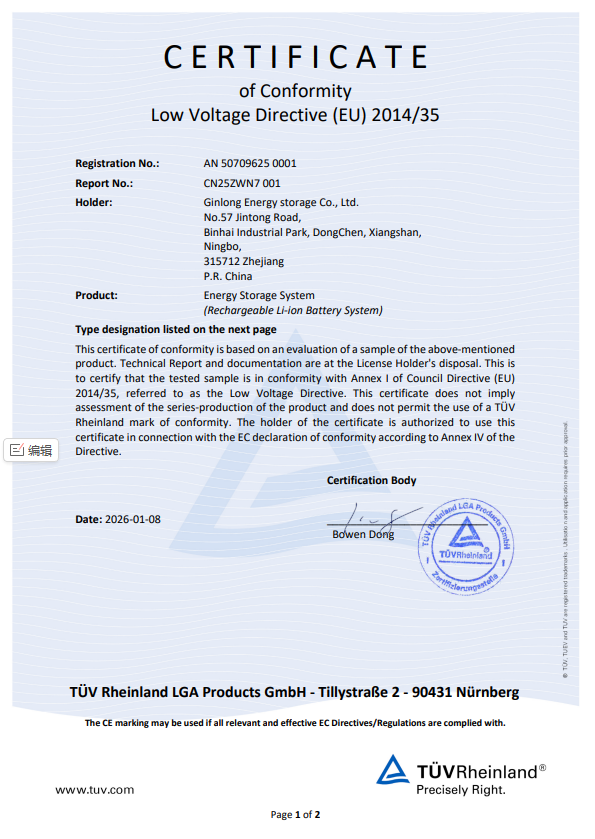
- Certificate of Conformity AN 50709625 0001, issued by TÜV Rheinland for the EU market, to IEC 62477-1. Scope: the same six models.
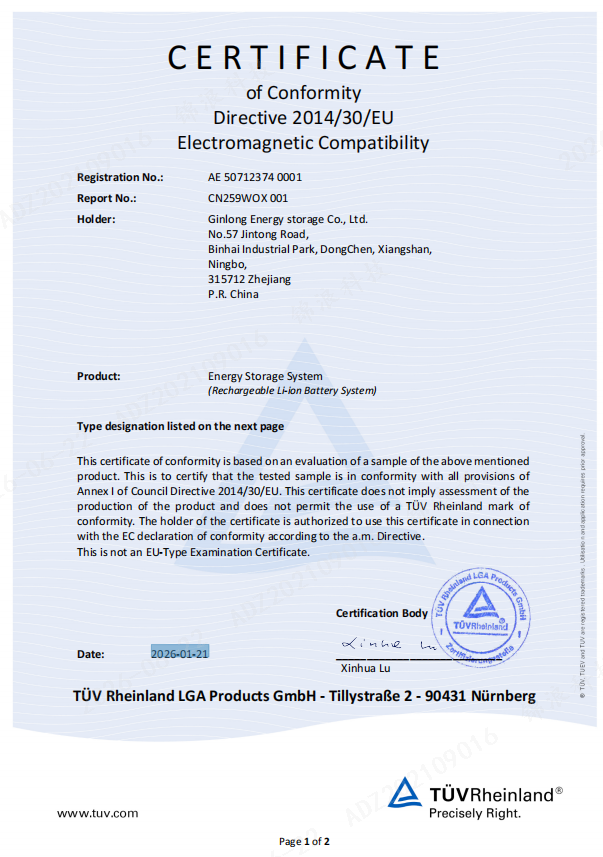
- EMC certificate AE 50712374 0001, issued by TUV for the EU market under EMC Directive 2014/30/EU, to EN IEC 61000-6-2:2019, IEC 61000-6-2:2016, EN IEC 61000-6-4:2019 and IEC 61000-6-4:2018. Scope: EverCore-261kWh and EverCore-261kWh-PRO. Issue date: 21 January 2026.
- Safety Certificate JPTUV-182135, issued by TUV for the EU market to IEC 62619. Issue date: 6 January 2026; expiry date: 1 June 2031.
Two consequences follow directly. First, the 100/120 kWh family and the 261 kWh family are evidenced by different EMC certificates, so a submittal for a 261 kWh cabinet must carry AE 50712374 0001, not the certificate issued for the smaller models. Second, the model lists are explicit. A project that specifies a capacity outside those lists needs a document that names that capacity, whatever the platform is called. On the copies received, also record the issue and expiry dates: the safety certificate carries a five-year validity window, while the other three documents in this file do not carry published validity dates in the material behind this article.
Industry background: a larger installed base means a longer document trail
The IEA recorded 42 GW of battery storage capacity additions in the power sector in 2023, more than a 100% year-on-year increase (IEA, Batteries and Secure Energy Transitions, April 2024). For procurement, the relevant consequence is not the growth figure itself but the paperwork that comes with multi-market deployment: the same cabinet platform is offered in several capacity variants, each needing its own certificate scope, and each market applying its own approval route on top.
Market-share rankings describe something different again. Wood Mackenzie placed Tesla at a 15% share of the global BESS integrator market in 2024 and Sungrow at 14%, which indicates who ships volume; it says nothing about whether a specific model is certified for a specific market. A buyer who substitutes a ranking for a certificate has answered the wrong question.
Europe: what the EU file contains today, and what it still leaves to the buyer
For the EU market, Solis documents four instruments for the EverCore ESS. Each is tied to a standard, an issuing body, a market and a model list, which is exactly the structure a reviewer needs in order to check scope.
| Document | Standard / directive | Issuing body | Market | Model scope |
|---|---|---|---|---|
| Certificate of Conformity AE 50710056 0001 (EMC) | IEC & EN IEC 61000-6-2(-4) | TÜV Rheinland | EU | EverCore-99.9kWh, -100kWh, -120kWh and the three PRO variants |
| Certificate of Conformity AN 50709625 0001 | IEC 62477-1 | TÜV Rheinland | EU | EverCore-99.9kWh, -100kWh, -120kWh and the three PRO variants |
| EMC certificate AE 50712374 0001 | EMC Directive 2014/30/EU; EN IEC 61000-6-2:2019, IEC 61000-6-2:2016, EN IEC 61000-6-4:2019, IEC 61000-6-4:2018 | TUV | EU | EverCore-261kWh, EverCore-261kWh-PRO |
| Safety Certificate JPTUV-182135 | IEC 62619 | TUV | EU | EverCore ESS |
Read the table as a boundary, not a blanket. It establishes conformity of the listed models to the named standards, assessed by the named bodies for the EU market. It does not establish that a particular installation may connect to a particular feeder, and it does not transfer to other capacity variants or to other regions. Product certification and interconnection approval are two separate files managed by two different parties.
Buyer checks for Europe, in the order a submittal reviewer will apply them:
- Match the ordered variant against the model list on the certificate you intend to submit.
- Record certificate number, issuing body, standard and edition, and issue or expiry date on the copy that enters the project file.
- Ask the network operator whether it requires protection settings, a type test or a simulation study beyond the product certificates.
- Confirm fire and building approval for the position of the cabinet, which the electrical certificates do not address.
Africa, including South Africa: build the file from the site backwards
Solis lists Africa, including South Africa, among its main markets and states that its products are used in more than 100 countries and regions. That is deployment context, not a certificate claim for any African market, and this guide makes none. The practical method is to start from the site and work backwards to the documents required in that jurisdiction.
- Interconnection route. Identify whether the utility, a regulator or a municipal distributor approves the connection, and what it accepts as evidence of equipment conformity.
- Import file. Confirm the customs and dangerous goods documentation required for lithium batteries entering the country, separate from anything the equipment certificates cover.
- Installation inspection. Confirm the local electrical code inspection path and who signs it off.
- Fire and siting approval. Confirm clearance, separation and fire-service requirements for the cabinet location.
- Labels and manuals. Ask whether documentation must be provided in a specific official language for the installation to be accepted.
- Service coverage. Solis lists 24/7 global remote technical support and 27 local overseas service centers; confirm which center is responsible for your site and what response terms apply locally.
Middle East & Central Asia: the requirement that usually decides the model is thermal
In high-ambient, dusty markets, the environmental declaration often constrains the model choice before the electrical certificates do. The documented EverCore operating range is -25°C to 55°C, at altitudes up to 4,000 m, with IP66 protection on the hybrid energy storage inverter and IP55 on the battery cabinet.
Verification steps for this region:
- Compare the site design maximum ambient temperature, not the yearly average, against the 55°C upper limit, and confirm whether any allowance is needed for enclosure placement, shading or solar gain.
- Confirm the dust and sand exposure of the installed position and whether cleaning intervals are compatible with IP55 on the cabinet.
- State the project altitude explicitly. The 4,000 m figure is the documented envelope; local electrical clearance rules and the specific configuration still need separate confirmation at that altitude.
- Ask the network operator for its voltage and frequency ride-through expectations, since these are set per market and are not part of a product certificate.
South Asia: humidity, monsoon and hybrid operation
South Asian projects commonly mix grid supply, PV and diesel, and the compliance file has to reflect that mix rather than a single grid-tied configuration. Solis describes its system approach as combining solar, storage, diesel, load and energy management. Three checks carry most of the weight here: the corrosion class specified for a humid or coastal site; the protection coordination between storage, generator and load when the system runs islanded; and the local approval path for a hybrid installation that may not fit a standard grid-tied interconnection category. Where a site runs off-grid for long periods, the review shifts from interconnection requirements towards the site's own earthing, protection and load management documentation.
How the operating mode changes the standards review
The same cabinet carries different obligations depending on how it is operated. The certificate set does not change; the review around it does.
| Operating mode | What the review focuses on | Evidence to place in the file |
|---|---|---|
| Grid-tied | Interconnection approval, protection settings, behaviour when the grid is lost | Equipment certificates for the exact model, plus the operator's interconnection approval |
| Off-grid or islanded | Site earthing, load-side protection, coordination with generator or PV source | Equipment certificates plus the site protection and earthing design |
| 24/7 continuous | Continuous duty, thermal margin, maintenance access, remote monitoring | Equipment certificates plus the O&M and monitoring plan |
In grid-tied operation the decisive document is usually the interconnection approval, because the network operator reviews protection behaviour and ride-through for that connection point. Solis documents a seamless grid-tied to off-grid transfer in under 10 ms without an external static transfer switch, achieved through the integrated hybrid inverter architecture; for a grid-tied project, that figure matters mainly because it defines how the site behaves during a disturbance the operator will ask about. In off-grid operation the same hardware is reviewed against the site's own protection scheme instead, and the questions move to earthing, fault levels and source coordination. In 24/7 operation the added burden is operational rather than electrical: duty cycle, thermal margin, service access and whether the monitoring platform gives the operator the records needed for warranty and performance claims.
How the application changes the checklist
Application determines which additional documents a buyer should expect to produce, and often which counterparty has to approve them.
Peak shaving and load shifting. The review concentrates on metering and energy accounting: which meter defines the baseline, how charge and discharge cycles are recorded, and how the site's demand profile is documented. Solis reports a warehouse self-consumption project in Denmark using a 125 kW / 261 kWh EverCore system with a 20-year horizon and savings on electricity bills as the stated result. The compliance weight in that kind of project sits with the metering and the utility's tariff rules, not with an ancillary-services qualification.
Frequency regulation and ancillary services. Here the grid operator typically prequalifies the unit before it can bid, which adds telemetry, metering accuracy and dispatch-response evidence to the file. Product certificates are necessary but not sufficient; the qualification is granted to the aggregated unit or portfolio.
Virtual power plant (VPP) participation. Aggregation adds a data and control layer that has to be documented in its own right: which protocol the aggregator uses, who holds the dispatch authority, and how the site is isolated on command. Solis states that EverCore has been connected, or is in the process of connecting, with 102 third-party VPP and EMS operators across 11 European countries, including the Kraken platform under Octopus Energy in the UK and aggregator platforms such as Check Watt in the Nordic market. For a buyer, that list is a compatibility statement to verify against the named aggregator for the specific site, not a substitute for the aggregator's own onboarding requirements. Where the local protocol differs, Solis lists communication protocol and regional voltage standard among the parameters open to OEM/ODM customization.
Grid stability retrofits. A retrofit usually begins with a system study rather than a product datasheet. Expect the operator to require protection coordination, fault-current contribution and control-interaction evidence, and expect the equipment certificates to be only the entry ticket to that discussion.
Environmental verification: IP, corrosion class, temperature and altitude
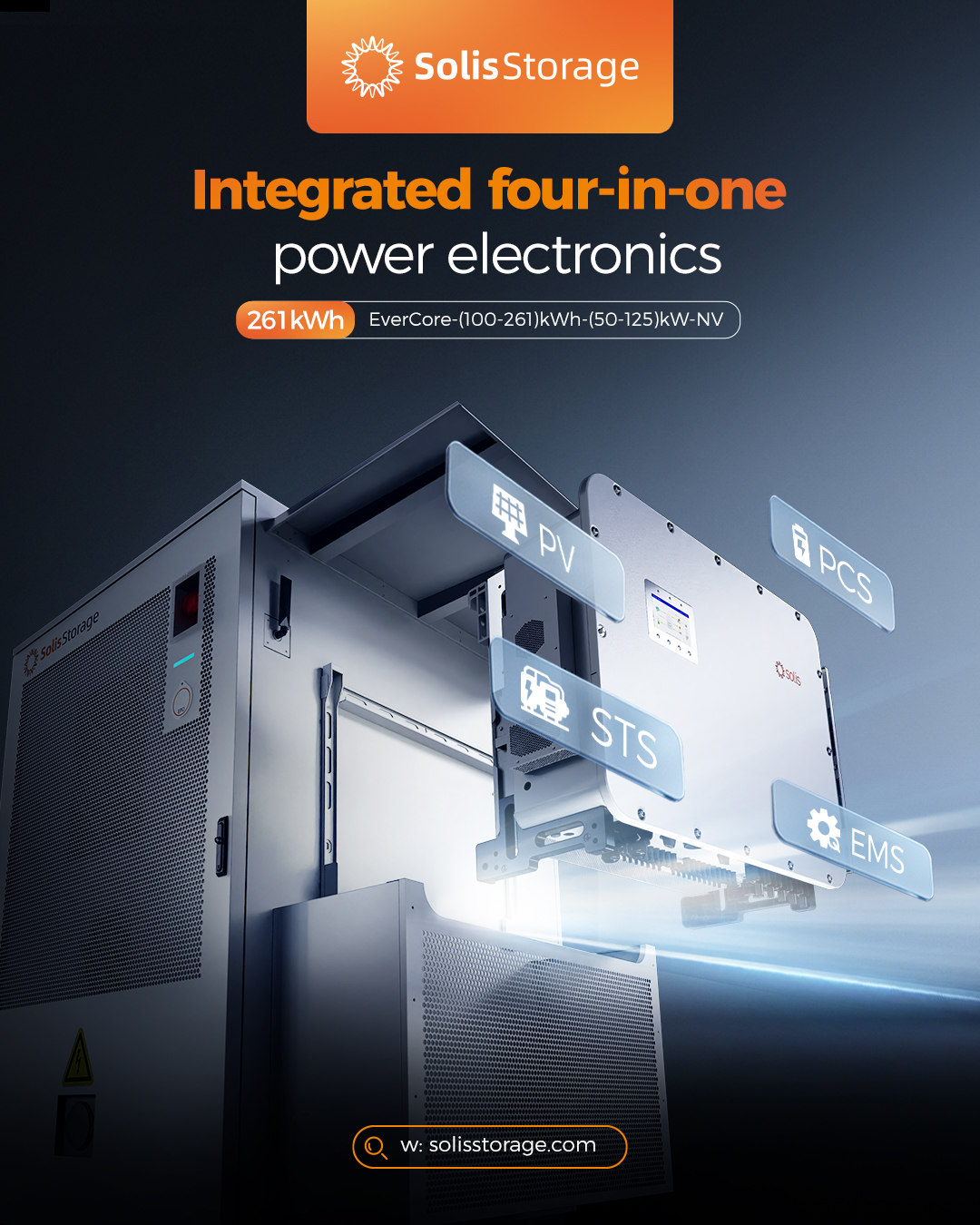
Environmental claims are the easiest to repeat and the hardest to trace, so verify them against the configuration actually ordered. Solis documents IP66 protection for the EverCore hybrid energy storage inverter and IP55 for the battery cabinet; the residential IntelliHome unit is documented at IP66 with a 5 kWh LiFePO4 capacity and a cycle life of more than 6,000 cycles over 10 years.
Corrosion needs a more careful reading than a single grade suggests. The EverCore C&I system description refers to a C4-grade anti-corrosion coating, while Solis's harsh-environment application profile lists C5 anti-corrosion as a special requirement for coastal salt-fog deployment. Those two statements serve different purposes: one describes the coating specified in the system, the other describes the requirement a coastal site imposes. A buyer should therefore confirm which coating class applies to the cabinet bill of materials for the project, and compare it with the corrosivity category of the site, rather than assuming the highest grade mentioned anywhere in the literature.
Three further verification items belong in the same section:
- Temperature. Compare the documented -25°C to 55°C operating range with the site's design maximum and minimum, and record which figure is a design limit and which is a tested value.
- Altitude. State the site altitude in the specification so the 4,000 m envelope can be checked explicitly rather than assumed.
- Factory test evidence. Solis lists incoming material inspection, 100% full functional testing before shipment, aging tests, high-low temperature cycle tests and IP protection testing among its quality controls. Request the test record that corresponds to the unit shipped, not a generic certificate of quality.
An eight-step documentation check
The sequence below is written to be run once per project, and repeated whenever the model, market or mode changes.
- Fix the model and capacity in writing. State the exact variant and rating, for example EverCore-261kWh, in the purchase specification. Ambiguity at this step invalidates every check that follows.
- Map the market to its approval route. List who approves the connection, who inspects the installation and who approves the fire and building aspects.
- Match certificate scope to the model list. Compare the ordered variant against the models named on each certificate, and reject a document that names a different capacity.
- Verify the issuing body, standard and dates. Record the certificate number, the standard edition and the issue or expiry date on the copy received.
- Separate product certification from site approval. File them as two documents with two owners; never present one as the other.
- Layer the operating mode and application. Add interconnection approval for grid-tied, protection and earthing design for off-grid, and metering or prequalification evidence for ancillary services and VPP participation.
- Check environmental ratings against site data. Confirm IP rating, coating class, ambient range and altitude against measured site conditions, not against regional averages.
- Confirm the service and spares position. Ask which service center covers the site and what the stated response terms are locally, so the compliance file and the operating plan describe the same reality.
Two documented deployments and what they illustrate
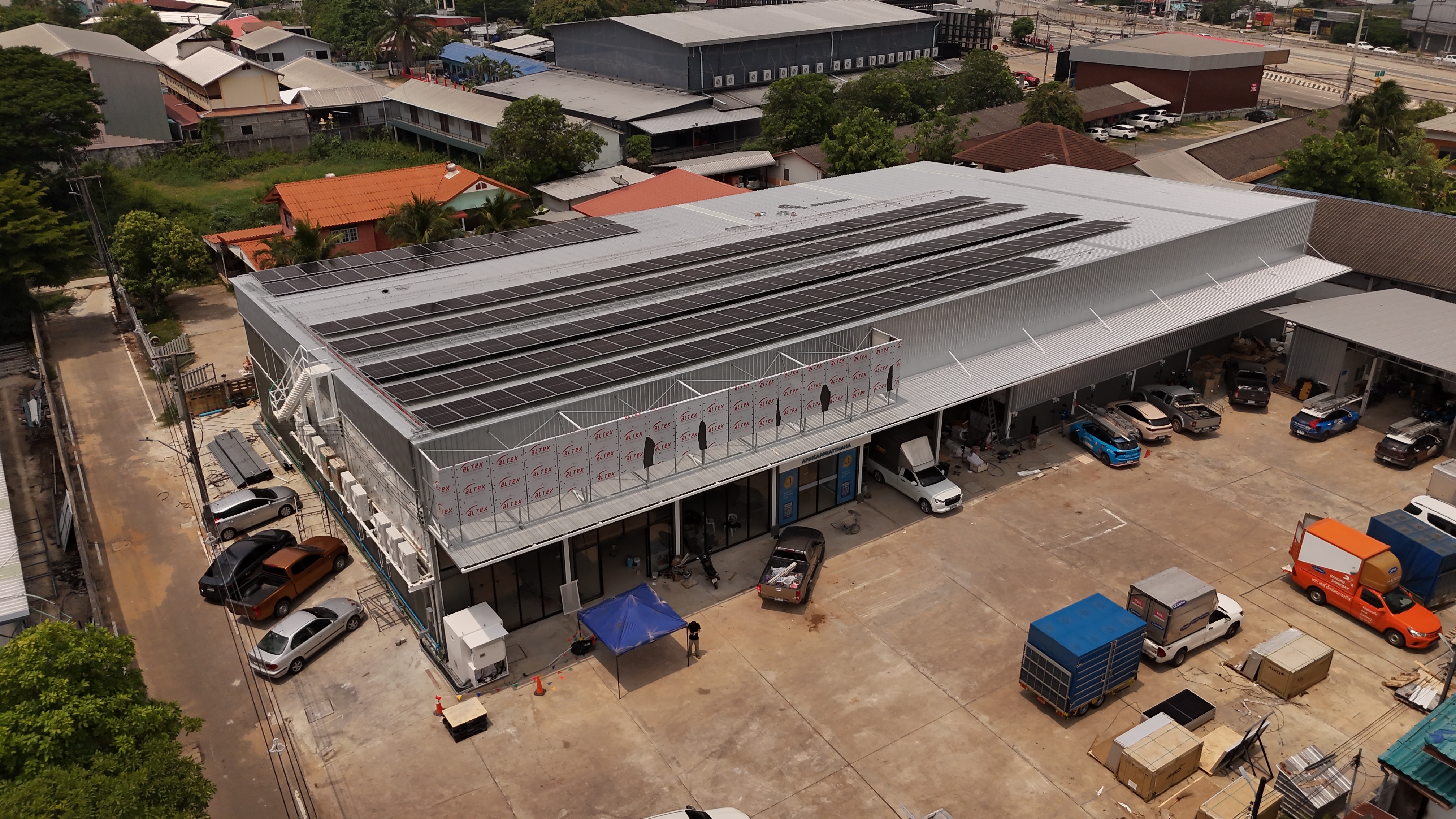
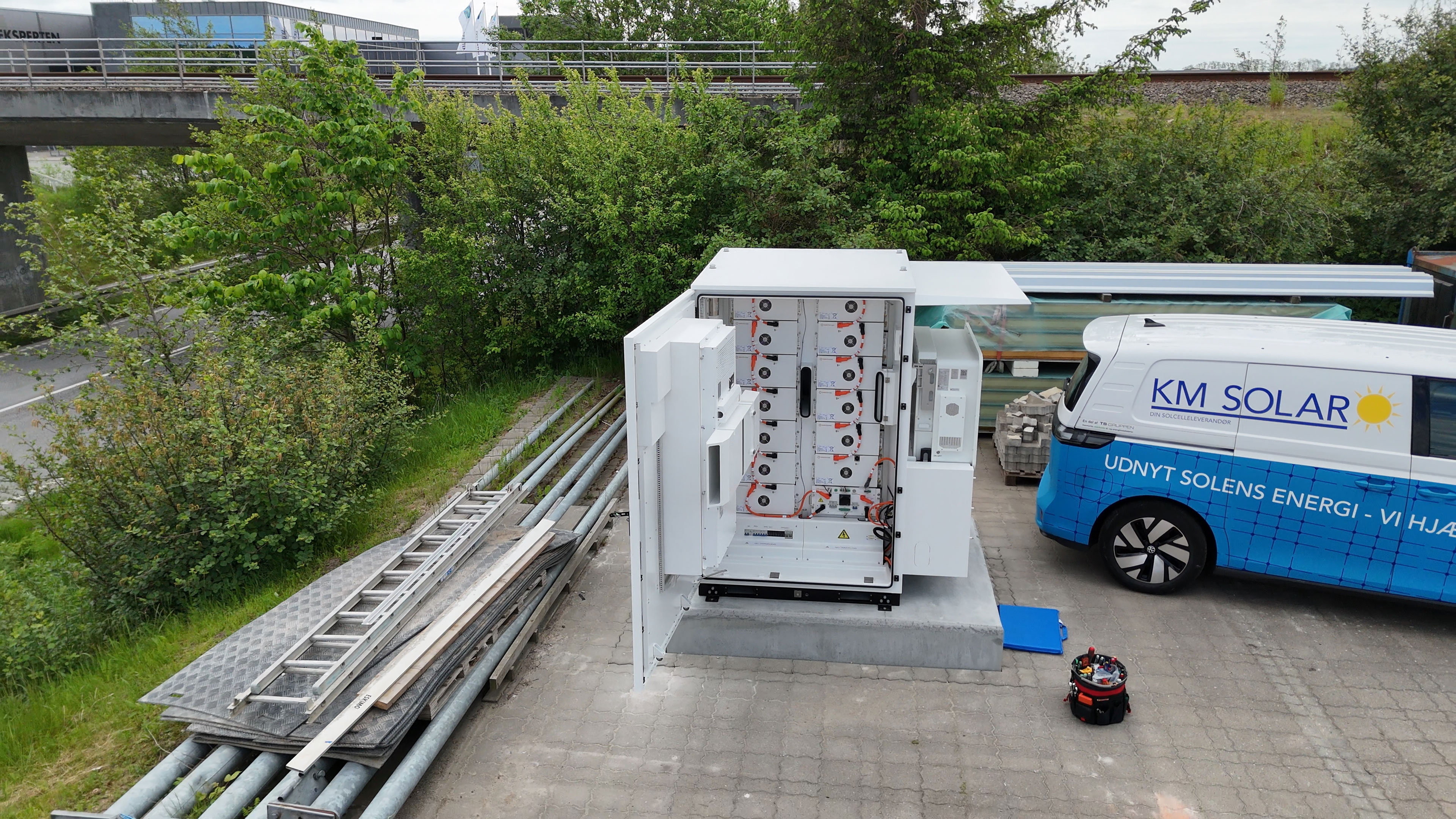
A warehouse self-consumption project in Denmark uses a 125 kW / 261 kWh EverCore system over a 20-year horizon, with the stated result of savings on electricity bills and grid-tied to off-grid switching in under 10 milliseconds to prevent interruptions. A second project in Thailand uses a 125 kW / 522 kWh configuration for self-use and backup power, also over 20 years, with stable operation reported.
Both are C&I installations where the compliance weight sat with the interconnection approval and the site's own protection design, with the environmental ratings deciding whether the cabinet could be placed outdoors. The Thailand configuration also shows how capacity scales: two cabinets' worth of energy on the same 125 kW inverter platform, which is why the model list on a certificate has to be read as a list of specific capacities rather than a power rating.
Frequently asked questions
How should a buyer verify UL-certified residential battery energy storage system manufacturers?
Verify per model, not per brand. Ask each manufacturer for the certificate number, the issuing body, the standard cited and the exact model list, then check that the listed model is the one being purchased. In the material behind this guide, Solis's documented certificates are EU-market certificates covering the EverCore C&I series, and no UL listing is claimed here; the residential IntelliHome unit is documented at 5 kWh LiFePO4 capacity, IP66 protection and a cycle life of more than 6,000 cycles over 10 years. A submittal showing a certificate for a different capacity or product family does not establish the required listing.
Which Solis certificates cover the EverCore ESS in the EU?
Four documents: Certificate of Conformity AE 50710056 0001 issued by TÜV Rheinland to IEC & EN IEC 61000-6-2(-4); Certificate of Conformity AN 50709625 0001 issued by TÜV Rheinland to IEC 62477-1; EMC certificate AE 50712374 0001 issued by TUV under EMC Directive 2014/30/EU; and Safety Certificate JPTUV-182135 issued by TUV to IEC 62619. The first two cover the 99.9 kWh, 100 kWh and 120 kWh models and their PRO variants; the EMC certificate covers EverCore-261kWh and EverCore-261kWh-PRO.
Does an EU certificate cover an installation in South Africa or the Middle East?
No. The certificates listed in this guide state the EU as the market. For Africa, the Middle East & Central Asia or South Asia, the buyer must confirm the national approval route, the interconnection requirements and the import documentation, and request the certificate package that applies to the destination market. Solis's stated deployment across more than 100 countries is context for experience, not evidence of an approval in a specific country.
What should be verified for a coastal or harsh-environment site?
Three things together: the IP rating of each unit (IP66 inverter, IP55 cabinet on EverCore), the anti-corrosion coating class on the cabinet bill of materials, and the documented ambient and altitude envelope of -25°C to 55°C and up to 4,000 m. Solis's EverCore system description cites a C4-grade coating while its harsh-environment application profile lists C5 anti-corrosion as a special requirement, so the coating class must be confirmed for the specific order rather than inferred from a general product claim.
Does grid-tied versus off-grid operation change which certificate is required?
The equipment certificates stay the same; the surrounding review changes. Grid-tied operation adds the network operator's interconnection approval and its protection requirements. Off-grid operation removes that interconnection review but adds the site's earthing, protection and source-coordination documentation, particularly where diesel generation is part of the mix.
How can a buyer obtain the certificate package and technical documentation?
Request it directly from Solis with the exact model, capacity, destination market and application stated in the request, so the correct certificate scope is returned: email sales@solisstorage.com or call +86 574 65802188. The Solis global brochure provides the product and company overview to accompany the request.
Conclusion: compliance is a matched file, not a marketing claim
The workable rule for a BESS buyer is narrow and repeatable. Identify the exact capacity variant, match it against the model list on each certificate, record the issuing body, standard and dates, and then treat interconnection approval, fire approval and transport documentation as separate files with separate owners. Environmental declarations — IP rating, coating class, ambient range and altitude — should be checked against measured site conditions rather than regional averages.
Ginlong (Solis) Technologies Co., Ltd. documents EU-market certificates for the EverCore ESS series with published certificate numbers and model scope, supported by a manufacturing base of 98,114.69 m², more than 5,000 employees, a 1,000-strong R&D team and a 70% export share across markets that include Europe, Africa (including South Africa), the Middle East & Central Asia and South Asia. Deployment in more than 100 countries is useful context for experience across grid conditions. It is not a substitute for the document check described above, and the check remains the buyer's to run.
Request the documentation package for your project. Send the model, capacity variant, destination market and application, and Solis will return the certificate scope that applies.
Email: sales@solisstorage.com | Phone: +86 574 65802188
Company website: Ginlong (Solis) Technologies Co., Ltd.

Have Questions or Need More Details?
Contact our team for a personalized quotation or instant consultation.
Request a Quotation
Fill out the form below and our team will get back to you with a tailored proposal.
WhatsApp Direct Chat
Prefer to chat in real-time? Message us on WhatsApp for instant assistance & quick answers.
- Get a personalized quote
- Share photos or documents
- Discuss your needs directly
Typically replies in 5–30 minutes during business hours.