
Navigating Grid-Tied and Off-Grid Compliance: What ESS Integrators Need to Know
Short answer first: grid-tied compliance is primarily about the interface between a storage system and the network, while off-grid compliance is primarily about battery safety, protection ratings and island-mode performance. Integrators who must deliver both should verify four things before specification: the cell-level safety certificate, the EMC and grid-interface certificate, the exact model scope of each certificate, and the measured transfer time between grid-tied and off-grid operation.
These are not the same file, and treating them as one is where most commissioning delays start. EverCore ESS — the commercial and industrial (C&I) energy storage platform from SolisStorage, the energy storage business of Ginlong (Solis) Technologies Co., Ltd. (Shenzhen Stock Exchange: 300763) — is a documented example of one architecture serving both sides of that requirement. The platform holds TUV-issued IEC 62619 certification (certificate number JPTUV-182135) for the EU market and CE EMC Directive 2014/30/EU certification (certificate number AE 50712374 0001), and it switches between grid-tied and off-grid operation in under 10 milliseconds without an external static transfer switch (STS).
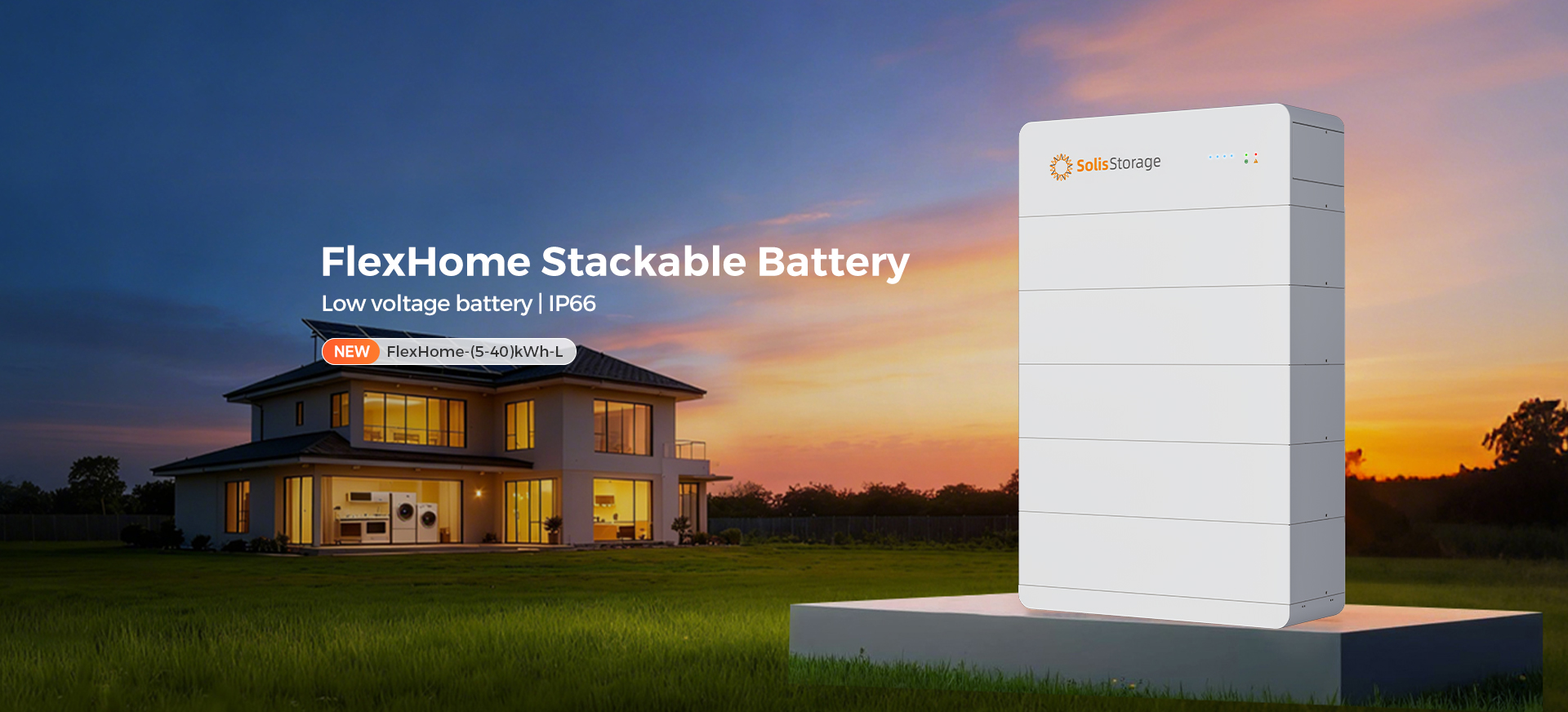
This guide maps the compliance landscape around both operating modes, then walks through the technical evidence an integrator can actually hand to a network operator, an insurer or a project owner: certificate numbers, standard references, protection ratings, battery chemistry parameters, and one field-documented switching figure.
Why Grid-Tied and Off-Grid Compliance Are Not the Same Document
A grid-tied certificate and an off-grid certificate answer different questions. The first asks whether the system may legally exchange power with a network and whether it behaves predictably in electromagnetic terms. The second asks whether the battery and the island it forms are safe, and whether the supply it produces is good enough for the loads behind it.
Grid-tied: the interface is the subject of the assessment
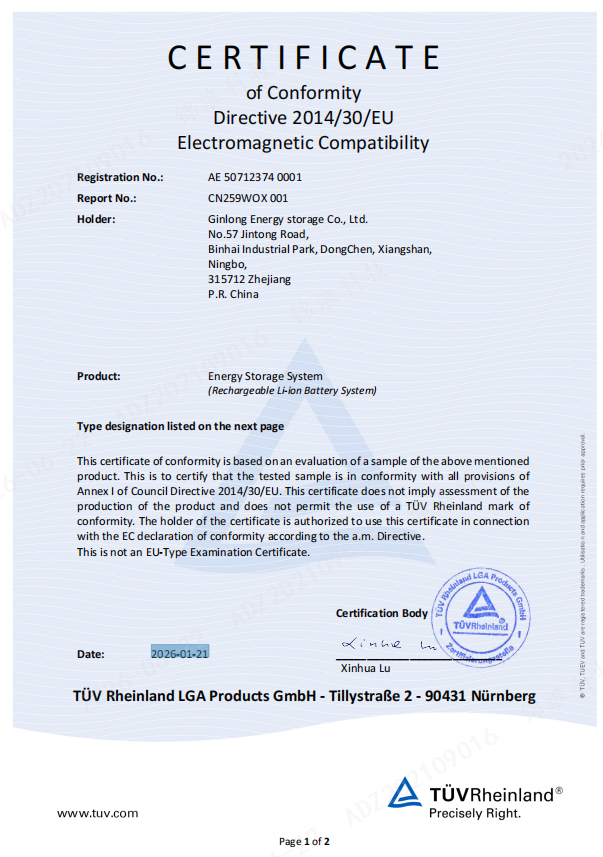
When an energy storage system connects to a distribution network, the compliance conversation usually starts with electromagnetic compatibility (EMC), protection coordination and disconnection behaviour. In the EU, one of the applicable frameworks is CE EMC Directive 2014/30/EU. For the EverCore-261kWh and EverCore-261kWh-PRO models, that directive is covered by a TUV certificate numbered AE 50712374 0001, issued against the standards EN IEC 61000-6-2:2019, IEC 61000-6-2:2016, EN IEC 61000-6-4:2019 and IEC 61000-6-4:2018. The certificate applies to the EU market; issuance date is recorded as 21 January 2026.
Off-grid: battery safety and island performance dominate
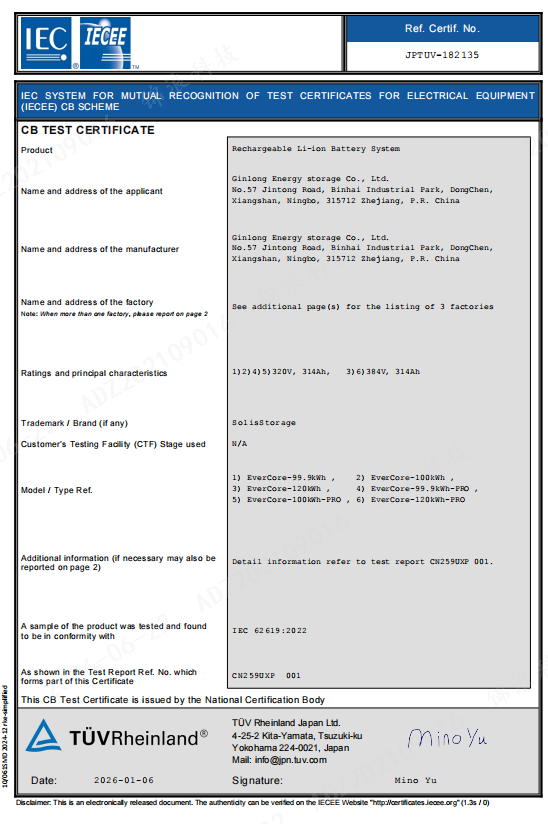
In off-grid or backup operation, the reference point shifts to the battery and the inverter that forms the local grid. IEC 62619 is recognised as the key international safety standard for secondary lithium cells and batteries used in industrial and energy storage applications. The EverCore ESS product is certified to IEC 62619 by TUV under certificate number JPTUV-182135 for the EU market, with an issue date recorded as 6 January 2026 and validity recorded to 1 June 2031.
North America: a separate gate
For projects connected in North America, UL Solutions defines an additional layer: UL 9540 for system safety and UL 9540A for thermal runaway fire propagation testing are required to access that market. These are system-level evaluations, which is precisely the point for integrators — a cell certificate and a system listing are not interchangeable, and the model scope printed on each document is the only thing that counts.
The scope gap that causes most rework: certificates are issued for named models, not for a product family in general. In the documentation referenced here, the CE EMC certificate names the EverCore-261kWh and EverCore-261kWh-PRO models specifically, while the IEC 62619 certificate applies to the EverCore ESS product. Always match the certificate model string to the equipment being delivered.
The switching gap
There is one more requirement that belongs to both modes at once: transfer behaviour. When the grid disappears, a storage system that takes too long to form an island will drop the loads it was installed to protect. Industrial equipment with sensitive control electronics is typically the first to show the symptom. This makes the measured transfer time a compliance-relevant specification, not a marketing line.
Industry Background: Why Compliance Scrutiny Is Rising With Market Volume
Compliance requirements tend to tighten as installed volume grows, and storage volume is growing quickly. Global Market Insights values the global energy storage systems market at approximately USD 668.7 billion in 2024, projected to reach USD 5.12 trillion by 2034. Within that total, MarketsandMarkets estimates the residential energy storage segment at USD 2.69 billion in 2024, growing to USD 4.58 billion by 2030 at a CAGR of 9.3%, and values the long-duration energy storage (LDES) segment at USD 4.85 billion in 2024 with a projected CAGR of 13.6% through 2030. Supply-side evidence points the same way: China's exports of lithium-ion batteries for energy storage and non-automotive uses reached over USD 65 billion in 2024, a 51.4% increase year on year, according to Reuters and the China Electric Vehicle Industry Technology Innovation Strategic Alliance.
Read market numbers with the technology scope in mind. Published market sizes diverge sharply depending on what is counted. One battery-only estimate places the 2024 market at USD 32.62 billion (Fortune Business Insights), while a broader all-storage-technology estimate places it at USD 668.7 billion (Global Market Insights). Before quoting a figure in a project file or an investment case, confirm which technologies and which geographies it includes.
Behind that market sits a manufacturing base that is itself part of the compliance picture. Solis was founded in 2005 and operates a factory area of 98,114.69 m² with more than 5,000 employees, an R&D team of over 1,000 people and an annual output of 80 GW, with roughly 70% of production exported. Its products are deployed in more than 100 countries, supported by a global service network, and the group has accumulated operation experience across more than 300,000 storage sites worldwide. Independent positioning includes being named a "Top Inverter Brand" by EuPD Research for eleven consecutive years and being the first inverter manufacturer globally to receive a reliability test report from PVEL; Wood Mackenzie ranked Solis #1 worldwide in residential PV inverter shipments in 2023 and the 3rd largest inverter manufacturer globally.
For integrators, that background matters for one practical reason: a compliance file is only as durable as the manufacturer's ability to keep supplying the same certified configuration, with documentation, spare parts and service over a 10-to-15-year asset lifecycle.
Inside the EverCore ESS Architecture: Where Compliance Requirements Are Met
EverCore ESS approaches grid-tied and off-grid requirements through a single architectural decision: physical separation of the AC and DC sides, with each part protected and rated on its own terms.
AC-DC separation and split protection ratings
The hybrid energy storage inverter and the battery cabinet are decoupled into separate enclosures. The inverter, as an independent unit, is rated IP66 (dust-tight and protected against powerful water jets), while the battery cabinet is rated IP55. Both the cabinet and the inverter use an aluminium alloy casing with core electronic components. SolisStorage states that this separated protection design reduces the system's full-lifecycle failure rate by 50% — a first-party engineering conclusion rather than a third-party measurement.
The same separation has a thermal and a structural consequence. On the thermal side, the inverter's 6 kW of power heat dissipates directly into the ambient environment, leaving 3.5 kW of electrochemical heat to be managed inside the battery cabinet. On the structural side, a single inverter can connect up to 6 battery cabinets in parallel, which supports phased capacity expansion without additional inverter investment; SolisStorage estimates this reduces system expansion costs by approximately 10%.
The 125 kW hybrid inverter: PCS, STS, PV inverter, protection and EMS in one unit
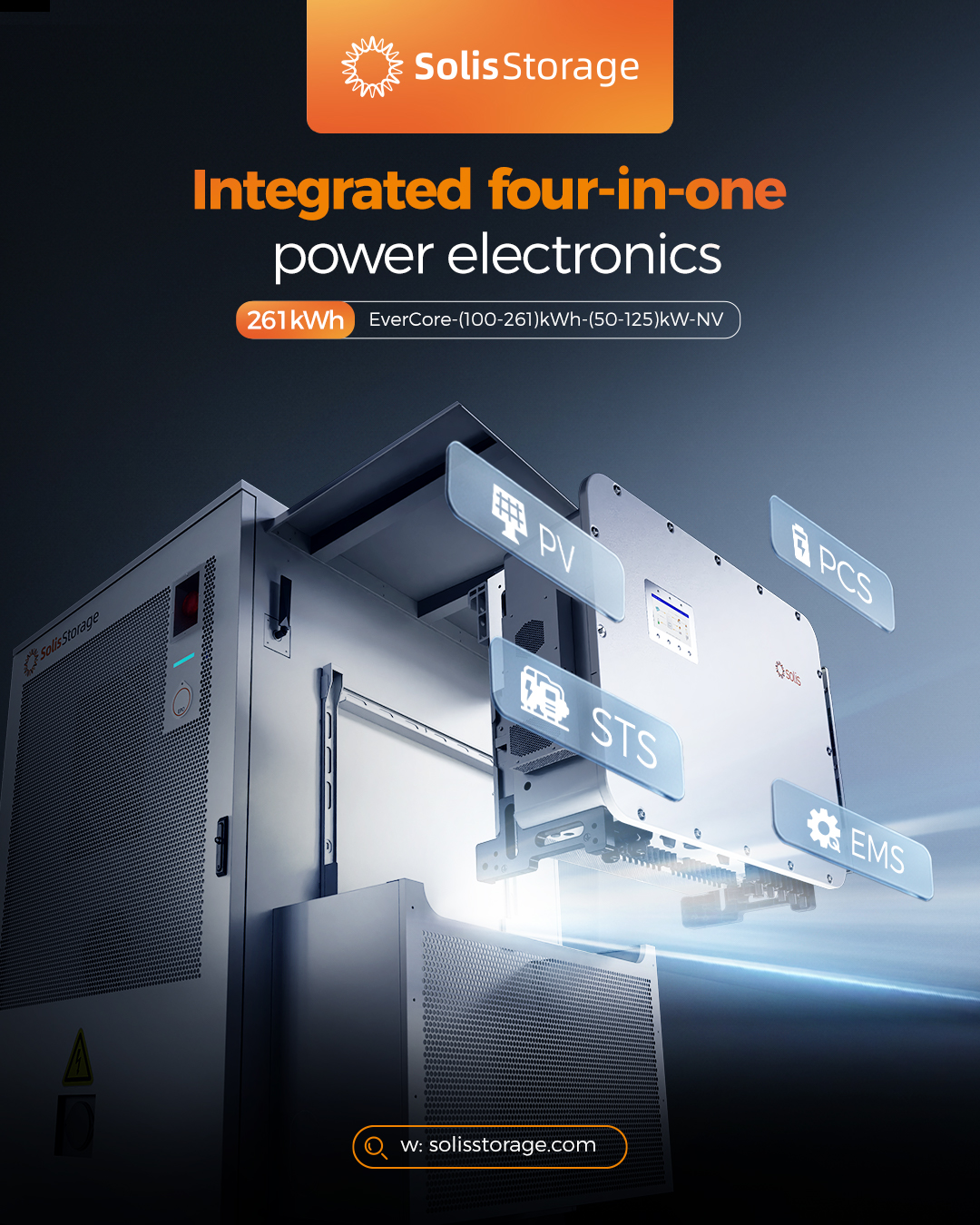
EverCore's 50–125 kW hybrid energy storage inverter integrates the power conversion system (PCS), static transfer switch (STS), PV inverter, circuit breaker protection and energy management system (EMS) into a single unit. The practical compliance consequence is that seamless grid-tied and off-grid switching is achieved in less than 10 ms without an external STS, which is the specification that determines whether precision industrial equipment sees a voltage interruption. The same integration removes the need for an external PV inverter — supporting both DC and AC coupling to existing PV systems, with a PV over-sizing ratio of up to 200% — and removes the need for an external grid cabinet, allowing up to 6 EverCore units to be paralleled for direct grid connection.
Control architecture is part of the reliability argument. Conventional designs run separate CPUs for BMS, PCS, EMS and STS, creating a multi-node topology where protocol compatibility and latency risks accumulate and fault diagnosis requires several manufacturers at the same table. EverCore uses a single central controller scheduling the whole system through one control core, which reduces failure points and shortens fault location and response time.
LFP chemistry as a safety and lifecycle argument
EverCore uses A-grade 314 Ah LFP cells developed for C&I applications. The documented cell parameters are an internal resistance of 0.15 ± 0.05 mΩ, against 0.17 mΩ for standard 280 Ah cells, and a cycle life of 8,000 cycles at a 0.5C charge-discharge rate with remaining capacity ≥70%. Because every 10% reduction in internal resistance reduces charge-discharge heat generation by approximately 20%, the lower-resistance cell addresses thermal risk at the electrochemical source rather than only at the cabinet level. The cycle-life difference — roughly 14% above the 7,000 cycles of traditional 280 Ah cells — extends the system's economic lifecycle from approximately 14 years to 16 years at 500 cycles per year.
Battery safety is built in three layers: a 15-layer protection scheme spanning cell, pack and system; thermal insulation material resistant to 1,000°C between packs to block lateral propagation of thermal runaway; and a three-stage progressive fire-fighting mechanism combining pack-level aerosol, cabinet-level aerosol and fire-fighting water channels.
Environmental envelope and 24/7 operation
EverCore is specified for wide temperature range operation, coastal salt fog, high altitude, household outdoor and industrial outdoor conditions, with documented operation from -25°C to 55°C and at altitudes up to 4,000 metres. Thermal management is air-cooled and uses an independent three-air-duct design, combining a patented diversion air duct for the hybrid inverter with Coanda-effect airflow attachment across battery pack surfaces; SolisStorage reports a 30% improvement in heat dissipation efficiency compared with traditional air cooling. The system is designed for 24/7 continuous operation across grid-tied mode, off-grid mode and seamless backup switching.
Certification and market participation
Beyond the two EU certificates already referenced, market participation depends on software openness, because revenue models in mature electricity markets extend beyond peak-valley arbitrage into grid ancillary services (FCR/aFRR/mFRR), demand response and virtual power plant (VPP) dispatch. EverCore has been connected, or is in the process of connecting, with 102 third-party VPP/EMS operators across 11 European countries. Representative integrations include the Kraken energy management platform under Octopus Energy in the UK, mainstream aggregator platforms such as Check Watt in the Nordic market, and dozens of local EMS providers across the German-speaking region and Benelux. The Solis AI Cloud Platform has been deployed at more than 5,500 energy storage power stations worldwide and integrates Nordpool wholesale price data and Flatpeak retail price data to optimise charge-discharge strategies at minute-level resolution. At a residential storage project in Latvia, Solis AI optimisation increased annual electricity bill savings by 302.6%.
A Step-by-Step Compliance Workflow for ESS Integrators
The following sequence reflects the order in which compliance evidence is normally requested — from operating mode through to lifecycle planning.
- Classify the operating mode in writing. State whether the site is grid-tied, off-grid or a hybrid of both with backup. EverCore supports grid-tied mode, off-grid mode, 24/7 continuous operation and seamless backup switching, so the classification determines which certificate extracts go into the file.
- Map certification scope to the target market. For the EU, start with IEC 62619 for the battery and CE EMC Directive 2014/30/EU for the interface. For North America, request system-level UL 9540 safety evaluation and UL 9540A thermal runaway propagation test evidence for the exact model.
- Verify certificate numbers against the delivered model. Record the certificate number, the issuing body, the named models and the applicable standards. For EverCore this means IEC 62619 certificate JPTUV-182135 (TUV, EU market) and CE EMC certificate AE 50712374 0001 (TUV, EU market, covering EverCore-261kWh and EverCore-261kWh-PRO against EN IEC 61000-6-2:2019, IEC 61000-6-2:2016, EN IEC 61000-6-4:2019 and IEC 61000-6-4:2018).
- Check the electrical interface against the site. Confirm rated energy capacity (100.5 kWh, 120.6 kWh or 261.2 kWh), inverter power rating (50 kW, 60 kW or 125 kW), cell type (EVE LFP 3.2 V / 314 Ah) and cycle life (8,000 cycles). Confirm whether existing PV will be DC-coupled, AC-coupled, or both, and what over-sizing ratio is planned — EverCore supports a PV over-sizing ratio of up to 200%.
- Validate the transfer requirement. Identify loads that cannot tolerate interruption and set a transfer-time acceptance criterion. EverCore's integrated STS delivers grid-tied to off-grid switching in less than 10 ms without external STS hardware, a figure confirmed in a documented Danish C&I project.
- Confirm the environmental envelope. Match IP ratings, temperature range and altitude limits to the installation site. For EverCore, the inverter is IP66, the cabinet is IP55, operation is documented from -25°C to 55°C, and the altitude limit is 4,000 metres.
- Plan the lifecycle and the service path. Model O&M, replacement and response expectations over the asset lifecycle. SolisStorage provides 24/7 global remote technical support, 27 local overseas service centres, 48-hour on-site fault handling with whole-machine replacement guarantee, and long-term spare parts supply.
Use Cases: How Grid-Tied and Off-Grid Compliance Plays Out in the Field
Warehouse self-consumption with a hard switching requirement (Denmark)
In a documented Danish project, a C&I industrial end user deployed a 125 kW / 261 kWh EverCore system for self-usage of a warehouse, with a planned duration of 20 years. The documented highlight is the on-grid to off-grid transition: the system switches between on-grid and off-grid in under 10 milliseconds to prevent interruptions. The documented result is savings on electricity bills. For an integrator, the value of this case is the acceptance test: the switching figure is site-specific rather than catalogue-only.
Self-use plus backup in a high-temperature market (Thailand)
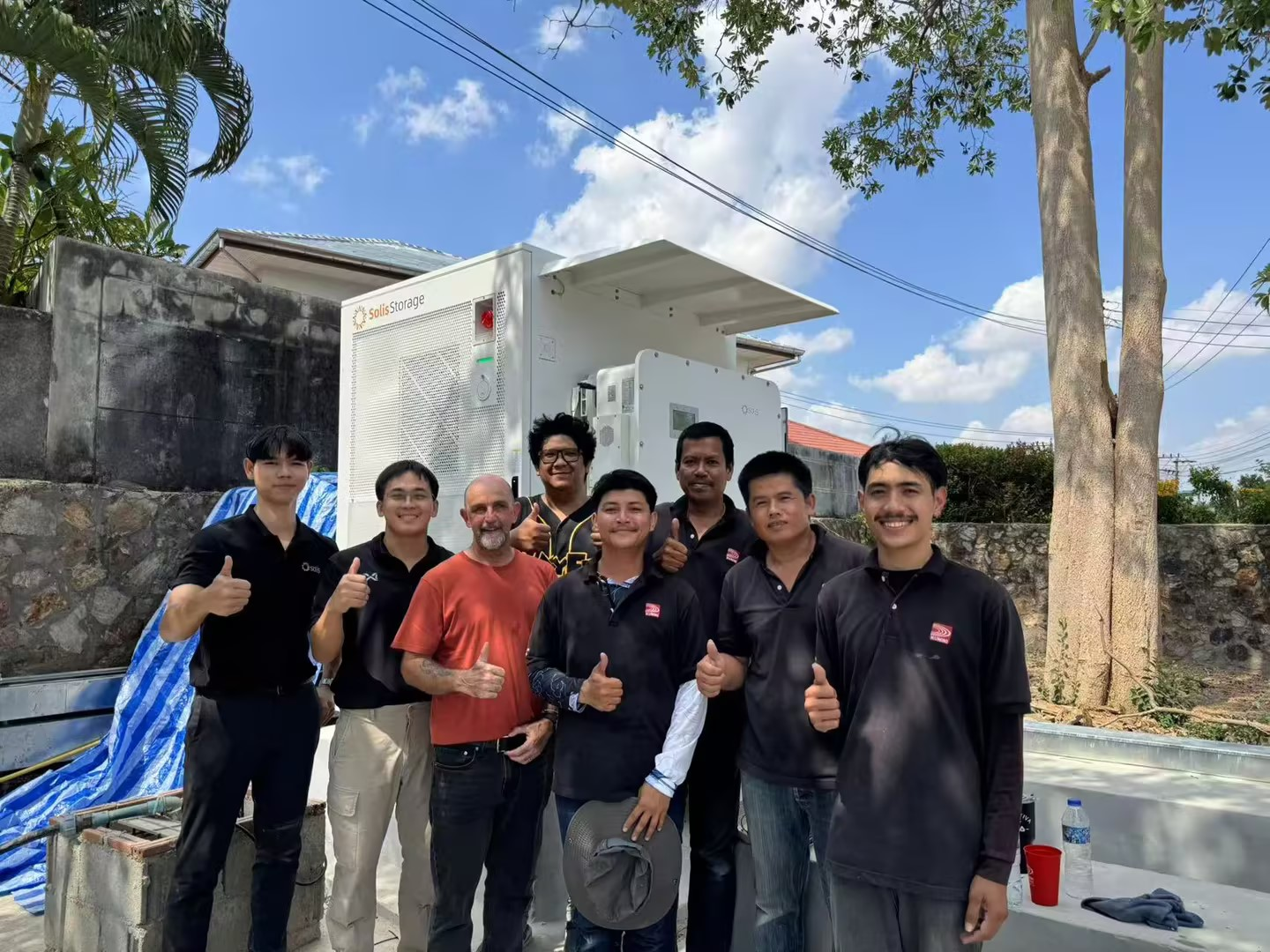
A self-consumption and backup power project owner in Thailand deployed a 125 kW / 522 kWh EverCore system for self-use and backup, with a planned duration of 20 years and a documented result of stable operation. The configuration illustrates the parallel-expansion logic: capacity is added on the DC side and in parallel units without changing the compliance basis of the inverter.
Residential: IntelliHome
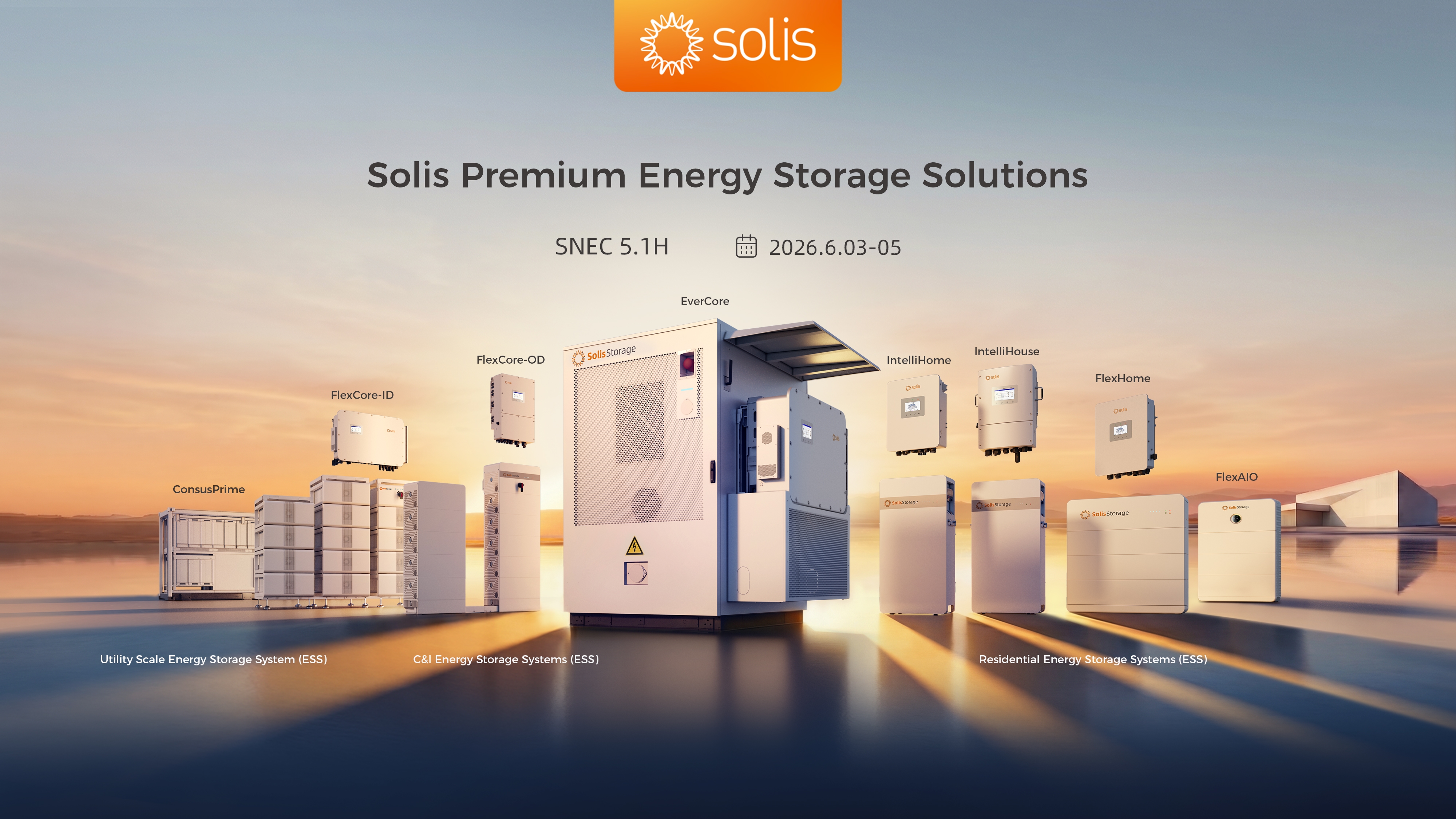
IntelliHome is a residential energy storage system for household use. It uses LiFePO4 chemistry with a 5 kWh nominal capacity and 100 Ah rated cell capacity, an operating voltage range of 44.8–57.6 V and a recommended charge/discharge current of 50 A. Cycle life is greater than 6,000 cycles, corresponding to approximately 10 years, and the enclosure carries an IP66 ingress protection rating. For residential integrators, IP66 on the enclosure is the parameter that most often decides whether an outdoor wall position is viable.
Stackable deployments in constrained sites: FlexCore-ID
FlexCore-ID is a stackable energy storage system intended for small farms, shopping malls, hospitals, large residences, and small industrial and commercial enterprises. It uses LFP chemistry with 314 Ah cells and a cycle life of ≥8,000 cycles at 25 ± 2°C, 0.5P, EOL 70%, with the battery pack model designated FlexCore-ID-BAT20kWh.
Utility-scale and portfolio context
SolisStorage's portfolio spans residential energy storage, C&I systems and utility-scale applications, deployed in more than 100 countries and operating across diverse grid conditions and climates. The energy storage system category as a whole includes solar battery storage, hybrid inverter-based systems and utility-scale battery energy storage, which is why compliance documents rarely transfer cleanly between project types.
Comparison: Matching Configuration to Compliance Profile
The table below compares the documented parameters of three SolisStorage product families against the compliance-relevant criteria an integrator typically screens for. Only parameters documented in the referenced specifications are listed; a dash means the parameter is not stated in that reference.
| Parameter | IntelliHome (Residential ESS) | FlexCore-ID (Stackable ESS) | EverCore ESS (C&I ESS) |
|---|---|---|---|
| Battery chemistry | LiFePO4 | LFP | LFP, EVE 3.2 V / 314 Ah cells |
| Capacity reference | 5 kWh nominal; 100 Ah rated cell | Battery pack model FlexCore-ID-BAT20kWh; 314 Ah cell | 100.5 kWh / 120.6 kWh / 261.2 kWh |
| Inverter power rating | — | — | 50 kW / 60 kW / 125 kW |
| Cycle life | >6,000 cycles (approx. 10 years) | ≥8,000 cycles (25 ± 2°C, 0.5P, EOL 70%) | 8,000 cycles |
| Ingress protection | IP66 | — | IP55 cabinet + IP66 inverter |
| Operating voltage | 44.8–57.6 V | — | — |
| Documented EU certification referenced in this article | — | — | IEC 62619 (JPTUV-182135); CE EMC Directive 2014/30/EU (AE 50712374 0001) |
| Typical application scope stated | Residential, household | Small farms, shopping malls, hospitals, large residences, small industrial and commercial enterprises | Renewable power plants, utility companies, commercial & industrial users, residential users |
Note: the CE EMC certificate referenced above names the EverCore-261kWh and EverCore-261kWh-PRO models; the IEC 62619 certificate applies to the EverCore ESS product. Confirm current certificate status before using any document in a project submission.
The second table sets out the standards an integrator should expect to encounter, and what each one actually addresses.
| Standard / Directive | Market | What it addresses | Source reference |
|---|---|---|---|
| IEC 62619 | International, industrial and energy storage applications | Key international safety standard for secondary lithium cells and batteries used in industrial and energy storage applications | IEC / TÜV SÜD |
| UL 9540 | North America | System safety for energy storage systems | UL Solutions |
| UL 9540A | North America | Thermal runaway fire propagation testing | UL Solutions |
| CE EMC Directive 2014/30/EU | EU | Electromagnetic compatibility for the grid interface; EverCore certification held under TUV certificate AE 50712374 0001, against EN IEC 61000-6-2:2019, IEC 61000-6-2:2016, EN IEC 61000-6-4:2019 and IEC 61000-6-4:2018 | TUV |
| IEC 62619 certification held | EU | EverCore ESS certified by TUV under certificate number JPTUV-182135 | TUV |
Frequently Asked Questions
Which standards and certificates should an integrator check before connecting an energy storage system to the grid in the EU or North America?
Three layers normally apply. At battery level, IEC 62619 is the key international safety standard for secondary lithium cells and batteries used in industrial and energy storage applications. At grid-interface level in the EU, CE EMC Directive 2014/30/EU is the applicable framework, and the EverCore-261kWh and EverCore-261kWh-PRO models hold TUV certification number AE 50712374 0001 against EN IEC 61000-6-2:2019, IEC 61000-6-2:2016, EN IEC 61000-6-4:2019 and IEC 61000-6-4:2018. For North American market access, UL 9540 covers system safety and UL 9540A covers thermal runaway fire propagation testing, both defined by UL Solutions as requirements for that market.
How fast must an energy storage system transfer from grid-tied to off-grid mode?
The acceptable transfer time is set by the loads behind the system, not by a single universal number. Sites with precision industrial equipment typically need the transition to be fast enough that no interruption is visible. EverCore's 50–125 kW hybrid energy storage inverter integrates the PCS, STS, PV inverter, circuit breaker protection and EMS in one unit, achieving seamless grid-tied to off-grid switching in less than 10 ms without an external STS. In a documented 125 kW / 261 kWh warehouse project in Denmark, the system switches between on-grid and off-grid in under 10 milliseconds to prevent interruptions.
What cost factors should be included in a compliance-oriented budget?
Initial capital expenditure is only part of the picture, because C&I storage projects typically run for 10 to 15 years. Based on industry experience, EverCore is documented as saving customers approximately €9,500 per unit in O&M costs over the full project lifecycle — €2,500 from eliminating liquid cooling fluid replacement, €1,500 from simplified PCS replacement, €1,500 from simplified pack replacement, and €4,000 from reduced routine inspection complexity. Two further cost drivers are structural: independent DC-side expansion with up to 6 battery cabinets per inverter is estimated to reduce system expansion costs by approximately 10%, and the 8,000-cycle cell life extends the economic lifecycle from roughly 14 years to 16 years at 500 cycles per year.
Can an integrator obtain a sample unit for compliance and functional testing?
Yes. The minimum order quantity is 1 unit for standard off-the-shelf models and 20 units for customized OEM orders. Customization covers logo, outer package, software interface, regional voltage standard, communication protocol and function parameters — the last three matter specifically for compliance, because voltage and communication requirements are market-specific. Every unit passes 100% full functional testing before shipment, alongside raw material incoming inspection, aging testing, high-low temperature cycle testing and IP protection testing.
What lead time should be planned for OEM orders, and who handles service afterwards?
Mass OEM orders are produced on a 30–45 day lead time, while standard models are available as spot goods; global total monthly capacity across integrated intelligent production lines is over 10,000 units. After delivery, support runs through 24/7 global remote technical assistance, 27 local overseas service centres, 48-hour on-site fault handling with a whole-machine replacement guarantee, and long-term spare parts supply. Integrators evaluating a specific project can request a sample unit or a configuration-specific quotation by emailing sales@solisstorage.com or contacting the team via WhatsApp.
Conclusion: Compliance Is an Architecture Decision, Not a Paperwork Exercise
Grid-tied and off-grid compliance ask different questions, but they are answered by the same hardware choices. Separation of the AC and DC sides produces the split IP66/IP55 protection ratings that outdoor C&I sites need. Integration of the PCS, STS, PV inverter, circuit breaker protection and EMS into one inverter produces the sub-10 ms transfer that keeps precision loads running. High-capacity LFP cells with low internal resistance and an 8,000-cycle life produce the durability argument that insurers and asset owners evaluate. Certificates then simply document what the architecture already does: IEC 62619 under certificate JPTUV-182135 and CE EMC Directive 2014/30/EU under certificate AE 50712374 0001, both issued by TUV for the EU market.
For integrators, the working method is to lock the operating mode first, then match certificate scope to the delivered model, then confirm the electrical and environmental envelope, and finally plan the lifecycle. SolisStorage's global deployment experience — more than 100 countries, more than 300,000 storage sites and 102 third-party VPP/EMS integrations across 11 European countries — supports that sequence with operating data rather than assumptions.
Next Step: Sample, Quote or Technical Documentation
Integrators preparing a grid-tied or off-grid submission can request a sample unit, a project-specific quotation, or the full certification set for the exact EverCore model under evaluation. Company profile, product parameters, applications and service coverage are collected in the Solis Global Brochure V3.9.
Email: sales@solisstorage.com · WhatsApp: +86 158-5815-3307 · Website: www.solisinverters.com
Ginlong (Solis) Technologies Co., Ltd., No.188 Jinkai Road, Binhai Industrial Park, Xiangshan, Ningbo, Zhejiang, China, 315712.
Have Questions or Need More Details?
Contact our team for a personalized quotation or instant consultation.
Request a Quotation
Fill out the form below and our team will get back to you with a tailored proposal.
WhatsApp Direct Chat
Prefer to chat in real-time? Message us on WhatsApp for instant assistance & quick answers.
- Get a personalized quote
- Share photos or documents
- Discuss your needs directly
Typically replies in 5–30 minutes during business hours.