
Comparing C&I Energy Storage Systems: EverCore ESS vs. Stackable Alternatives
Comparing C&I Energy Storage Systems: EverCore ESS vs. Stackable Alternatives
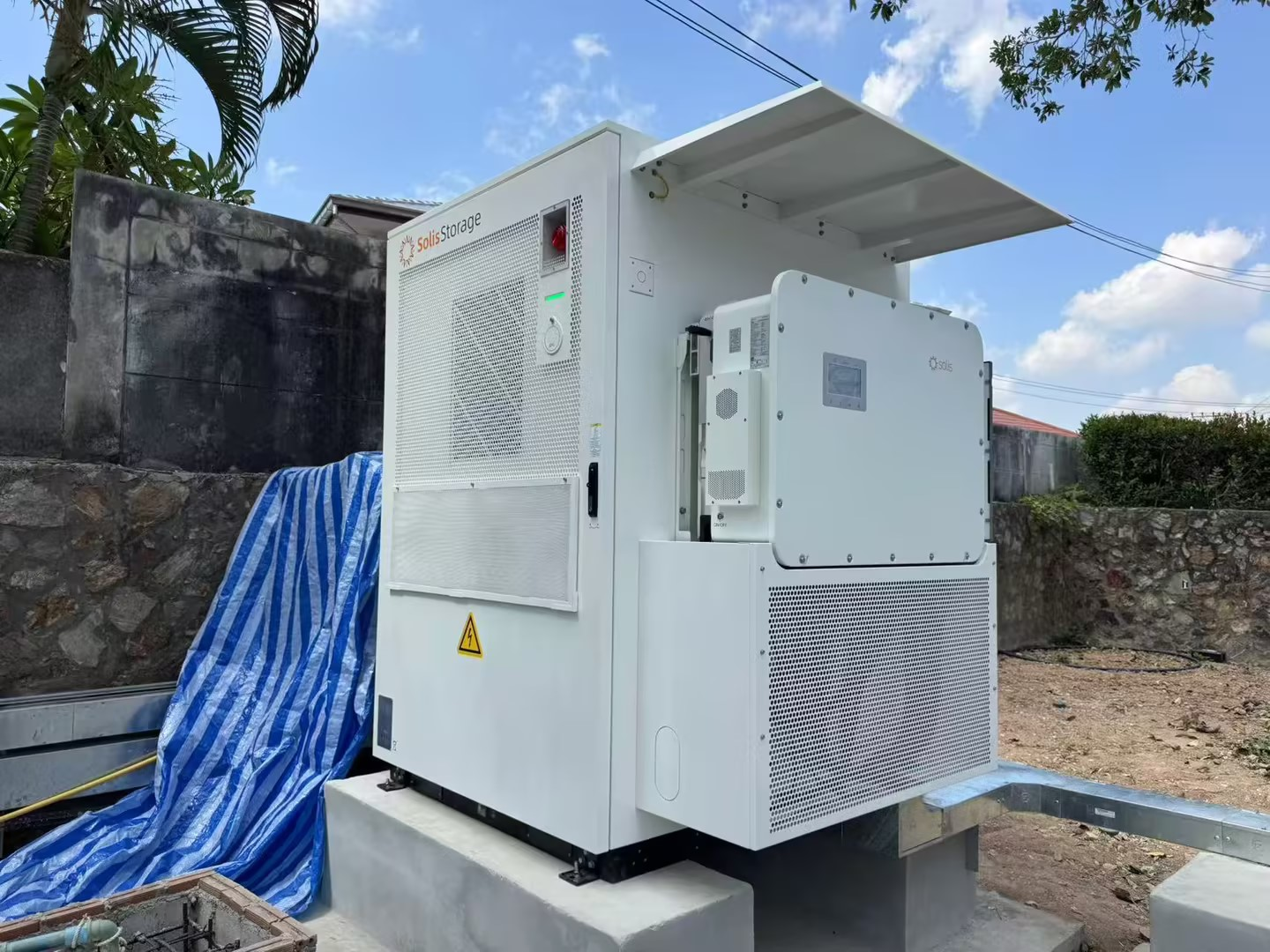
A commercial and industrial (C&I) energy storage procurement usually reaches the same fork: build the project around one integrated energy storage unit, or around a stackable architecture that grows unit by unit. The two paths lead to different expansion economics, different protection strategies and different O&M workloads over a 10–15 year asset life — which is why the architecture question deserves an answer before the price question.
SolisStorage's EverCore ESS is the integrated option. It is a C&I energy storage system built on AC-DC separation, offered in three rated energy capacity points — 100.5 kWh, 120.6 kWh and 261.2 kWh — with hybrid energy storage inverter ratings of 50 kW, 60 kW and 125 kW, IP66 protection on the inverter and IP55 on the battery cabinet, and LFP cells rated for 8,000 cycles. The stackable option, represented in this article by the FlexCore-ID stackable line, works from the opposite direction: capacity is assembled from stackable units rather than consolidated into a single inverter-and-cabinet pair.
This comparison stays deliberately narrow. No competitor brands are compared; the article compares two architectures inside the SolisStorage energy storage solution portfolio, and gives buyers the criteria that actually decide between them: capacity selection, inverter rating, protection class, cell chemistry, expansion path, grid-service readiness and lifecycle O&M cost.
Problem Definition: Why the Architecture Decision Is Hard to Reverse
An installed battery energy storage system is effectively permanent. Once the system is on site, interconnected and named inside a certificate scope, changing its physical architecture means re-engineering the site rather than swapping a component. Four constraints follow from the original layout choice:
- Expansion headroom. Whether capacity can be added later without a second inverter is fixed by the DC-side design, not by the budget that happens to be available in year three.
- Where the heat sits. An architecture that moves power-electronics heat outside the battery enclosure changes the thermal load the cabinet has to manage.
- Which component carries the protection rating. When inverter and battery cabinet share one enclosure, sealing and service access compete with each other.
- Serviceability. C&I assets are typically held for 10 to 15 years, so every component chosen at design stage becomes a recurring maintenance task.
Two failure modes are common enough to plan against. The first is under-modelling expansion: the site adds load or adds revenue streams, and the installed architecture cannot follow without proportional new investment. The second is under-modelling O&M: owners rigorously compare initial quotes during project approval, then watch lifecycle operating and maintenance costs erode the project's internal rate of return.
Industry Background: What a C&I Storage System Is Expected to Earn
The commercial case for C&I energy storage has widened. In mature electricity markets such as Europe, the profit model has evolved from basic peak-valley arbitrage into a multi-dimensional revenue model that includes grid ancillary services (FCR / aFRR / mFRR), demand response and virtual power plant (VPP) dispatch. That shift changes the hardware requirement: a system whose software ecosystem is closed cannot be dispatched by third-party platforms, and therefore cannot access most of that revenue.
Third-party market estimates indicate the direction of travel. Global Market Insights values the global energy storage systems market at approximately USD 668.7 billion in 2024, projected to reach USD 5.12 trillion by 2034. MarketsandMarkets values long-duration energy storage at USD 4.85 billion in 2024, growing at a CAGR of 13.6% through 2030. These figures are scope-dependent — all-technology estimates and battery-only estimates are not directly comparable — so they are useful as a demand indicator rather than as a procurement input.
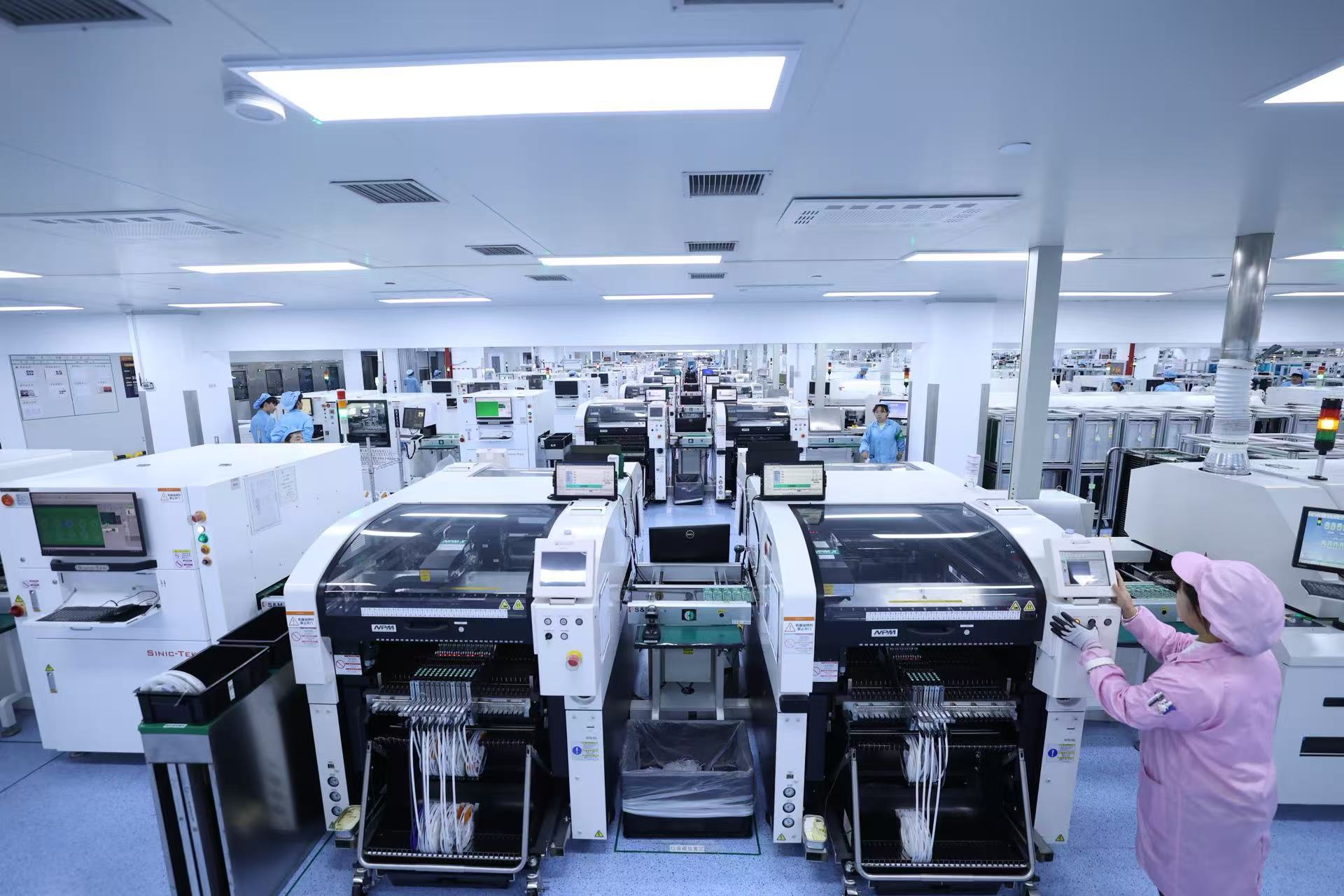
On the supply side, integration depth matters more than assembly volume. SolisStorage is the energy storage business of Ginlong (Solis) Technologies Co., Ltd., a Shenzhen Stock Exchange-listed manufacturer (stock code 300763) founded in 2005, with in-house development across PCS, EMS and system integration, and with energy storage deployed in more than 100 countries and regions. The company reports operating experience across more than 300,000 energy storage sites worldwide — the base on which its VPP and third-party platform integrations were built.
EverCore ESS: What the Verified Specification Covers
The confirmed EverCore ESS parameters are the starting point for any architecture comparison: rated energy capacity of 100.5 kWh / 120.6 kWh / 261.2 kWh; inverter power rating of 50 kW / 60 kW / 125 kW; EVE LFP 3.2 V / 314 Ah cells; 8,000-cycle cell life; anti-corrosion class IP55 (cabinet) + IP66 (inverter); aluminum alloy casing with core electronic components. The platform is designed for commercial storage and industrial energy storage applications, and also serves renewable power plants, utility companies and residential users within the wider SolisStorage portfolio.
AC-DC separation: the architectural difference
EverCore physically separates AC and DC, decoupling the hybrid energy storage inverter from the battery cabinet so that each component occupies its own space. Three consequences follow. Thermally, the inverter's 6 kW of power heat dissipates directly into the ambient environment, leaving only 3.5 kW of electrochemical heat to be managed inside the battery cabinet — which allows an air-cooled design to approach the cell temperature uniformity of liquid-cooled systems. In protection terms, the independent inverter can be sealed to IP66 (dust-tight, protected against powerful water jets) while the cabinet holds IP55; based on its power-electronics experience, SolisStorage concludes that this separated protection design reduces the system's full-lifecycle failure rate by 50%. Structurally, a single inverter can connect up to 6 battery cabinets in parallel, enabling linear capacity expansion without additional inverter investment and reducing system expansion cost by approximately 10%.
The 125 kW hybrid inverter and its integration
The 50–125 kW hybrid energy storage inverter integrates PCS, STS, PV inverter, circuit breaker protection and EMS in one unit. In practice, this produces three outcomes buyers can verify on site: grid-tied to off-grid switching in less than 10 ms without an external STS, which matters for precision industrial equipment; no external PV inverter required, supporting both DC and AC coupling for existing PV systems with a PV over-sizing ratio of up to 200%; and no external grid cabinet required, with up to 6 EverCore units connected in parallel for direct grid connection. On control, EverCore uses a single central controller instead of the distributed "multi-brain" topology built from separate BMS, PCS, EMS and STS CPUs, which reduces failure points and speeds up fault location.
Cooling, enclosure and operating envelope
EverCore retains air cooling for 125 kW / 261 kWh C&I systems using an independent three-air-duct design: a patented diversion air duct for the hybrid energy storage inverter combined with Coanda Effect airflow attachment across battery pack surfaces, which raises system heat dissipation efficiency by 30% compared with traditional air cooling. With IP66 / IP55 protection and C4-grade anti-corrosion coating, the system operates from -25°C to 55°C and at altitudes up to 4,000 m — covering climate profiles from high-temperature deserts to cold European sites.
Cells, cycle life and safety layers
EverCore uses A-grade 314 Ah LFP cells custom-developed for C&I applications, with internal resistance of 0.15 ± 0.05 mΩ against 0.17 mΩ for standard 280 Ah cells. Because every 10% reduction in internal resistance cuts charge-discharge heat generation by roughly 20%, the chemistry decision is also a thermal-safety decision. Cycle life is rated at 8,000 cycles at a 0.5C charge-discharge rate with remaining capacity ≥70%, compared with 7,000 cycles for conventional 280 Ah cells; at 500 cycles per year, that extends the system's economic lifecycle from approximately 14 years to 16 years. Safety is built in 15 layers across cell, pack and system level, including thermal insulation materials resistant to 1,000°C between packs and a three-stage fire-fighting mechanism of pack-level aerosol, cabinet-level aerosol and fire-fighting water channels.
O&M design and software openness
Maintainability was designed as a cost line, not an afterthought. Over a full project lifecycle, EverCore is engineered to save customers approximately €9,500 per unit in O&M cost: €2,500 from eliminating liquid cooling fluid replacement, €1,500 from simplified PCS replacement, €1,500 from simplified pack replacement and €4,000 from reduced routine inspection complexity. Component selection supports the same logic — Minebea cooling fans with 10-year maintenance-free performance, and Honeywell industrial-grade flammable gas detectors with 10-year calibration-free performance.
On software, EverCore has been connected, or is in the process of connecting, with 102 third-party VPP / EMS operators across 11 European countries. Representative integrations include the Kraken energy management platform under Octopus Energy in the UK and aggregator platforms such as Check Watt in the Nordic market, alongside dozens of local EMS providers in the German-speaking region and Benelux. The Solis AI Cloud Platform has been deployed at more than 5,500 energy storage power stations worldwide and integrates Nordpool wholesale and Flatpeak retail price data to support dynamic charge-discharge optimisation.
Step-by-Step: Choosing Between EverCore ESS and a Stackable Alternative
Both architectures can serve a C&I site; they fail in different ways. Work through these eight steps in order, and the architecture usually selects itself.
- Size usable energy from the load profile. Confirm the required usable capacity and the daily cycling pattern, then match them to the closest rated point. On EverCore ESS the available rated capacities are 100.5 kWh, 120.6 kWh and 261.2 kWh.
- Match inverter power to load and switching requirements. The 50 kW, 60 kW and 125 kW hybrid inverter ratings determine how much simultaneous load and how much PV the unit can serve. If the site runs precision equipment, verify the grid-tied to off-grid switching time — EverCore specifies under 10 ms without an external STS.
- Decide the expansion path before signing. If the project is likely to be built in phases, ask one question: can capacity be added without a second inverter? On EverCore, one inverter supports up to 6 battery cabinets in parallel, with approximately 10% lower expansion cost.
- Verify the protection envelope against the site, not the brochure. Compare the enclosure rating with dust, wash-down and corrosion conditions. EverCore's split is IP66 on the inverter and IP55 on the cabinet, with C4 anti-corrosion and an operating window of -25°C to 55°C at up to 4,000 m.
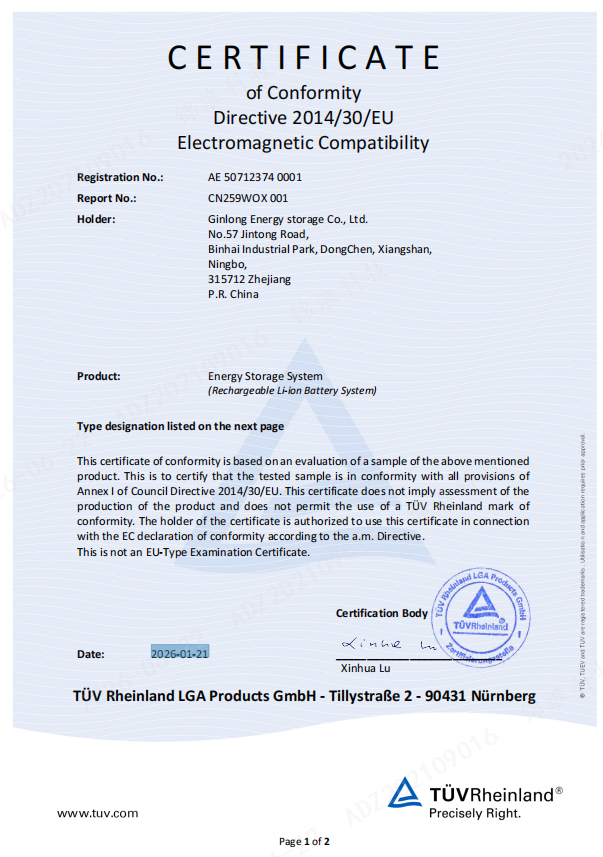
- Check compliance documents against the exact model scope. A certificate issued for one capacity does not automatically extend to another. For EverCore ESS in the EU, the relevant documents include CE certification under the EMC Directive 2014/30/EU (certificate AE 50712374 0001, issued by TÜV) and IEC 62619 safety certification (certificate JPTUV-182135, issued by TUV, Zone 2 scope), with the certificate scope naming EverCore-261kWh and EverCore-261kWh-PRO.
- Confirm grid-service and platform readiness. Ask for the current third-party VPP / EMS compatibility list, not a statement of intent. EverCore's list currently covers 102 operators across 11 European countries.
- Model lifecycle cost, not purchase price. Build expansion cost, cooling maintenance, component replacement and inspection hours into the model. EverCore's designed O&M saving is approximately €9,500 per unit over the project lifecycle.
- Lock commercial and delivery terms. Minimum order quantity is 1 unit for standard off-the-shelf models and 20 units for customized OEM orders; lead time for mass OEM orders is 30–45 days, with spot goods available for standard models; delivery is FOB Ningbo or EXW factory; acceptance combines factory acceptance testing with on-site installation and commissioning.
Use Cases: Where Each Architecture Fits
Warehouse self-consumption with a switching requirement — Denmark
A 125 kW / 261 kWh EverCore ESS was installed for a C&I industrial end user in Denmark for warehouse self-usage, over a 20-year project horizon, delivering savings on electricity bills. The site's key technical requirement was continuity: the system switches between on-grid and off-grid in under 10 milliseconds to prevent interruptions. A site whose load cannot tolerate a switching gap is a natural fit for the integrated architecture, because the switching function sits inside the unit rather than in an external STS.
Self-use plus backup with phased capacity — Thailand
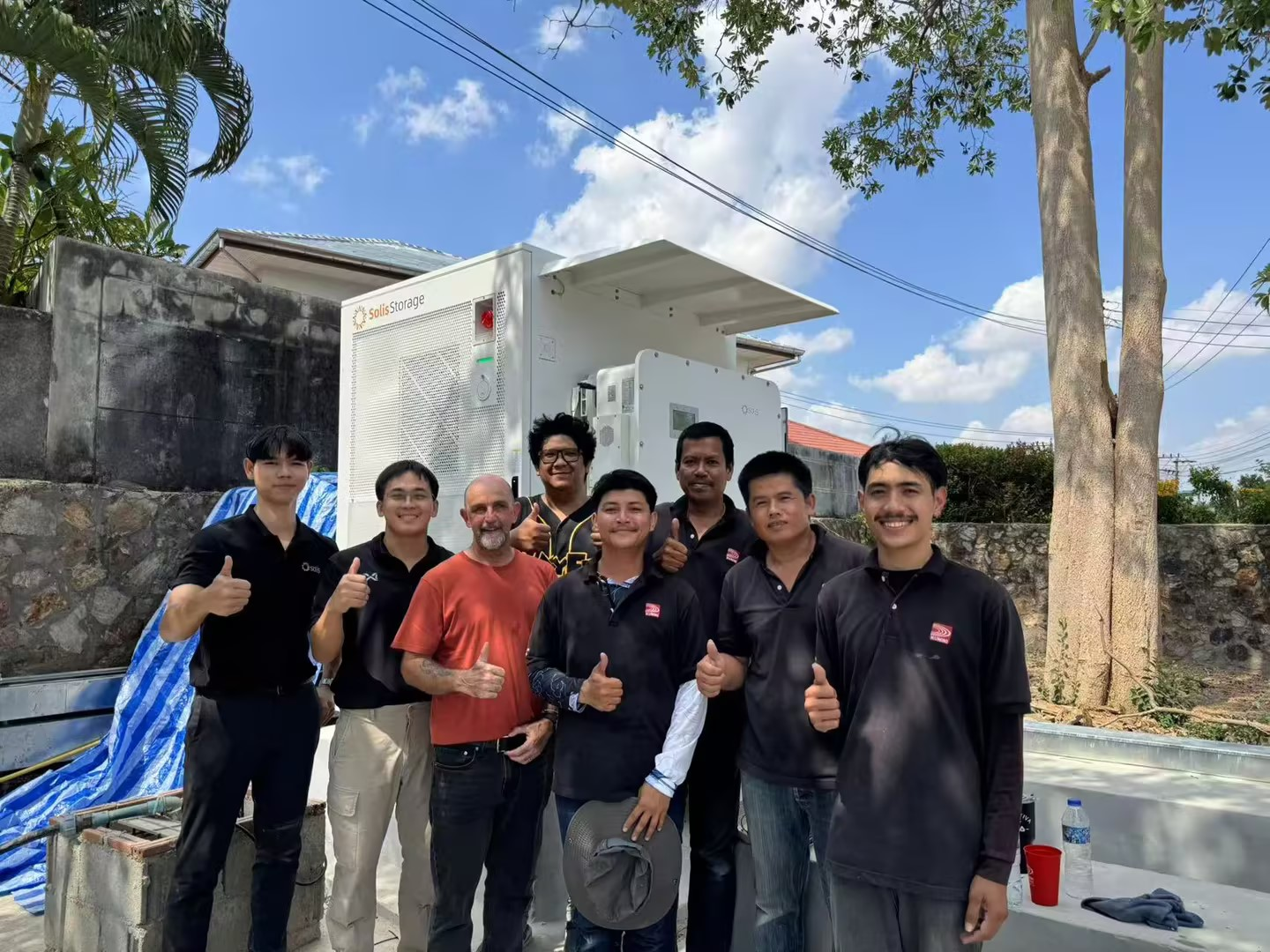
A self-consumption and backup power project owner in Thailand operates a 125 kW / 522 kWh system over a 20-year duration, reporting stable operation and savings on electricity bills. The configuration illustrates the expansion logic of AC-DC separation: a single 125 kW hybrid inverter platform serving a larger battery cabinet capacity — the pattern a phased-build site follows when it starts with peak shaving and adds capacity later.
Multi-revenue C&I projects
Where the business case depends on more than arbitrage, the deciding factor is whether the system can be dispatched by third parties. Peak shaving, frequency regulation and VPP participation all require an open software path — which is why the compatibility list, not the datasheet alone, tends to decide these projects.
Stackable, granular-growth sites
Stackable architectures such as the FlexCore-ID line suit sites that need to add capacity in small, frequent increments, or where physical space is distributed across several points. Because module-level parameters vary by configuration, buyers should confirm rated capacity, inverter rating, protection rating, cycle life at the intended C-rate and the required expansion method in writing before design freeze.
Comparison Table: EverCore ESS vs. Stackable ESS Architecture
| Decision dimension | EverCore ESS (verified) | Stackable ESS (FlexCore-ID line) — confirm in writing |
|---|---|---|
| Deployment model | Integrated unit with AC-DC separation: hybrid energy storage inverter and battery cabinet in separate spaces | Modular: capacity assembled from stackable units |
| Rated energy capacity | 100.5 kWh / 120.6 kWh / 261.2 kWh | Module and configuration dependent |
| Inverter power rating | 50 kW / 60 kW / 125 kW hybrid inverter, integrating PCS, STS, PV inverter, circuit breaker protection and EMS | Confirm per module string and site demand |
| Protection rating | IP66 (inverter) + IP55 (cabinet), C4 anti-corrosion | Confirm per enclosure design and location |
| Cell chemistry | EVE LFP 3.2 V / 314 Ah | Confirm cell specification per module |
| Cycle life | 8,000 cycles at 0.5C, remaining capacity ≥70% | Confirm cycle life at the intended C-rate and depth of discharge |
| Expansion method | DC-side expansion only; one inverter supports up to 6 battery cabinets in parallel; approximately 10% lower expansion cost | Add modules or units; verify whether additional inverter capacity is required |
| Control architecture | Single central controller (single-CPU centralized management) | Confirm whether control is centralized or distributed across module controllers |
| Thermal design | Air-cooled, independent three-air-duct design with Coanda Effect airflow; 30% higher heat dissipation efficiency than traditional air cooling | Confirm cooling method and continuous duty-cycle limits |
| Operating envelope | -25°C to 55°C; altitudes up to 4,000 m | Confirm site-specific derating and altitude limits |
| Grid switching | Grid-tied to off-grid switching in under 10 ms without an external STS | Confirm switching time and whether an external STS is required |
| Software / VPP ecosystem | 102 third-party VPP / EMS operators across 11 European countries; Solis AI Cloud Platform deployed at more than 5,500 stations | Confirm platform compatibility list for the target market |
| Best fit | Multi-revenue C&I projects with defined expansion phases and limited initial investment budgets | Sites requiring granular, incremental capacity growth in distributed spaces |
| Lifecycle O&M | Approximately €9,500 per unit designed O&M saving over the project lifecycle | Request an equivalent cooling, replacement and inspection breakdown |
Reading the table correctly matters more than reading it quickly. Only the EverCore ESS column is built from approved specification and certificate data; the stackable column lists the parameters a buyer must obtain in writing, because stackable configurations change with module selection and market.
FAQ: C&I Energy Storage Architecture Questions
What compliance documentation should be verified before approving an EverCore ESS deployment in the EU?
For EverCore ESS, the confirmed EU documentation includes CE certification under the EMC Directive 2014/30/EU — certificate AE 50712374 0001, issued by TÜV on 21 January 2026, citing EN IEC 61000-6-2:2019, IEC 61000-6-2:2016, EN IEC 61000-6-4:2019 and IEC 61000-6-4:2018, with a scope covering EverCore-261kWh and EverCore-261kWh-PRO — plus safety certification under IEC 62619, certificate JPTUV-182135, issued by TUV on 6 January 2026 for Zone 2 scope. IEC 62619 is the key international safety standard for secondary lithium cells and batteries used in industrial and energy storage applications. Buyers should read the certificate scope rather than the product family name: a certificate issued for one capacity does not automatically extend to another. Projects targeting North America should additionally screen for UL 9540 and UL 9540A, the system safety and thermal runaway fire propagation standards applied in that market.
Can EverCore ESS be expanded after commissioning without replacing the inverter?
EverCore ESS supports DC-side capacity expansion after commissioning. A single hybrid energy storage inverter can connect up to 6 battery cabinets in parallel, which allows linear expansion of storage capacity without additional inverter investment and reduces system expansion cost by approximately 10%. This is the practical difference an integrated AC-DC separated architecture creates: capacity can grow without the conversion equipment growing with it. If a stackable alternative is under consideration, the equivalent question is whether added modules require additional inverter capacity — confirm that in writing before comparing prices.
How should buyers compare cost between an integrated unit and a stackable alternative?
Compare lifecycle cost rather than purchase price. EverCore's design targets approximately €9,500 per unit of O&M savings over the full project lifecycle, composed of €2,500 saved on liquid cooling fluid replacement, €1,500 on simplified PCS replacement, €1,500 on simplified pack replacement and €4,000 on reduced routine inspection complexity. Component specification reinforces the same logic: Minebea cooling fans are rated for 10-year maintenance-free performance and Honeywell industrial-grade flammable gas detectors for 10-year calibration-free performance. For a stackable configuration, request the equivalent breakdown — cooling maintenance, replacement scope and inspection intervals — so both options are compared on the same cost basis.
What is the minimum order quantity for evaluating an EverCore ESS configuration?
The minimum order quantity is 1 unit for standard off-the-shelf models and 20 units for customized OEM orders. Customization options include logo, outer package, software interface, regional voltage standard, communication protocol and function parameter, supported by OEM and ODM production services. A practical evaluation path is to start with a standard unit to validate operation and integration on site, then move to a customized OEM configuration once the site's voltage standard and communication protocol are fixed. The Solis Global Brochure provides the portfolio context needed before that first order.
What lead time, delivery and acceptance terms should be planned for?
Mass OEM orders carry a lead time of 30–45 days, while standard models can be supplied from spot goods. Delivery is FOB Ningbo or EXW factory delivery. Acceptance combines factory acceptance testing with on-site installation and commissioning. Payment structure typically follows a deposit, a payment before or after shipment, and a final acceptance payment, with specific terms depending on customer tier, order size and regional policy. For projects with a fixed energisation date, confirm the OEM lead time against the certificate scope of the exact model and capacity being ordered. To validate the timeline against a specific project date, request a quote with your target capacity and destination market.
Conclusion: Let the Expansion Path Choose the Architecture
EverCore ESS versus stackable alternatives is not a contest between two products; it is a decision about how a C&I site expects to grow. Choose the AC-DC separated EverCore ESS when the project has a defined expansion path and a limited initial budget, when grid-tied to off-grid switching continuity matters to the load, or when the business case depends on third-party VPP and EMS dispatch — a single 125 kW hybrid inverter supporting up to 6 battery cabinets, with certificate scope covering EverCore-261kWh and EverCore-261kWh-PRO. Choose a stackable architecture such as the FlexCore-ID line when capacity must be added in granular modules across distributed locations, after confirming module-level capacity, inverter requirement, protection rating and cycle life in writing.
Either way, the deployment sits inside the same service infrastructure: 24/7 global remote technical support, 27 local overseas service centers, 48-hour on-site fault handling and whole-machine replacement guarantee, and long-term spare parts supply.
Next Step for C&I Storage Buyers
Download the Solis Global Brochure (V3.9) for full portfolio context: Solis Global Brochure V3.9.
For capacity sizing, sample validation or an OEM quotation on EverCore ESS, contact the SolisStorage team at sales@ginlong.com, WhatsApp +86 158-5815-3307, or visit www.solisinverters.com.

Have Questions or Need More Details?
Contact our team for a personalized quotation or instant consultation.
Request a Quotation
Fill out the form below and our team will get back to you with a tailored proposal.
WhatsApp Direct Chat
Prefer to chat in real-time? Message us on WhatsApp for instant assistance & quick answers.
- Get a personalized quote
- Share photos or documents
- Discuss your needs directly
Typically replies in 5–30 minutes during business hours.