
Which Energy Storage System Fits Your Project? A 2026 Scenario-Based Guide
Which Energy Storage System Fits Your Project? A 2026 Scenario-Based Guide
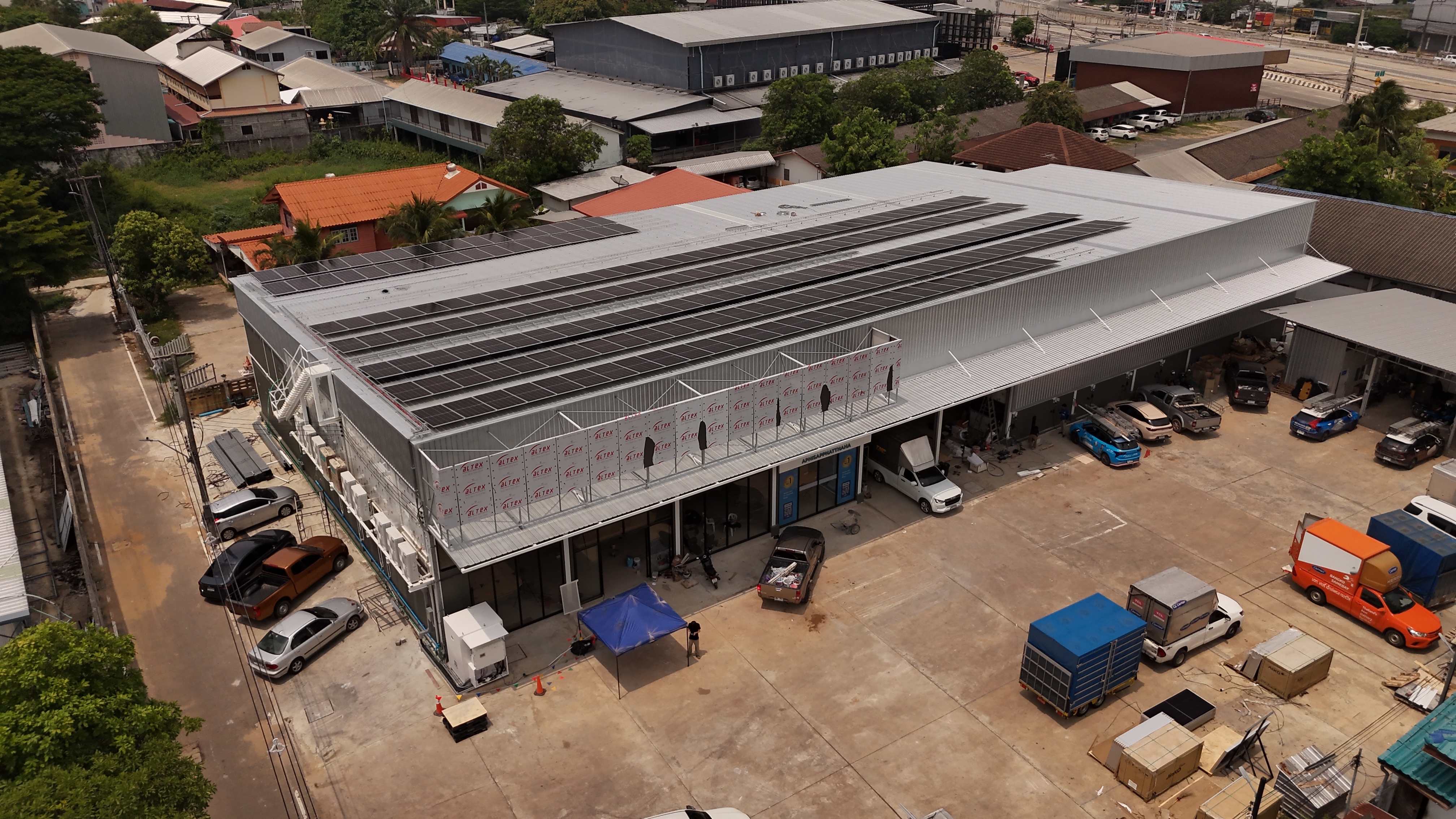
Aerial view of a rooftop solar PV factory project used for energy storage system fit assessment
As energy storage projects expand from small home batteries to large grid-connected systems, one question keeps returning: which energy storage system actually fits this project?
The right energy storage system is seldom the one with the largest capacity or the lowest initial price. It must match the project’s application scenario, site conditions, capacity requirements, operation mode, and full-lifecycle maintenance strategy. A poorly matched system may still run, but it will carry hidden costs throughout the project lifetime.
This guide is designed for buyers in the research and evaluation stage. It explains how to assess whether a candidate energy storage system is aligned with a specific project scenario—covering residential, commercial and industrial (C&I), and utility-scale applications.
Why Project–System Fit Determines ESS Performance
Energy storage systems do not fail only because of battery quality or inverter faults. In many cases, the root cause is a mismatch between the system design and the project environment. Typical fit problems include:
- Systems installed at high altitude, in coastal salt fog, or in extreme temperatures without verifying the equipment specification.
- Projects that need fast grid-tied / off-grid switching but are deployed with systems requiring an external STS.
- Buyers comparing initial CAPEX while underestimating lifecycle operating costs such as coolant replacement and sensor calibration.
- Systems with no DC-side expansion path, forcing owners to replace inverters when capacity grows.
- Hardware that cannot communicate with VPP or EMS platforms in liberalized electricity markets.
These risks can be reduced through a scenario-based fit assessment. The process starts with project goals, then moves through site conditions, product architecture, capacity planning, and lifecycle operating costs.
Industry Background: From Single Products to Scenario-Based ESS Portfolios
Market data confirms that energy storage has entered a multi-scenario era. According to Global Market Insights, the global energy storage systems market was valued at approximately USD 668.7 billion in 2024 and is projected to reach USD 5.12 trillion by 2034. MarketsandMarkets estimates the residential energy storage market will grow from USD 2.69 billion in 2024 to USD 4.58 billion by 2030, at a CAGR of 9.3%. The long-duration energy storage market was valued at USD 4.85 billion in 2024 and is expected to grow at a CAGR of 13.6% through 2030.
China’s exports of lithium-ion batteries for energy storage and non-automotive uses surpassed USD 65 billion in 2024, a 51.4% increase year on year, according to Reuters. Behind these figures is a rapid expansion of project types: PV self-consumption, backup power, peak shaving, frequency regulation, virtual power plants, and seamless island-mode operation.
Ginlong (Solis) Technologies Co., Ltd. is a solar inverter manufacturer and energy storage solution provider founded in 2005, headquartered in Ningbo, China, and listed on the Shenzhen Stock Exchange (Stock Code: 300763). SolisStorage is the dedicated energy storage subsidiary of Solis (Ginlong Technologies), delivering complete energy storage solutions across residential, C&I, and utility-scale applications. Solis has been named a “Top Inverter Brand” by EuPD Research for eleven consecutive years, and according to Wood Mackenzie, Solis ranked first in global residential PV inverter shipments in 2023.
For project planners, the important shift is that energy storage suppliers now design product platforms around specific project scenarios rather than offering a one-size-fits-all cabinet.
How SolisStorage Maps Systems to Project Scenarios
Residential Scenarios: IntelliHome ESS
Residential projects are typically built on rooftops and household loads, requiring compact, safe, and outdoor-capable storage. The SolisStorage IntelliHome system uses LiFePO4 battery cells with a nominal capacity of 5 kWh, an operating voltage of 44.8–57.6V, a rated cell capacity of 100Ah, and a recommended charge/discharge current of 50A. Its cycle life exceeds 6000 cycles at 10 years, and its IP66 ingress protection makes it suitable for household outdoor installation.
Stackable and Small C&I Scenarios: FlexCore-ID
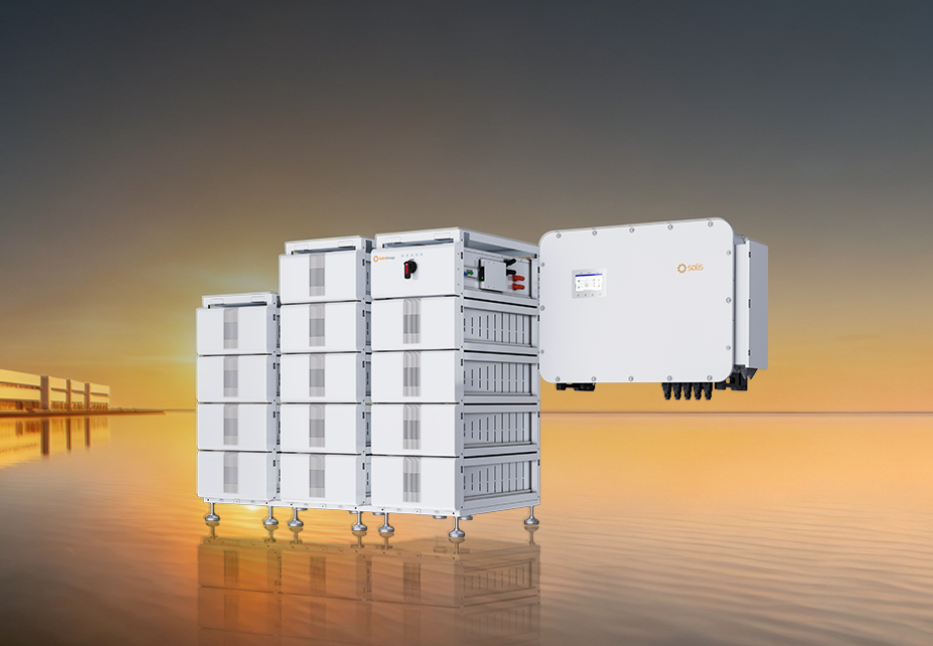
FlexCore-ID stackable energy storage platform for small farms, shopping malls, hospitals, and small C&I projects
Projects such as small farms, shopping malls, hospitals, large residences, and small industrial and commercial enterprises require moderate capacity with modular expansion. SolisStorage addresses this with the FlexCore-ID stackable energy storage system. Each battery pack provides 20 kWh, using LFP battery cells with 314Ah cell capacity. The cell cycle life is rated at ≥8000 cycles at 25±2°C, 0.5P, EOL70%, offering a long operational life for distributed projects.
C&I and Grid Scenarios: EverCore ESS
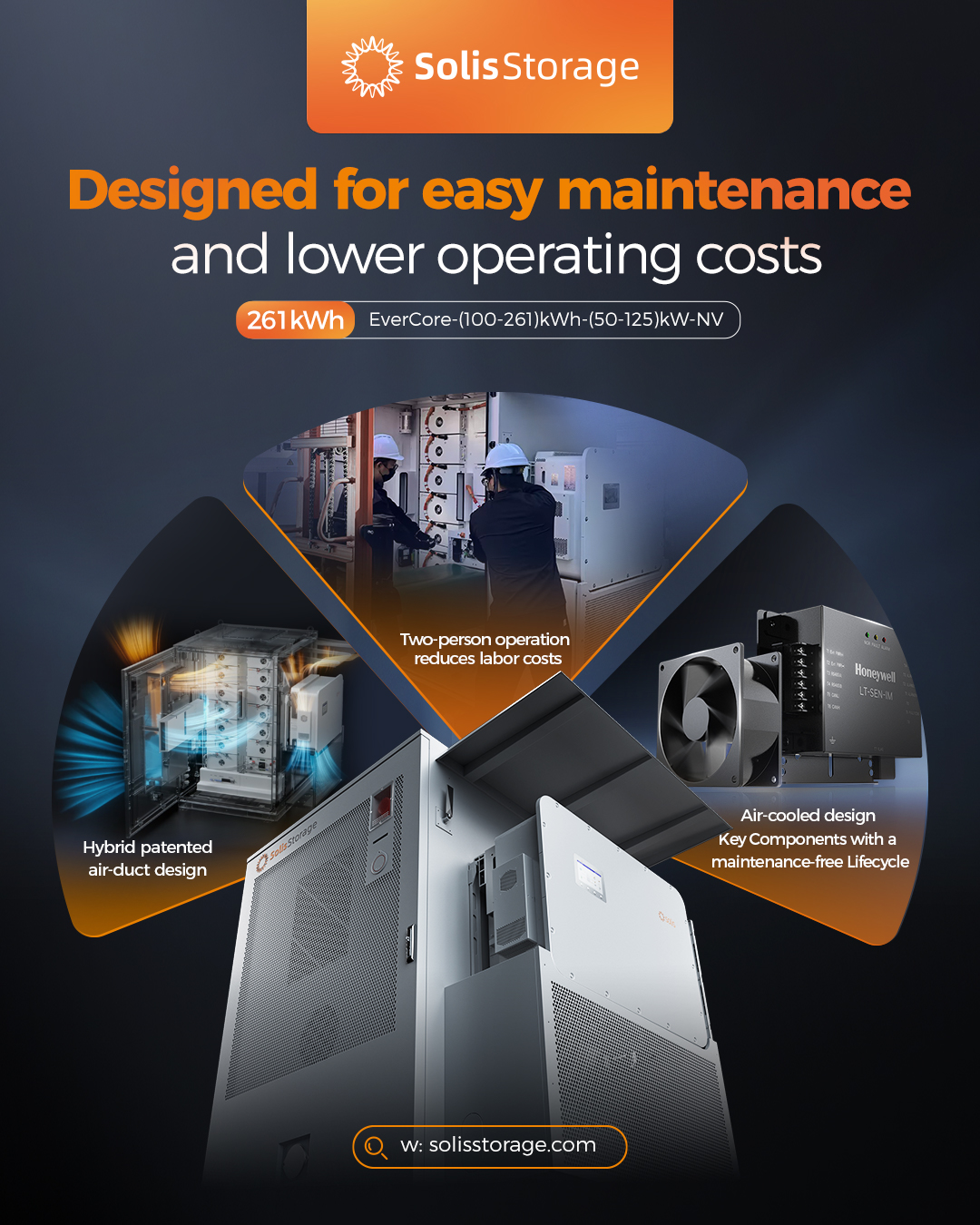
EverCore ESS for C&I and grid-connected energy storage projects
The EverCore ESS series is designed for the renewable energy and power grid industry, serving renewable power plants, utility companies, commercial and industrial users, and residential users. The system is available with rated energy capacities of 100.5 kWh, 120.6 kWh, or 261.2 kWh, and inverter power ratings of 50 kW, 60 kW, or 125 kW. It uses EVE LFP 3.2V / 314Ah cells, delivers 8000 cycles, and provides IP55 protection for the battery cabinet and IP66 for the inverter.
EverCore’s project fit is determined not only by cell performance but also by its system architecture. The platform separates the AC side (hybrid energy storage inverter) from the DC side (battery cabinet), each in its own dedicated space. The external inverter dissipates 6 kW of power heat directly into the environment, leaving only 3.5 kW of electrochemical heat to be managed inside the battery cabinet. This enables a temperature uniformity close to liquid-cooled solutions while retaining an air-cooled design—an important factor for projects that want to avoid liquid-cooling maintenance.
The separated protection design also improves reliability. As an independent unit, the hybrid energy storage inverter reaches IP66 ingress protection, while the battery cabinet maintains IP55. Based on its 20 years of power electronics experience, Solis estimates this separation reduces the system’s full-lifecycle failure rate by 50%. Additionally, structural separation allows flexible DC-side expansion: one inverter can connect up to six battery cabinets in parallel, enabling linear capacity growth without additional inverter investment. According to Solis, this can reduce system expansion costs by approximately 10%, which matters for projects with phased construction budgets.
The 125 kW hybrid energy storage inverter integrates PCS (power conversion system), STS (static transfer switch), PV inverter, circuit breaker protection, and EMS (energy management system) into a single unit. This integrated architecture delivers three practical benefits:
- Seamless grid-tied / off-grid switching in less than 10 ms without an external STS, meeting power quality requirements for precision industrial equipment.
- Direct and alternating current coupling with existing PV systems, and a PV over-sizing ratio of up to 200%.
- Up to six EverCore units can be connected in parallel for direct grid connection without an external grid cabinet, simplifying construction procedures.
EverCore retains an air-cooled thermal management design. Its independent three-air-duct design combines a patented diversion air duct for the inverter with Coanda-effect airflow attachment on battery pack surfaces, improving heat exchange efficiency by 30% compared to traditional air cooling. The system operates in extreme temperatures from -25°C to 55°C and at altitudes up to 4,000 meters, with IP66/IP55 protection ratings and C4-grade anti-corrosion coating standards—covering climate profiles from Middle Eastern deserts to European cold regions.
Lifecycle operating costs are another fit dimension. Compared with liquid-cooled alternatives, Solis estimates EverCore saves customers approximately EUR 9,500 per unit over the full project lifecycle: EUR 2,500 from eliminating liquid cooling fluid replacement, EUR 1,500 from simplified PCS replacement, EUR 1,500 from simplified pack replacement, and EUR 4,000 from reduced routine inspection complexity. The system also uses Minebea cooling fans with 10-year maintenance-free performance and Honeywell industrial-grade flammable gas detectors with 10-year calibration-free performance.
For safety-critical projects, EverCore builds a 15-layer, three-dimensional fortress protection system across cell, pack, and system levels. Thermal insulation materials resistant to 1,000°C are used between packs to block thermal runaway propagation. A three-stage fire suppression mechanism includes pack-level aerosol, cabinet-level aerosol, and fire-fighting water channels. The system uses A-grade 314Ah LFP cells custom-developed for C&I applications, with an internal resistance of only 0.15±0.05mΩ compared with 0.17mΩ for typical 280Ah cells. Every 10% reduction in internal resistance reduces charge-discharge heat generation by approximately 20%. At 0.5C charge-discharge rate, the cells achieve 8,000 cycles with remaining capacity ≥70%, compared with 7,000 cycles for traditional 280Ah cells. Based on 500 cycles per year, this extends the economic lifecycle from approximately 14 years to 16 years.
Projects in liberalized electricity markets also need software openness. EverCore has been connected or is being connected with 102 third-party VPP/EMS operators across 11 European countries, including the Kraken platform under Octopus Energy in the UK, Check Watt in the Nordics, and numerous local EMS providers in German-speaking and Benelux markets. Solis AI Cloud Platform has been deployed at more than 5,500 energy storage power stations worldwide, integrating Nordpool wholesale price data and Flatpeak retail price data for minute-level optimization of charge-discharge strategies. In a residential storage project in Latvia, Solis AI optimization increased annual electricity bill savings by 302.6%.
Step-by-Step: ESS Fit Assessment for Real Projects
Project buyers can use the following six-step process to select an appropriate energy storage system before issuing a purchase order.
- Define the project objective. Is the goal to reduce electricity bills, provide backup power, increase PV self-consumption, perform peak shaving, participate in frequency regulation, or join an electricity market? The objective determines the required capacity and dispatch strategy.
- Identify the application scenario. Map the project to a residential household, small farm / shopping mall / hospital / large residence, C&I facility, renewable power plant, or grid infrastructure project. Each scenario has different load profiles and operating durations.
- Audit the site and operating conditions. Check whether the installation is indoor or outdoor, the local temperature range, humidity, salt fog exposure, altitude, and corrosive environment. Confirm the required ingress protection and anti-corrosion level. Projects in coastal or industrial environments often require higher protection grades.
- Select the product platform. Use the findings to narrow the choice to IntelliHome for residential, FlexCore-ID for stackable and small C&I, or EverCore ESS for C&I and grid-scale applications.
- Confirm capacity and power configuration. Match the available energy in kWh and inverter power in kW to the project load. For scalable systems like EverCore, plan the number of battery cabinets per inverter to allow future expansion without additional inverter investment.
- Review operation mode and ecosystem compatibility. Verify that the system supports the required grid-tied, off-grid, seamless backup, or 24/7 continuous operation, and that it can integrate with VPP/EMS platforms and AI scheduling if the project participates in electricity markets.
Reference Cases: How Project Scenarios Were Matched
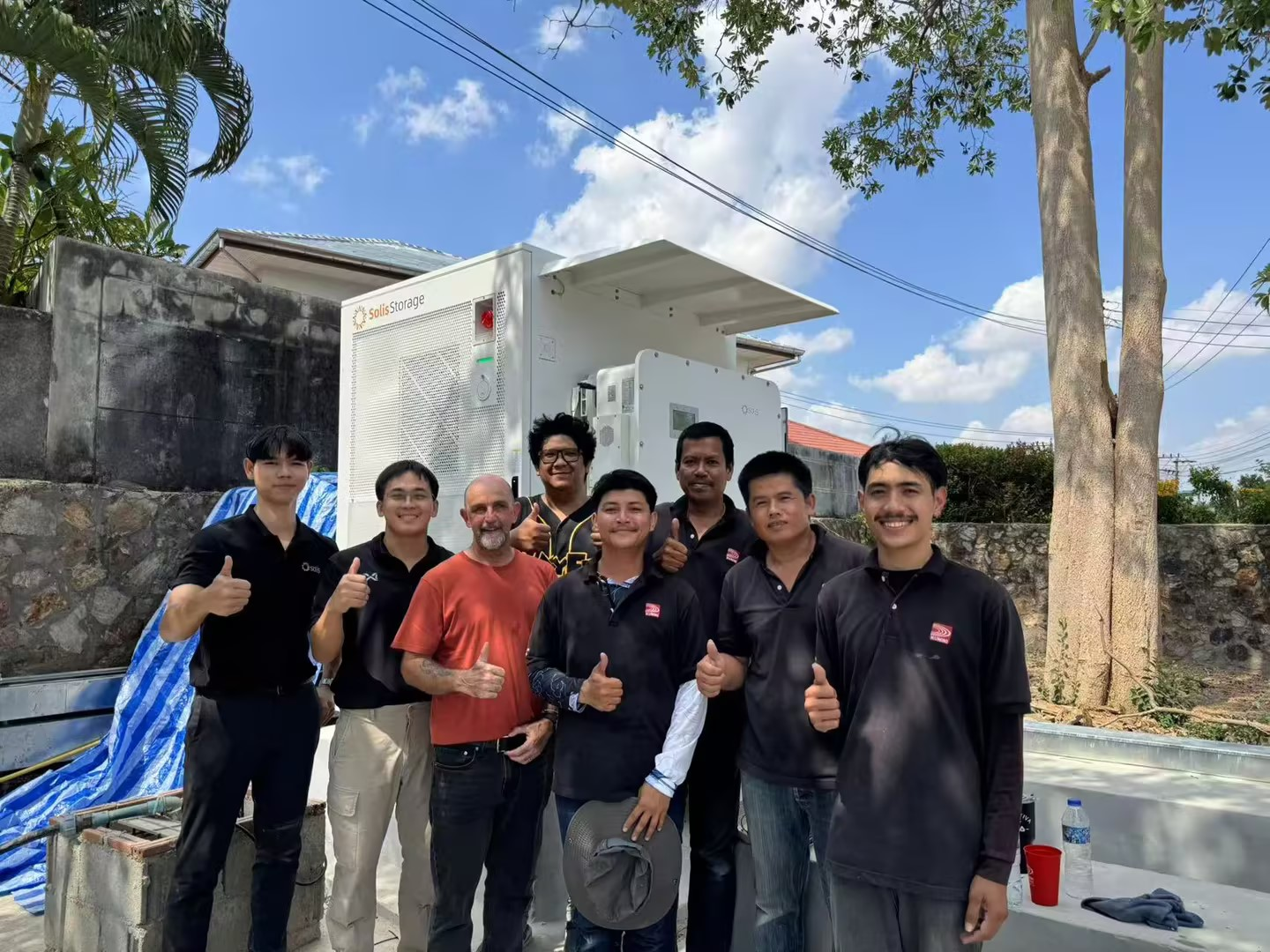
Thailand self-consumption and backup energy storage project reference
Denmark – C&I industrial end user (125kW/261kWh). A C&I industrial facility deployed a 125kW/261kWh EverCore ESS for warehouse self-usage. The project required uninterrupted operation over a 20-year duration. EverCore switches between on-grid and off-grid in under 10 milliseconds to prevent interruptions, and the customer saves on electricity bills.
Thailand – Self-consumption and backup project (125kW/522kWh). A self-consumption and backup system was installed with a 125kW/522kWh configuration over a 20-year project duration. The system maintains stable operation in a tropical climate while reducing electricity costs—demonstrating the importance of thermal management and outdoor protection in hot, humid operating conditions.
Product Platform Comparison by Project Scenario
| Dimension | IntelliHome | FlexCore-ID | EverCore ESS |
|---|---|---|---|
| Target project scenario | Residential / household | Small farms, shopping malls, hospitals, large residences, small C&I | Renewable energy and power grid projects, C&I and utility users |
| Nominal capacity | 5 kWh | 20 kWh per battery pack | 100.5 / 120.6 / 261.2 kWh |
| Battery type | LiFePO4 | LFP, 314 Ah cells | EVE LFP 3.2V / 314Ah |
| Cycle life | >6000 cycles / 10 years | ≥8000 cycles (EOL70%) | 8000 cycles |
| Battery cabinet protection | IP66 | — | IP55 |
| Inverter protection | — | — | IP66 |
| Anti-corrosion coating | — | — | C4-grade |
| Key architecture feature | Compact residential unit | Stackable modular expansion | AC-DC separation, air-cooled, high-integration hybrid inverter |
Procurement Capabilities That Affect Project Fit
Supplier production and delivery capabilities also participate in project fit. SolisStorage provides OEM/ODM services with customization options covering logo, outer package, software interface, regional voltage standards, communication protocol, and function parameters. Global total monthly capacity exceeds 10,000 units. The MOQ is 1 unit for standard off-the-shelf models, which allows a pilot unit before full deployment, and 20 units for customized OEM orders. Mass OEM orders typically require 30–45 days for delivery, while spot goods are available for standard models.
Quality control includes 100% full functional testing before shipment, incoming material inspection, aging tests, high-low temperature cycle tests, and IP protection tests. After-sales support includes 24/7 global remote technical support, 27 local overseas service centers, a 48-hour on-site fault handling and whole-machine replacement guarantee, and long-term spare parts supply.
FAQ: Project-Specific Questions Before You Procure ESS
1. What protection and anti-corrosion ratings should an outdoor ESS project require?
Outdoor ESS projects require high ingress protection and corrosion resistance. In the EverCore ESS, the hybrid energy storage inverter reaches IP66 (dust-tight, protected against powerful water jets) while the battery cabinet maintains IP55. The system is designed with C4-grade anti-corrosion coating standards and operates at altitudes up to 4,000 meters. For market access, IEC 62619 is a key safety standard for industrial and energy storage batteries, and systems entering North America typically need UL 9540 / UL 9540A.
2. Which project scenarios can SolisStorage systems cover?
SolisStorage systems cover residential, stackable, and C&I project scenarios. IntelliHome is designed for residential households. FlexCore-ID targets small farms, shopping malls, hospitals, large residences, and small industrial and commercial enterprises. EverCore ESS serves the renewable energy and power grid industry, including renewable power plants, utility companies, and commercial and industrial users. Typical project functions include peak load shifting, frequency regulation, VPP participation, backup power supply, and self-consumption of PV power, with grid-tied, off-grid, and seamless backup switching modes.
3. How can lifecycle costs be controlled in ESS projects?
Architecture choices help control lifecycle OPEX. For example, EverCore’s AC-DC separation and air-cooled design can save approximately EUR 9,500 per unit in O&M costs over a full project lifecycle. The DC-side expansion design reduces system expansion costs by approximately 10% when capacity is added, compared with adding another inverter. Its 314Ah cells with 8,000-cycle life extend the economic lifecycle from roughly 14 to 16 years at 500 cycles per year.
4. Can a sample or pilot unit be obtained before full deployment?
Yes. The MOQ for standard off-the-shelf models is 1 unit, which allows pilot testing before broader procurement. For customized OEM orders, the MOQ is 20 units.
5. What are the lead times and after-sales support for a project purchase?
Mass OEM orders generally require 30–45 days for delivery; spot goods are available for standard models. After-sales support includes 24/7 global remote technical assistance, 27 local overseas service centers, a 48-hour on-site fault handling and whole machine replacement guarantee, and long-term spare parts supply.
Need to assess your project scenario against a real energy storage platform?
Download the Solis Global Brochure for system overviews and technical references: Download Brochure
Or contact the Solis sales team at sales@ginlong.com / +86 574 65802188
Have Questions or Need More Details?
Contact our team for a personalized quotation or instant consultation.
Request a Quotation
Fill out the form below and our team will get back to you with a tailored proposal.
WhatsApp Direct Chat
Prefer to chat in real-time? Message us on WhatsApp for instant assistance & quick answers.
- Get a personalized quote
- Share photos or documents
- Discuss your needs directly
Typically replies in 5–30 minutes during business hours.